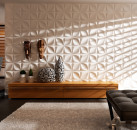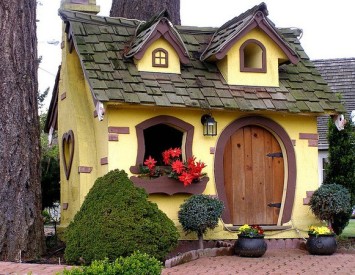
Most people rightly consider giving the best place to relax, so they try to make it as much as possible by all their might. However, when finishing walls in the country, it is important not to turn it into another apartment, but to make the interior diametrically opposite. However, in most cases, it is necessary to repel from the financial side of the issue, forgetting about the psychology of the interior. In this article, we will tell, as well as with the help of what to turn any cottage to a cozy place, where you want to spend every minute of free time.
Content
Ideas of wall decoration in the country
Any urban resident I want to escape from the city noise and fuss to feel unity with nature and yourself. Cottage for many is exactly the "rescue island", so it is very important to pay its inner and external finish maximum attention. From what materials and technology you will use, your psychological state and level of comfort during rest depends directly.
Using supporting structures
Before you begin to finish the walls in the country with your own hands, carefully look around - perhaps the structure of the house already hints at the fact that you can minimize repair work, favorably beat the available surfaces. Very often, people do not notice that in the interior you can profitably use the structural elements of the house: beams, partitions, rafters or walls themselves.

Best of all, such a finish is obtained in bruschers and log houses, because with a tree it is easy to work and pleasantly - it is only necessary to clean the surface, treat the antiseptic and cover it with varnish. If you wish, you can artificially form wood or tinkering it with a verse to simulate an expensive breed.
If there is an attic in the house, feel free to use in the creation of the interior of the rafted and ceiling beams. Many simply overlap them with boards or plasterboard, forming a familiar and boring ceiling, but why intention to reduce the space when you can enjoy the scope and beautifully beat rafters, decoring them with lighting devices or decorative elements. Try to cover their contrast paint in relation to the rest of the surfaces. To enhance thermal insulation, put the insulation between the rafters, after which they squeeze these gaps by boards, clapboard or block house, imitating the timing. To visually expand the space to be visually even stronger, the plates are not across the rafter, but along them. You can add any wooden finish with a decorative natural or artificial stone. These two natural material are perfectly combined with each other and create a favorable calm atmosphere in the house.

If your cottage is built of brick, its structural elements can also be advantageously presenting as decorative. For example, try to leave the brick wall without finishing, cleaning its surface, processing the seams and covering the protective varnish. It will only be supplied to the interior with metal accessories, put a glass table, vintage clothes hanger or minimalistic iron sculpture, and you will get a stylish loft style room. If the brick does not grind out the sandpaper, and leave as it is, you can create an imitation of an old laying and beat the interior accordingly. Naturally, the cost of such a "finish" will be meager.

Finish wood
Wood finish is the most common option for giving. The most suitable material is wooden lining, since it not only looks attractive, but also has durability, durability and simplicity of laying. Even the miniature cottage can be turned into a cozy "nest" with the help of lining made of natural wood, and if it is covered with a special transparent impregnation, you can emphasize a unique natural pattern.

If you have always dreamed of living in a log house, but fate dismissed only on a brick or concrete cottage, cut the wall by a block house to create the effect of log walls. But best of all, of course, use materials from natural wood, because only in this case you can count on a unique atmosphere, which can reorganize only in a wooden house.
The tree can be used not only for the immediate walls of the walls, but also to change the geometry of the premises. For example, you can build niches and shelves, at the same time overlapping the walls, creating a decorative surface and introducing a functional element in the interior. Thus, you will avoid additional spending on the purchase of furniture and save free space. The tree is the perfect material for finishing small rooms, since it allows you to use all "non-working" corners.

Plywood, as derived wood material, is also often used when the walls are internal decoration in the country. It is inexpensive, it creates a perfectly smooth surface, helps to quickly and high-qualityly close thermal insulation. Plywood snacks well, which means that it can be built arched passages. In most cases, plywood sheets require subsequent decorative finishes, but there are models with beautiful wood textures that are easy to cover with varnish. The painting of plywood is no different from the color of ordinary wood: covered with impregnation, mourn, apply paint or varnish.
Useful advice: Previously, all the walls in the room were separated the same, and it is still considered a normal phenomenon. But for the sake of fairness it is worth noting that this is a strong outdated way. Try to "dilute" the same type of interior, covering one of the walls is not a tree, but, say, decorative stone or paint. This option will look much more interesting and more dynamic. Alternatively, you can also use wooden material, but another plan, for example, cork coating or laminate.
Painting of walls
Painting of the walls is one of the easiest and rapid performed methods for finishing walls in the country. The cost of such a venture is also low, so many economical owners prefer to other paint materials.

A wide selection of all sorts of compositions allows you to make repairs in any room with different operational features. So, there are paints for dry rooms or rooms with elevated levels of humidity, for children, bedrooms, etc. To deal with this will help you. Wall paints: Tips for choosing" How to choose and use paint in different rooms, described in detail in the articles " Painting of walls in the bathroom: Step by step instructions», « Painting of walls in the kitchen: Step by step instructions", and " Painting of walls do it yourself».
Consider brief paints used for wall decoration:
- Water-emulsion - budget option for those who want to make quick and accurate repair. The paint consists of natural ingredients, and therefore is completely safe for people, animals and the environment. Proof of this is almost a complete absence of smell. The water-emulsion is sold in buckets from 1 l, has white color. To get the desired shade, it needs to be cooled by adding a special liquid pigment.
- Acrylic is quick-drying paint odorless. Of the main advantages, it is also worth noting the widest color palette, bright saturated shades. The paint has water-repellent properties, but is not intended for too humid premises.
- Latex - Latex-based interior paints more resistant withstand contacts with water, moreover, they can be washed, and they are completely harmless to health. For this reason, latex paints are often used to finish the cottage walls in the kitchen and in the nursery.
- Decorative - series of paints capable of imitate various surfaces: stone masonry, silk, stone, sand, etc.
Wall decoration panels
Plastic panels do not create such a cozy atmosphere in the house, like a tree or brickwork, but they are very inexpensive and help to quickly disguise the defects of the walls. This is one of the most common ways of inner and outdoor wall decoration in the country. The price of panels depends on their composition, thickness and other technical specifications. The main advantage of this material is that for its laying there is no need to thoroughly align the walls, as needed, for example, for coloring.

Another important advantage of plastic panels - they are withstanding high humidity, which you can not say about the wood. For internal and outdoor decorations, there are types of panels, but recently siding designed for facades is increasingly can be found inside the house. It looks good on the verandas, kitchens, attic. At the same time, the masters use only vinyl models, leaving metal products for outdoor cladding.
In favor of the panels, there is also a variety of textures and colors, which makes it possible not only to choose an option to your taste and for any interior, but it is also advantageous to combine different panels to achieve the original effect. About how to install siding, described in detail in the articles " Plastic siding: choice and installation" and " Metal siding. Installation instructions».
We listed only a few options for the internal and external finishes of the country house, but the materials and methods there are much more. You can separate the walls with decorative stone, plaster, shove wallpaper, tile - everything is limited to your fantasy and budget.
Features of wall decoration in the country
As you know, the finish of the house may be inner and outdoor. In this chapter, we will consider in detail how each of the processes occurs on the example of using one of the most popular materials - plaster. Depending on the composition, it can be used both inside the house and outside. Facade plaster contains special components that prevent the destruction of atmospheric and mechanical effects. In addition to the composition of the mixtures, the technologies of their application differ.

Wall decoration inside
With the application of plaster on the wall, any hardworking owner can cope, but the only mandatory condition - the solution should be applied to a flat surface. If the walls of your country house are made of bricks or have chips and cracks, they must be pre-aligned. To do this, you can use one of the types of plasters, phaneur or drywall. Alignment plaster solution is advantageous if the surface swings horizontally constitute no more than 4-5 cm. Otherwise, the flow mixture will be too large, and a thick layer may fall off under its own weight. In such situations it is better to align the walls of sheet material: plywood or plasterboard.
If the wall is smooth, and you just decided to change the finish, clean the surface from the previous coating (wallpaper, whitewashes, plaster) with a metal brush, then cover with several layers of adhesive primer. If you make repairs in the kitchen or cottage is located in a region with high humidity, the walls are better to increase with antiseptics and enhance waterproofing. For concrete walls, you can advise the waterproof primer of deep penetration.

Consider briefly what kind of plaster are:
- Cement - it is she who align the walls with small drops. It consists of mineral components resistant to moisture, temperature, mechanical effects. Cement plaster can be used for internal and outer decoration. Of the advantages, you can also highlight low cost and simplicity of application. Of the disadvantages - the need for finishing decorative processing.
- Gypsum - this plaster gives a perfectly smooth and smooth surface, but absolutely does not endure high humidity. The gypsum solution works very quickly that on the one hand speeds up the repair, on the other, it does not allow to knead the large volume at once. Gypsum plaster can be used not only to align the wall, but also to create an original texture and even blinds. The perfect white color of the frozen solution creates ideal conditions for subsequent coloring or blending wallpaper. If you wish, you can add a dye into the solution and get a ready-made color surface.
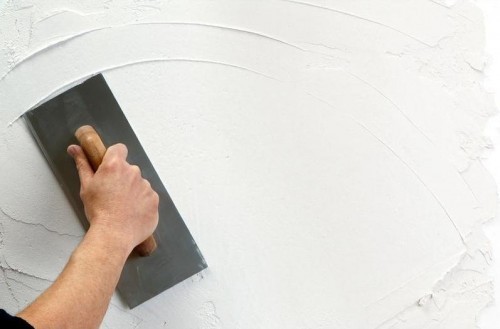
- Decorative is a whole series of plasters with various decorative effects. The solutions are applied to the finish layer on any flat surface. They can imitate the skin dried up the ground, brickwork, wood, seized by trellis beetles, etc. Apply the decorative plaster need a layer is not thicker than 5 mm (depending on the type and composition) with a special tool "Ironing". Working with fine-grained compositions, you can create interesting effects by the movements of the spatula according to different trajectories: straight, arc, wave, circle, etc.
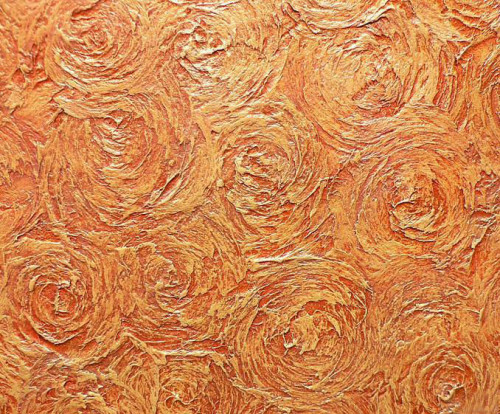


After processing the whole wall with decorative plaster, it is necessary to leave it to dry by 8-12 hours, after which go through the surface of fine-grained emery paper to remove dried drops of solution. Next, you can proceed to painting or protect the plaster with a water-repellent means.
Finishing walls outside
Bring out the outer decoration of the walls of the country house only after laying thermal insulation, and it is best to do outside. First, so you will save the useful living space, secondly, avoid changing the walls due to the movement of the dew point inside under the insulation. This will help you with articles " Wooden house insulation with their own hands" and " Warming facade house with foam».
The quality of work by 70% depends on the correctly selected materials. Thus, in addition to the special front plaster, you will need a facade reinforcing grid, which will firmly hold the solution on the wall and will not allow it to fall off from humidity or wind gusts.

Types of outdoor plaster:
- Acrylic is convenient because it does not require mixing and is already ready for use, which avoids errors. Solutions are characterized by good vapor permeability, enhance the heat and sound insulation of the house. It is quite elastic, which means can evenly cover surfaces with any configuration. The big palette makes you forget about typical white houses and paint your cottage in any color.
- Silicone is good because it reliably protects the walls from the penetration of moisture, but it does not interfere with parium permeability. Creates a dense elastic layer that you can wash and constantly maintain the purity of the facade. The only drawback is the high cost.
- Silicate - plaster based on liquid glass. Basically, it is used to finish facades from cellular concrete, since it fills all cracks and emptiness, creating a dense, but vapor-permeable water barrier.
- Mineral - cement plaster of increased strength. It is cheaper than all of the above analogues, but it does not differ with elasticity or attractiveness, and therefore requires the skills of applying and subsequent finishes. It is mainly used to align the facade and enhance the thermal insulation of the walls.

Regardless of the selected type of plaster, you must prepare the wall. First, appreciate its condition, if necessary, cover the cracks, chips, remove the former coating. If the wall is not insulated, put the thermal insulation material: mineral wool, foam or its derivatives. For a better clutch of plaster with the surface of the wall must be primed. For concrete, use a special primer betacontact.
Application technology depends on the purpose of plaster. So, if you deal with a decorative solution, the principle of operation does not differ from the interior decoration, where you can enjoy the "ironing" and a spatula. If the plaster is needed for alignment, first it is necessary to install beacons and work by the construction rule. More information on this topic can be found in the article " How to align the walls».

Useful advice: Facade work should be carried out only in dry and warm weather so that the plaster can see how to dry, so browse the forecast for the next few days.
Let us summarize the above information on the finishing of walls at the cottage:
Wall decoration at the cottage: photo