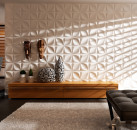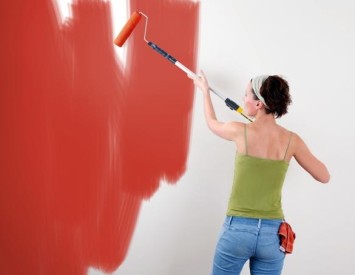
The decoration of the walls of the apartment is the most important stage of all repairs, as it completes the whole cycle of work. Wall facing options can be a lot and each of them has its advantages and disadvantages, so the choice in favor of any way should be done on the basis of the specific situation and the desire for the host of the premises.
Content
Advantages and disadvantages of painting

Painting walls recently is gaining popularity. This option of wall decoration has a large number of advantages. In comparison with the unattractive painted panels in half the walls, which met in Soviet high-rise buildings, modern materials are able to create a unique interior. And the variety of shades will make it interesting. Painted walls can be easily updated at any time without spending a lot of effort and means. Just a couple of cans of waterfront paint, a little time and the interior of the room can be changed beyond recognition. The painted walls in comparison with the wallpaper are fireproof, are not subject to mechanical damage, long retain a presentable look.
Of the disadvantages of the walls of painted paint, you can allocate what they need to be prepared. The surface planned to be painted should be perfectly smooth, without flaws. Otherwise, painting just spoil
The choice of optimal paint for repair work indoors is a rather difficult task. And if the color usually does not occur with the color (modern devices for coloring can create any shade), then with the type of paint for a person who has not encountered such a task, problems may arise. About what paint it is better to choose for painting walls, let's tell further.
Waters

The name of these types of paints speaks for itself. Their solvent is the usual water. Such mixtures are the most popular when painting walls for several reasons:
- Relatively low price. The cost of water-making paints, in comparison with alkyd, is not too high, which favorably affects the total costs for repair. In this case, such paint has a small consumption per 1 m 2 surface. As the solvent in water-based paints performs plain water, even permanent ink can easily and quickly be diluted with water, which is much cheaper solvent.
- Environmentally friendly. In operation vodnodispersnye paints do not emit noxious fumes, as alkyd. The refurbished room can be a lot of time without much harm to health.
- Resistance to pollution. Any dirt stain, because it can not penetrate the painted surface, can be easily washed away with water.
Among the shortcomings of the paint can be identified that it is very afraid of freezing temperatures. If a container of paint will stand in the cold, it can not be used in the future.
Water-emulsion paints by type of their foundations are divided into:
- Based on PVA.
- Acrylic.
- Latex.
Polyvinyl acetate based water paints are their cheapest variety. Of all the species, such a material does not differ practicality, as it is easily subject to pollution. They are used mainly for painting ceilings. The greatest advantage of such paints is that they have good vapor permeability, so that the surface can "breathe." PVA-based paint can not be used in rooms with high humidity.
The basis for acrylic paints for walls are acrylic resins. Due to them, the structure of the material becomes dense and does not miss the dirt and moisture. Therefore, they are often used for painting walls in public places, where the probability of pollution is quite high. Also, due to the dense layer, which dries quickly, the paint does not allow moisture to the wall, which makes it possible to apply it in places with high humidity, for example, to finish the walls of the bathrooms. It will quickly dry and does not distinguish absolutely no smell.
The disadvantage of such paint is that it has low vapor permeability, that is, does not give the walls to "breathe."
Latex paints are produced based on the well-known polymer. The thin layer of latex makes it possible to improve the mechanical resistance of the surface to moisture and dirt, which allows you to successfully apply them in public places. Like acrylic, latex paint dries pretty quickly, lies with a thin and dense layer. It is often used when painting textured wallpaper when you need to highlight their drawing. Such paint is very well suitable for Venetian plaster or "Coroeda", because it can penetrate deep into the coating structure, while licking the thin layer. Based on latex make special paints for walls with effect.
Like acrylic paints, latex do not "breathe", which many pushes from their purchase.
Alkyd paints

Alkyd paints, or, as they are also called - enamels, differ from the water-emulsion in that hydrocarbons are used as a solvent: gasoline, kerosene, solvent, etc. The structure of the paint itself is similar to latex water dispersed, however, the process of its drying occurs not due to the evaporation of water, but due to the oxidative reaction with the participation of oxygen in the air. Thanks to this, alkyd paints dry very quickly.
The main advantage of such paints is their durability, excellent surface protection against moisture, mechanical damage. Due to the fact that when applied, such paint forms a thin but rather durable layer, in addition to the procratry of the walls, they are used to process wooden and metal surfaces, protecting them from rust.
The disadvantage of enamel is a sharp smell that does not quite well affect the human body. Therefore, after the end of the work, the premises need to thoroughly ventilate and limit the finding in it. Although enamels have recently appeared, the solvents of which do not distinguish a sharp smell, use them in the room for painting the surfaces of a large area is needed carefully.
Oil paints

The peculiarity of oil paints is that natural or synthetic oils are used as their solvents, as well as olifes. This feature is the reason that such paints will dry for a very long time, while highlighting not very pleasant smell. It is because of this, oil mixtures for processing the inner walls of the room are extremely rare. The advantage of oil paint is its excellent antiseptic properties. Olife and oils can deeply penetrate the pores of plaster or wood, protecting them from the appearance of fungus or mold. However, this feature has the other side of the medal. Thus, reduced vapor permeability can cause the disposal of plaster.
A layer of such material applied to the surface is capable of listening to a single year without repainting. Due to this, oil paints are very often used for outdoor work.
Silicone paint for walls and ceilings
This is a new material in the construction industry. Thanks to the use of various additives in its production, it has excellent performance properties. Park permeability, moisture resistance and wear resistance - all these qualities buyer will find in silicone paint. Its main advantage is considered not wetted by water layer, which is formed when applied. It is it that allows the surface for a long time to have a prime appearance, even in places of high humidity.
The disadvantage of such paint can be considered its price. It is slightly higher than at the loontinate-based water mixture.
Eco-paints for walls
Fashion for use in the construction work of environmentally friendly materials increased the demand for similar products. The technology of manufacturing eco-paints involves the use of natural components in their composition, not harmful to the human body. That is why they can be used without any fears for painting walls in an apartment or house.
The disadvantage of such paints, of course, is their price, which is why they are trying to apply in a limited number of cases, for example, for painting a children's room. It is also worth noting that eco-paints will slowly dry, but at the same time, without singing any odors.
Application of water-mounted paint on the walls

Procedure for work:
- On the surface of the wall, the water-level paint is applied with a long pile roller. Before starting work, training both material and surfaces are prepared.
- Aligned with a putty, the surface of the wall before painting is necessary necessary to be projected. This is done using a mixture of deep penetration based on PVA. During the primer, the wall is checked for the presence of small defects that need to be deleted.
- While the primer will dry, produce paint preparation. It must be thoroughly mixed to homogeneous mass. Specialists recommend doing this on the eve of the work (about a day) and immediately before the start. For uniform stirring, a low-robust drill is used with a special nozzle in the form of a mixer. If desired, before starting work, you can change the color of the paint for the walls. For this use special kokes. However, it should be neat with them, because it cannot be gone a little with a consistency, you can not get the necessary color. If the wall shade plays great importance, it is better to do in specialized stores that have special equipment that clearly dispensing the kel, depending on the chosen palette.
- The prepared paint is poured into a special trough and lower the roller in it. After that it is rolled so that the mixture is distributed throughout its surface. The texture paint for the walls is applied with a special roller.
- They are applied to the wall on the wall, gradually roll over, while there is no uniform pattern without divorces on the surface.
When painting the walls of water-emulsion paint, it is better not to apply more than one layer.
Decorative wall paint: photo