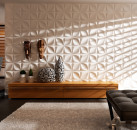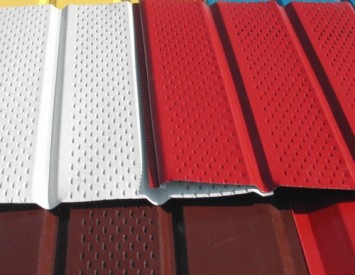
Metal siding or metal is a facing material made of galvanized steel. Covered by polymers of several varieties with a wide range of color gamut.
Content
General properties of metallic siding
1. Common types and scope of material:
- metal and robberies is equipped with latches-locks to simplify installation;
- on the panels with a perforated surface, the holes for the self-tapping screw and nails are made in advance;
- on smooth surfaces of siding, the holes are performed independently. Apply the siding of this type to build panels with non-standard sizes;

- figure siding is used to create a pattern or finishing of one wall;
- wide and smooth panels are most often used during self-installation. They do not require professional skills, quickly selected, are exhibited on any inclined surface, unlike other types;
- the preferred method of laying metal - vertical. It allows you to avoid slots between sheets, economically use the material, use less sealant for processing joints;
- professional use of metal rims allows you to create real artistic work of buildings. This possibility is given by good elements, for example, corners, internal or outer angles, brackets, platbands.
2. Benefits of the material:
- the material is resistant to the temperature difference, has the lowest coefficient of temperature expansion;
- non-combustible building material. Used as additional protection against fires;
- high corrosion and chemical stability. Used in aggressive environments;
- ecological and safe material;
- well withstands the mechanical impact, it is used to protect the open parts of the building;
- installation of panels using the material heat insulating layer allows you to warm up, reflect the appearance of the building;
- easy simple installation. Professional skills and complex tools are not required.

Metal siding. Instructions for conducting a preparatory stage
1. Tool for work:
- electric drill or manual;
- screwdriver or screwdriver;
- construction level;
- hammer;
- gloves;
- bar 40x40 mm Counting to produce by the number of siding sheets;
- self-tapping screws, dowel-nails, screws with a sealing head;
- aligning brackets.
2. Surface processing:
- free the working surface from attachments of attachments and decorative decorations;
- wallpaper wet water and carefully remove. Oil paint is washed with soap solution and dry. Old stucco, catch up with a hammer on the subject of emptiness;
- prepare stuffing material, recesses, depression. Close all irregularities. Dry;
- treat the surface with an antibacterial agent in 2 layers.
Specificity Mounting Metal Siding
1. Doborny elements, as the original architectural solution:
The calculation of the required number of sheets is made on the basis of the standard sizes of the material at 10 m. The height of the room from the plinth to the ceiling is considered to be 2 cm. These 2 cm are then close to decorative challenges:
- using bulk angles at the walls of the walls, you can create a bulk relief and an unusual design;
- the docking rail, attached symmetrical wall width, will give a beautiful architectural solution;
- a wide platband around the perimeter of the window or opening will completely replace a thin elegant plank for slopes;
- moldings can be very gently and harmoniously cover the window slopes.

2. Metal Siding Mounting Obet:
- professional installation of metal panels begins with the installation of the crate. For its manufacture, wooden rails or metal-plastic are taken;
- wooden lattice is cheaper, but has a lot of flaws. She absorbs moisture, swells, rotates, "eats up the fungus", changes its configuration under the weight;
- the grille from the metal profile is more expensive, but in durability exceeds natural material;
- by installing the crate, it is necessary to use water level or level and plumb. Output exactly horizontally and vertically all elements;
- on the uneven surface there are always height differences. Fasteners to such a wall of the rail or profile are made with the help of special metal brackets. They successfully compensate for surface irregularities and form the optimal plane under the crate;
- the recommended step between crossbars from 400 to 600 mm;
- the insulation for laying under siding is selected by the width of the shade of the crate. The insulation is stacked into the crate, fix it and cover the pair-hydro insulating film. Film can be shot in a stapler. The joints are sampled in scotch so that the moisture does not penetrate.
3. How to install the first bar:
- the horizontal of the first strip, affects the correct installation of all subsequent panels. Installation is performed by level;
- the beginning of the work, the installation of the first strip starts from the bottom of the wall, measured the distance by 4 cm above the edge of the bottom panel;
- fix the bar on the claw rivets or self-drawing;
- further fasten the exterior, internal angles and nicknames. With the help of a plumb, all elements are set as accurately as possible by vertical, and then attach to the crate.

4. Practical installation tips:
- mounting direction from top to bottom;
- the lower panel is snapped on the first (initial) bar, screw to the bracket to the crate;
- fasten with self-drawing stands after checking the tight snap-down strip over the entire length;
- self-tapping screws into the center of the holes. This will leave the freedom to move the panel for several mm with possible deformation on temperature;
- spinning self-tapping screws, leaving 1-1.5 mm of free space under a hat. Do not twist them to the end;
- crouching panels in length to carry out so that they are freely entered in the nickname and angle. The clearance between the end and the vertical should not be more than 9 mm on both sides.
Independent decoration with metallic siding. Work with facade
1. The initial stage. Preparation of the surface of the facade:
- conduct a visual examination of the surface of the facade. Remove the coseed plaster, check the strength of the brickwork with climbing. Crop the curly plants, remove shutters or rolling shutters. Remove structural elements that support drainage pipes, eaves;
- construction level Check the surface of the walls to smoothness, measure the angles to the coincidence from 90 degrees;
- for uneven walls to buy crate material: Wooden or metal rails. The lamp will smooth the differences and eliminate the skews when finishing siding.
2. Installing metallic siding for the crate:
- it is necessary to immediately decide why siding is stacked. If it only performs the function of the decor, then put the crate and cover with sheets. If work is performed on the shelter of the house, then it is better to perform high-quality insulation for scrappers;
- the insulation laying is produced to maintain heat in the cold season and saving cool air indoors in the heat;
- insulation must be removed from humidity. Establish additional membrane type hydraulic protection with anti-condensation properties;
- the optimal choice is a fiber with basalt inclusions. It is characterized by non-hatched, resistance to humidity and chemical effects. The cost of the fiber is high. You can replace it with a construction mineral wool with a fiberglass structured insert. The material has good indicators of moisture and anti-grapple stability. The only drawback is to combust in the class of g3;
- depending on the form and condition of the surface, the insulation is attached to the facade with wire or dowels;
- the photo below clearly demonstrates the diagram of the installation of the diffuse film:

Tip: Film must be fixed only on top of the insulation material.
Tip: from the quality and type of film material depends on the laying density: for a film with a thickness of 10 microns, a gap of 3 / 3.5 - 5 cm is left.
3. Rules for the installation of good structural elements:
- determine the overall height of the casing with metal siding. Using the level to set 5-6 labels along the lower and upper perimeter of the surface;
- attach the initial (starting) bar for 4 cm above the line of the present overall level;
- the second bar is 6 mm above. Such an installation will reduce the nailestone;
- the latter (finishing) plank is attached closely under the cornice;
- accurately and clearly set a complex docking bar, use the corner;
- the next step is the installation of slats around the openings. The start of the stacking is lowered up;
- to lay the protective layer from rain falls, snow, fog under the ventilated facade: corners to hide any universal sealing material.
Mounting metal siding with your own hands
1. Prepare metal: remove the protective film from its surface.

2. Stay laying the panels from the corner of the building.
3. With the help of self-sufficiency, attach them to the crate. Start fixing from the center. Align the sheet in terms of horizontally or vertical, and then fasten the bottom.
4. Self-tapping screws do not twist "tight". There should be an air layer between the top of the element and the sheet. This is necessary to create compensatory movement of the material of the casing during heating or cooling.
5. The first row is attached for the initial strip by the lower lock.
6. By installing the finishing panel under the openings, first attach it to the window / door item and mark the place for the platbands and the size of the window itself.
7. The marked figures must be cut off with a hacksaw or a grinder.
8. Ready sheet Wid in the bar near the window, snap into the lower row of the panels exhibited under the opening.
9. In the same sequence, panels under the cornice are stacked.
Recommendations of experienced masters
1. The success of high-quality, ideal laying of metallic siding begins with surface preparation. It should be perfect after processing building materials.

2. Choose a profile step 300 - 400 mm. This is the optimal value.
3. Consider the ability of the siding material to expand / shrink under the influence of external factors. Leave between sheets of a gap of at least 5 mm, but not more than 8 mm. Crepe a sheet is not up to the stop, leave the gap between the fastener and the surface.
4. Metal installation always start from the center of the site towards the corners.
5. Laying the crates and the first strips is reached upward.
6. Fasteners are first done in the center of the sheet. Checked by level. Then the left and right sheet is attached. After that, the bottom and top of the sheet is attached.
Frequently encountered mistakes when laying metal, do it yourself:
1. The gap is not left between the nail / dowel hat and the surface of the panel. When operating, the material will start, at best, make clicking sounds when expanding or compressed. In the worst case, the deformation will begin, visually break the surface design, there will be bulges or depressions. If you do not eliminate flames, then the sheets will begin to "move".
2. The original design of the panels is provided by a special edge. The rigid fixation of this element is required. The mounting center leads to a displacement of the band under the influence of temperature differences.
3. Apply Metalizing for purpose. The scope of use of the material recommended by the manufacturer is the finishing of industrial, building structures not for housing. Finishing garages, hangars, household buildings. Do not separate the material indoor rooms, such as the hall, bedroom, kitchen.

Comparison of the cost of work in professional firms:
1. Video instructions on assembly work with metal-trip from $ 60.
2. Siding installation:
- preparation of the surface, removal of old finish from 1-1.25 $ per m2;
- the baton of the old plaster manually from 1.8-2.9 $ per m2;
- cleaning the surface of sandblasting from 2.4 - 2.6 $ per m2;
- purification by hydraulic method from $ 3.2 per m2;
- chemical washes from 5.4 $ per m2;
- repair of masonry with partial disassembly and restoration of $ 10 per m2;
- facing steel siding from $ 2.52 per m2;
- warming of the surface, depending on the material, from 2.1 to $ 5.2 per m2.
Cost of material for m2 in construction companies:
- siding from the South Korean metal with a color range: Oak, Alder, Pine from $ 10;
- siding for an exterior finish, without perforation with a range: white, cherry, red, graphite from $ 12;
- metal siding from galvanized steel with a polymer coating under a tree from 8.5-15.8 $.
The selection of the material will be facilitated if you decide in advance with its purpose: for design finishes, for restoration or wall protection.
Metal siding, the photo below shows how you can change the appearance and create an original architectural object:

Installation of metal siding video lesson for the proper installation of the initial strip: