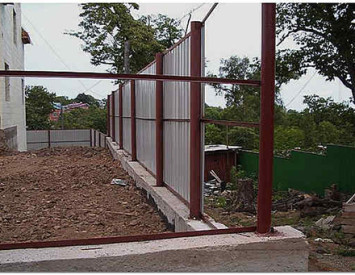
Each particular possession is needed. Even if you live in the forest wilderness, where the likelihood of meeting a robber or a detractor is zero, the fence will guard you and your garden from wild animals. There are many varieties of fences, but not all of them differ in durability, reliability and durability. In order not to fear for your life and value of the property, it is better to immediately build a strong fence from stone, concrete or metal. For such fences, it is necessary to lay the foundation first, otherwise the strong impact of the wind, the blow or the powered forces will overturn it. In this article we will tell about the fill of the foundation under the fence with their own hands.
Why the fear of foundation
If you are going to build a truly durable and durable fence around your site, it is absolutely necessary for the foundation. What happens if, for example, just stick the iron pillars to the ground and pull the grid between them? First, iron will very quickly begin to oxidize and rust. Secondly, with the onset of spring, the water frozen in the ground will begin to melt, reducing the soil strength indicators (the land is rascis), and heavy pillars will swing. With the onset of the cold moisture in the ground will begin to stick, increasing in this amount. The pillars in the ground will be so closely that they can simply go to the surface. The foundation holds the fence support in a vertical position and does not allow for the powers and other factors to harm him.

In most cases, a ribbon foundation is laid for fences, but it also happens that it is more convenient to build a bargain base. The ribbon is better to use for heavy fences from stone, concrete or metal, especially if you have to work on the grunted soil. A durable reinforced concrete or boot concrete base will hold the fence in place, even if a hurricane wind blows. Such structures are the only correct solution for the installation of monolithic intake sections with a length of 2 m, since no other base will withstand a similar load.
Video about the fill of the foundation for the fence will allow you to more clearly understand the technology of work:
The ribbon foundation in this case is slightly different from the foundations for the construction of houses and is a solid reinforced concrete or boot concrete tape, the width of which can vary from 20 to 40 cm. The width of the foundation determine the size of the fence section and support elements. In the height, the foundation is 50-60 cm, and it is important that this figure is the same throughout the length. Otherwise, you will have a curve fence.
To fill the foundation under the fence, you can use a lower brand cement than to work with the foundation for the house, since in the event of the load are not so large. Mack M250 or M300 is suitable, but if we are talking about a truly heavy fence, for example, about the design of a natural stone with a height of 3 m, it is better to buy cement M400.

Inside the cement ribbon can be placed fittings, more precisely, the reinforcement framework. The thickness of the reinforcement rod is 8-12 mm. They are then needed that the monolithic concrete tape is not cracked under the influence of the load inside the soil and under the weight of the fence. More information on this topic can be found in the article " The device of a ribbon monolithic foundation».
With formwork or without?
Many have enough experienced self-taught builders, taken for the construction of the foundation for the fence, get up before choosing: Do you build a formwork before filling or you can do without it? We suggest to consider this question.
If you decide to make a foundation without formwork, you will need to install the support poles for intake sections and firmly fix them into the tranner even before you fill there concrete. The cost of filling the foundation under the fence in such a way of slightly lower than if you were making a formwork, but there are several nuances. First of all, it is necessary to drive the poles deep enough - that their lower end entered the ground by 10-15 cm below the level of the freezing. You can find out this level in SNIP 2.01.01-82, where there are deposition maps of primers of soils for each region of the country.
Important: Know the level of primerization of the soil is particularly necessary on clay, drunken soils and squeeces, because they are more susceptible to powder forces.
The image below indicates the approximate depth of the primer of the soil in various Russian cities from greater to the smaller (in cm).

So, when you beat the poles to the ground (the depth of freezing + 15 cm), they must be fixed in a strictly vertical position. To do this, you can take advantage of any infrient materials using them as a backup: pipes, stones, bricks. After fixing each column and after filling the concrete, check the vertically with a construction level or plumb. But before pouring the solution, the pillars need to be tied with reinforcement into three "threads", fastening all compounds with welding. Here you need to take into account an important point - the reinforcement frame must be positioned so that after filling the concrete it is in the very center, that is, on an equal distance from the bottom and the top (at least 10 cm).
Formwork is needed, for the most part, for beauty. If you will lay out a brick or stone fence, then its base part should be straight and neat, so that the laying is smoothly lay down, and there was no additional finish. For the manufacture of formwork, you can take any boards or fane, after overcoming them with machine oil or throughout (as they do not stick to concrete, and after frozen the foundation, the formwork is easy to dismantle).

Stages of fill the foundation
Any construction begins with the preparation of the location of the future building and training site. In the case of a fence, the platform will go along the entire perimeter of your possessions, so the first thing to designate it. To do this, stick the pegs into the ground at a distance of 3-5 m from each other and tension rope between them. Now you can calculate what the length of the future fence and the foundation is respectively. This will help to purchase the necessary materials in the desired volume.

Useful advice: When you counted the amount required for the construction of materials, add 10% to this value. Since here it is about such things as cement, sand and fittings, even if you do not spend this stock, you can easily find where to apply it in the farm. Article " Calculation of tape fundament»Help you understand this issue.
In this chapter, we will consider the formation of the foundation under the fence of a small-breed type. This means that the lower part of it will not reach the level of primerization of the soil. Such a foundation will respond to seasonal soil movements, climbing and dropping together with it, so it can only be laid on homogeneous along the entire length of the soil fence. If there are several types of soils on the path of the foundation, or the ground is too bumming, it is better to replace it with a sand mixture with a crushed stone to the entire depth of the friction point. Alternatively, you can build a pile-belt or blown out foundation, but the cost of such an event will be higher. More information about this type of foundation is told in the article " The device of a ribbon fine-breed foundation».

By the way, the price of fillings of the foundation under the fence is not so great if you work with your own hands. The main materials are cement, river sand, crushed stone and iron bars are not so much. Reduced costs can also be due to transportation on a personal car. More information on this topic can be found in the article " How to save when building foundation».

Stages of construction of a belt foundation for a fence:
- After you marked by knicks with the rope of the boundary of your territory and the length of the future fence, make marking on the width of the future foundation. To do this, you can use the canister with paint or other way to designate the dumpled distance.
- Drop the trench in accordance with the markup and a depth of 50-70 cm. Try to make the bottom of the trench work as smooth as possible.
- At the bottom of the trench, put a layer of river sand with a thickness of 15 cm, plenty of water from a watering can or hose to thoroughly take it.
- On top of the sand layer, put as much crushed stone. It is better to purchase crushed stone with different sizes of fractions and mix it so that it remains smaller than the free space between the stones. Cruspank in this case can be replaced with granite or brick crumb. Together with the sand, it creates high-quality drainage, which will be dug underground, sedimentary and melting water from the porous structure of concrete. If you immediately board the concrete in the trench, such a foundation will last at all long.
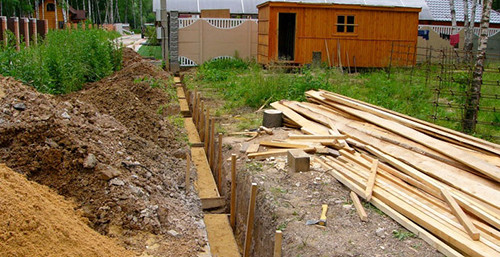
- On top of the crushed stone, you can lay a layer of waterproofing material - rubberoid or conventional construction polyethylene. This will serve as an additional protection of the concrete tape from wetting and will prolong the service life of the foundation.
- If you build a fence where the supports for sections will serve posts, arimize the garden brown and try the wells into the trench with a diameter of 20 cm. The depth of the wells should exceed the trench depth by 30-40 cm, and the distance between them is 2-3 m (depending on The size of the sections used). At the bottom of each well, pour 10 cm layer of sand to ensure elementary drainage.
- Sticks in the wells and set them out strictly vertically.
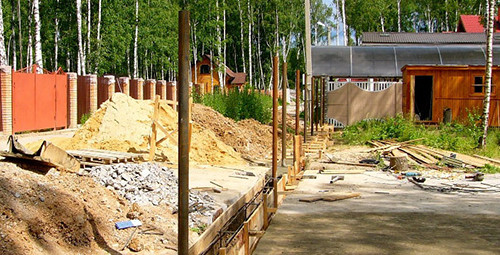
- Tie the pillars with each other by reinforcement, strengthening the places of junction of rod welding. In the tight space inside the trench, it is not very convenient to work, so it is better to use a mobile and necromodine welding machine. There is another way of reinforcing the foundation for the fence - steel bars are installed in a vertical position, sticking them into a drainage pillow. After that, the reinforcement is tied with horizontal jumpers, connecting elements with each other with welding or steel wire.
- If you will lay out a brick or stone fence, install the formwork so that the walls of the top of the foundation are smooth and neat. On the inside of the formwork shields, make a markup, which will designate the level of filling of concrete. This is a very important point from which the evenness of future masonry will depend. If you are afraid that you will get the label with a solution, write wooden slats instead.
- Prepare a classic solution, mixing the cement with sand in the proportion of 1: 3. First mix dry components, and then gradually add water without stopping mixing. The consistency of the solution should be sufficiently thick, but not a merciful. Because you have to pour a fairly large area, it is better to rent a concrete mixer or order a ready solution. The latter will be more expensive, but you quickly end with the main stage of work. To increase the strength of the foundation into the solution, you can add a bit of rubble or granite crumbs. If you have to work in the cold season, use special anti-sore additives for concrete, which will not allow water to freeze it too quickly.
- After the fill of the concrete, check again and, if necessary, adjust the verticality of the columns.
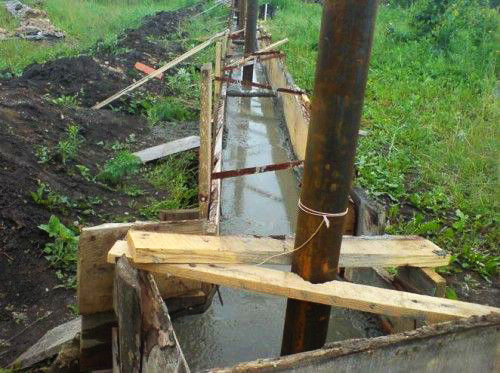
- Treat the vibromachine concrete to remove air bubbles (they reduce the strength of the foundation). If there is no such typewriter, just stick the solution with reinforcement or stick.


After that, it remains only to wait for the pouring of concrete and proceed to the construction of the fencing itself. Depending on weather conditions, it will take from 6 to 15 days. If the weather forecasters foreshadow rain, cover the foundation by polyethylene so that it does not overtake in moisture.
If you have to build a fence on the slope, in no case do not build an oblique foundation! In all its length, it should be strictly horizontal, so it is better to build a stepped design.

At first glance, it seems that building a fence is easier to light, but now you see that this work is associated with a mass of nuances and technical features. We hope we managed to fully state the information, and you can build a reliable fence on a strong foundation.