The use of a classic foundation of deep downstream when erecting low-rise light structures justifies itself by 15-20%. Those., The funds spent on the bookmark of such a foundation in the construction of small brick or stone buildings will be wasted.
Content
For such cases, it is better to use the foundation of a ribbon small-breeding. This is a concrete tape that is stacked right into the freezing ground layers half the meter above groundwater under all the bearing walls of the building.
Types of belt foundation
- Made.
- Monolithic.
The national foundation implies the laying of already ready-made iron-concrete slabs of standard sizes in the trench, and the compound of them between themselves by means of a cement mortar. This method is suitable for construction projects. After all, laying such a foundation, do not wait for it to harden and shrinkage. However, it requires attraction of a lifting crane. In addition, this method is not appropriate in the case of non-standard wall sizes. Therefore, this method of laying the foundation is not as popular as the next one.
The monolithic foundation is manufactured directly on the construction site by filling concrete into a prepared trench. Production of such a foundation is more laborious and requires much more labor force. But, but, the foundation will be even and perfectly fill the cavity cavity.
The depth of a small-breeding belt foundation, as clearly from the name, is small (0.5-0.8 m), in comparison with the usual foundation of deep downstream (1.5-1.8 m). The ribbon fine-breeding foundation is much simpler in the arrangement than the foundation from the plates or pile, but its price will be higher due to the volume of the material used.
A small-breeding ribbon foundation on the slope is not the most optimal option. This type of embezzlement, of course, will solve many technical problems, but it will be very expensive. This option is good for fairly secured developers.

Advantages of a tape fine-breed foundation
- The cost of a belt small-breeding foundation 3-4 times lower than the value of the foundation of a deep downstream.
- Significantly smaller costs of strength and time on the device of a belt small-breeding foundation compared with the standard analogue.
- The opportunity to arrange a small basement in the house.
- This type of foundation is less amenable to deformations associated with the movements of soils.
Disadvantages of a tape fine-breed foundation
- This type of foundation is only suitable for light low buildings.
-
It is combined only with soils that are not very extended.
-
A prerequisite for the use of this technology is the low location of groundwater.
-
The need for a thorough organization of the drainage system to protect the base of precipitation.
Melted tape foundation with your own hands

What do you need
- Rubble.
- Cement.
- Sand.
- Brick.
- Water.
- Metal rods for reinforcement with a diameter of 10 mm and 15-16 mm.
- Bruks from wood.
- Stakes and struts.
- Ruberoid roll.
- Polystolipropylene, fiberglass or agric.
- Boards, dying on the one hand.
- Geotextile.
- Building level.
- Excavator.
Technology laying fine-breeding belt foundation
-
Clean the work area from garbage and weeds.
- Make the markup of the future trench with the help of ropes and pegs.
- Distop the trench about 0.7 m wide and the same in the depth. So that the loose soil across the edges does not collapse, form a slope.
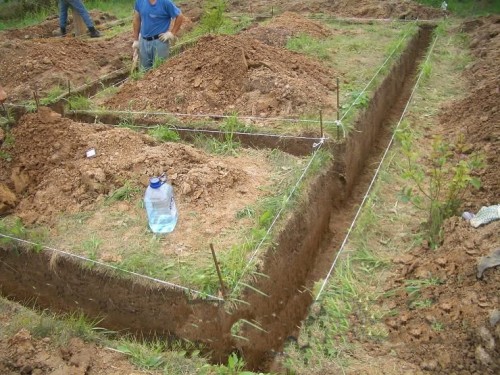
- At its bottom, pour sand with a layer of 0.2-0.4 m (this layer will serve as a kind of shock absorber when the temperature changes and the humidity level).
- Moisten the sand and confuse.
- Wheel struts and stakes around the perimeter of the ditch.
- Strengthen the boards on them are outrageous on the one hand, building a formwork.
- Check out the placement of wooden panels using a building level.
- Internal surfaces of the scene isolate the rubberoid.
- Pour the starting layer of concrete 0.1-0.15 cm.
- Build the reinforcement frame made of metallic rods in the form of a trench, leaving the gap between the longitudinal rods and the foundation plane in order to eliminate the occurrence of corrosion. The frame rods can be made with a special knitting wire or welding.
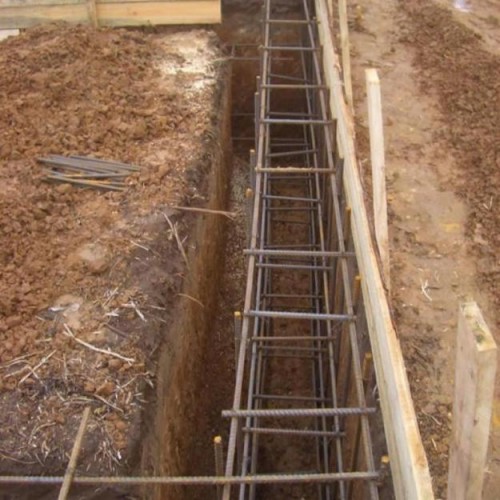
- Pour the concrete with layers of 0.2 m, sealing each of them in order to eliminate the possibility of forming voids inside the array.
- Sneakers pour sand.


It's important to know!
- The competent organization of the drainage system during the arrangement of such a foundation is very important.
- After filling the foundation, its surface must be covered with film. So you can avoid cracks in the future.
- We certainly need a scene, which is manufactured after the fill of the foundation.
- High-quality concrete is a pledge of high-quality foundation, do not try to save here.
- The foundation should not be winter outdoor. Construction work, if possible, should be assured before the onset of frosts. If there is no such possibility, it is necessary to "cover" the foundation of sawdust, claymzit, etc. materials capable of reduced the effect of temperature differences.

Small-breeding belt foundation on clay
- The creation of the foundation of this type on clay bunched soils is characterized by a number of problems dictated by unstable clay properties. In this case, it is necessary to highly carefully equip the drainage system. The execution of this stage occurs after digging the trench.
- Try two wells at a distance of 2-3 m from each other. Their depth should not be less than the depth of the primer of the soil.
- Insert pipes inside well.
- Empty in pipes fill in rubble.
- Put the bottom of the trench with rubble.
- Region around the pipes fall asleep sand, carefully his ramming.
- Sand surface cover with rubble.
- Install formwork shields and reinforcement.
- Fill the concrete mix.
- Outside the design, roll out another trench in a depth of a crumbling layer of the foundation.
- Put a new trench with rubble.
- On top of the device with a width of 0.5-1 m.
Nuance! The pipe can be replaced, rolled into a roll, any non-burning material (fiberglass, polypropylene, Agril, etc.)
Thus, the water of atmospheric precipitation will be outlined into a crumb of snowing, and then, in drainage pipes. The foundation itself will be contacted with a frighting of dry rubble and, as a result, will not be removed during the freezing of the soil.
Learn more about what is the foundation of a ribbon small-breeding, you can learn from the video: