Each owner of the apartment with a balcony or loggias sooner or later thinks about their insulation. This procedure allows you to increase the useful living area, which always lacks, no matter how spacious. Firms and private masters providing such services are incredibly much, and this suggests that the work may be not so complex and specific. In fact, it turns out - to warm up the balcony with their own hands can any hardworking owner, if it will thoroughly study the theory.
Content
The main points of the insulation of the balcony
First of all, it is necessary to designate the main differences between balconies and loggias. The balcony is called a fenced platform, which is issued outside. The outer line of the loggia is in the wall of the house, it seems to be drowning inside and for this reason to warm the loggia is much easier and cheaper than the balcony, because it will be necessary to protect against moisture and cold only the outer wall, and not the entire perimeter.

From the balcony you can make a functional continuation of the residential room or a separate room: a children's, office, workshop or just a cozy place for relaxation. However, it is important to prevent a number of common mistakes, which are not only sealing, but also some declared professionals.
Important moments of insulation of balconies and loggias:
- Glazing is the most important embossing is the installation of double-glazed windows. It would seem that in this one? But the fact is that some balconies are not intended for warm glazing. If the house is the old building, the balcony slab can simply not withstand the weight of the window structure, and therefore it must be examined and strengthened. We recommend paying attention to articles " Balcony glazing in Khrushchev", and " Glazing panoramic windows».
- The slots - to create a warm and cozy atmosphere of one windows, is not enough and after installing double-glazed windows, it is necessary to close all the cracks through which heat will go. To do this, use sealants and mastic on a polyurethane basis - they are durable, durable and not afraid of moisture.
- Insulation - it is very important to choose the properly to choose the insulation, and here it is not so much about the material itself, how much about its thickness. This parameter depends on the preservation of heat inside the room and the square of this room itself. So, if you live in the south, too thick insulation only take the precious centimeters of the square, and for the northern regions it will be a justified victim. Some materials have low thermal conductivity, which means that they are able to keep warm with a small thickness, for example, extruded polystyrene foam or penplex. In more detail we will discuss this just below.
- Fasteners - some unscrupulous construction companies saved on fasteners, hoping for the admission of customers in this matter. Therefore, even if you do not decide on the insulation of the balcony by penplex or foam, you must be able to understand the theory to control the process and do not fool yourself. If the glue is used, then it must be a special weatherproof adhesive for foam or polystyrene foam. For internal insulation, only it is usually enough, but the dowels and umbrellas are needed for external. So they must be located around the perimeter and 1 m² should have about 10 pcs. The seams between the insulation sheets after fixation should be filled with the mounting foam to prevent the appearance of cold bridges.
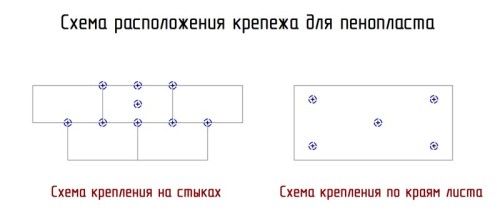
- Finishing finish - if the insulation was conducted outside, the external finish is better to trust the specialists, especially if we are talking about high-altitude work. As for the insulation of the balcony from the inside, here you can truly "get roaring" and give the will of fantasy - the range of finishing materials for internal works is very large. On top of the insulation slabs, you can apply plaster or close it with plasterboard plates, chipboard or MDF, after which it is covered with a wall with decorative plaster, tiles, panels, paint, clapboard, etc.
- Additional heating is an optional moment, but if there is an opportunity, it will be worth it to put the battery, air conditioning on the balcony, air conditioning, make a warm floor or at least put the heater.

The video about the insulation of the balcony is told about the main mistakes that lovers and professionals allow work:
When to insulate a balcony?
Many are interested, is it possible to carry out thermal insulation work on the balcony during the cold season? Of course, in summer, work proceeds faster and more convenient, but there are different situations, and it is impossible to leave this moment. The first thing to understand, if you are going to warm the balcony in winter - many building materials at low temperatures behave differently. For example, the classic cement-sandy solution used to strengthen the parapet of the balcony will freeze faster than it will be grabbed, so it is not necessary to talk about the strength of such a design. Therefore, instead of such a mixture, you will have to use more expensive compositions or adhesives with anti-massarizing additives.

Mounting foam, which is also indispensable when the balconies are insulated, also varies at low temperatures. There are "summer" and "winter" foams with various compositions, and, as you can guess, the "winter" cost more. But the problem is not only in value, but also in the fact that the specific composition of the foam can be badly combined with the rest of thermal insulation materials. An excellent example is some brands of "winter" foams, which corrode foam and expanded polystyrene, as well as paint coatings and plastic.
In addition to the low temperature in winter, it is also very humid, and the humidity does not effectively affect some types of insulation. Polyfoam is not afraid of water, which will not tell about the foam or mineral wool insulation. Also, wet walls will not stick the mastic, adhesives and foams. Therefore, if you still decide on the insulation of the balcony in the winter, first take care of the maximum possible waterproofing: work with the roof, parapet, block the slots and put the windows. Most construction and finishing materials are designed for the temperature of work from + 5C and higher, so they can be used in a cool, but relatively dry room.
Balcony strengthening
If you live in the old house of Soviet buildings (or earlier), in 80% of cases, the balcony stove needs additional strengthening. This moment complicates the work greatly, but it is absolutely necessary for a comfortable, safe and durable use of the balcony. The load, rendered on the stove from the window design, insulation, finishes and other elements of insulation, can be more than 700 kg, so it is very important to make sure that the stove will withstand.

Today, several methods of strengthening balconies are practiced, the choice of which depends on the initial state of the stove, as well as the possibility of mounting supporting elements. If the slab is relatively durable, it takes it as a basis, installing only a few additional points of the support. If it is covered with cracks and crumble, build a new metal frame unturined to it, firmly fixed on the building. In particularly poor cases, the old slab is completely dismantled and build a new ones on a new frame.

Selection of insulation
On the choice of materials for insulation of the balcony should be spoke in more detail. First of all, attention should be paid to the thermal conductivity coefficient, which for modern compositions varies from 0.02 W / ms (on average 0.03-0.Y04 W / ms). The higher the value, the worse the insulation will maintain heat in the room.
There are two options: select the heat-insulating material with the smallest coefficient of thermal conductivity, but such products cost quite expensive, or give preference to a thicker insulation at a lower price. In the first case, you will save the precious square centimeters of the useful balcony area, in the second - money.

Recently, extruded polystyrene foam is most often used to insulate the balconies from the inside. It has a fairly low thermal conductivity coefficient with a small thickness. It is durable and suitable for subsequent finishes, no moisture is afraid and weighs very little. If the first place is saving, use mineral wool in rolls or plates. It is cheaper, but requires additional waterproofing and for high-quality insulation it is necessary to put a rather thick layer. Polyfoam - something average between expensive thin insulation and thick layers of Minvati. Next, we describe in detail the technology of insulation of the balcony by foam.
The table below presents various options for thermal insulation materials used for balconies and loggias:

Hearth balcony foam
Polyfoam was invented relatively recently, but today is used in almost all spheres of activity, including even the food industry. There is an opinion on non-environmental and danger of this health material, however, low cost and excellent performance characteristics themselves for themselves. For insulation of balconies, it is used more often than any other thermal insulation material. The foam is very light, so it has a minimum load on the balcony slab, it is easy to process, so you will not need special cutting tools for tilt plates. You can buy it in any construction store or warehouse, and the carriage will not deliver special troubles. In general, one solid pleasure when working with foam, but there are several points that should be known about. So, it is better not to get involved in savings and buy high-quality certified material from a well-known and proven manufacturer so that the balcony remains warm and dry as long as possible. The second point - for adhesive attachment, use only those compositions that are intended specifically for foam.

Instructions for the insulation of the balcony:
- Prepare the room to work by removing all the furniture and cleaning surfaces from it.
- If there are cracks in the walls and parapets, clean them and make them with a polyurethane sealant or cement. Very large cracks can be chopped by foam and handle mastic. If plastic windows installed, cut the surplus of the mounting foam around the perimeter.
- Perform waterproofing work. For this construction can be used a polyethylene film of thickness 150-200 microns, or other roll material. Capture lengths of cloth overlap each other by 15 cm wide bonding between a tape. Before laying brick or concrete walls is recommended to treat penetrating waterproofing liquid and allow to dry. More useful information can be found in the article " Waterproofing of balconies: features and techniques».
- To lay the insulation you need from the ceiling, then move on to the walls and floor finish. For quality lock can be combined mounting glue and dowels-umbrellas. For more information about thermal insulation of walls and floors polystyrene can be found in the article " The technology of polystyrene foam insulation».
- After the arrangement of the waterproofing barrier is necessary to take care of the vapor barrier. To do this, use a special membrane (one- or two-sided). Also suitable penofol foiled coating. Fix its joint manner, prokleivaya aluminum tape. Foil side facing into the room, then it will reflect heat back, not allowing him to get out, and do not allow water vapor to hurt household insulation.
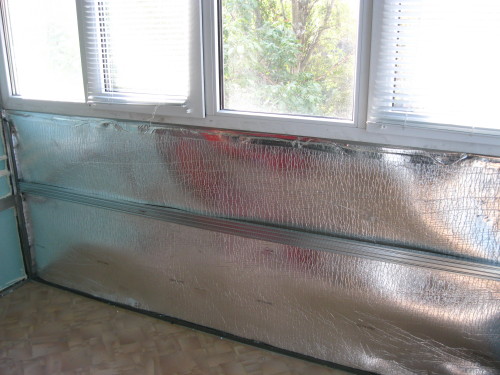
- When you close the heater steam insulating material, need to create a framework (crate) for mounting plates. For this purpose, around the perimeter of nail wooden slats (horizontally or vertically). The thickness of the boards lathing should be a few centimeters to between finishing and vapor barrier remained free space - as water vapor will erode. When finishing you will use the drywall, make a frame made of aluminum profiles for the drywall, but remember that in this case the load on the balcony slabs will increase significantly.
- Lock for sheathing sheeting: plasterboard, plywood, chipboard, MDF, boards, wood panels. If using drywall or boards, finishing can be carried out with the help of decorative plaster, paint, wallpaper or tile. To understand the ways of the interior trim article will help you " Finishing stucco balconies: step by step guide», « How to sheathe balcony clapboard" and " How to sheathe balcony plastic panels».

Such a step-by-step insulation of the balcony can only be given a general idea of \u200b\u200bthe scale of work, but it should be understood that to obtain a qualitative result it is necessary to study each stage and features of the materials used. Warming and decoration of the balcony from the inside differs from outdoor work, which is better to entrust professionals.
Balcony insulation: Photo