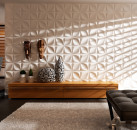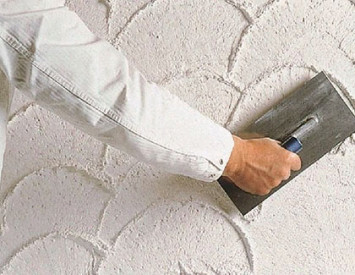
The balcony decoration is different from the work in the apartment. This is a special room that is closest to the street, and therefore is more susceptible to the risk of penetration of moisture, light, dust and etc.. That is why not all finishing materials are suitable for balconies and loggias, but decorative plaster is not from their number. This is a universal material that is capable of transforming any room. In this article we will tell you how to finish a balcony with decorative plaster and reveal several secrets of beautiful wall design.
Content
Alignment plaster for walls
Plaster is a special type of finishing material, the composition and method of applying which depends on the desired goal. So, if you need to make a wall smooth for finishing cladding, use leveling plaster. Over hERE Conveniently glue wallpaper, laying the tile or apply decorative plastering formulations. They often contain as part solid Particles, pigments and a variety of additives to create an original effect.
Plastering on the balcony should withstand the temperature differences and an increased level of humidity, as well as provide additional protection of the room. Make smooth walls is not a problem if clearly Follow the instructions and prepare the right mixture.

Any finish begins with alignment of walls, and often for this you have to use a special plaster, since it allows you to hide obvious surface drops. Moreover, the equalizing composition improves the performance characteristics of overlaps and takes a minimum of space, unlike drywall plates.

To prepare the walls in this way, cement-sand or gypsum solution is used - the selection depends on the material from which the wall is made. To heavy The cement solution was kept on a vertical surface, he needed a support in the form of metal profiles and reinforcing grid. Gypsum is much easier and firmly attached to the wall without additional support. However, such plaster is not recommended to use indoors with high levels of humidity, so if you are going to choose her For the balcony, make sure that he reliable Isolated. Basically, gypsum spheres are used for finishing finish with a layer thickness not more than 20 mm.
Specificity of work with the material
Alignment of walls by plaster can be divided into three stages: the preparation of the wall, the preparation of the solution and actually apply it to the surface. To prepare the wall, you must remove the old coating. It is best to deal with a balcony with plaster immediately after installing hydro and thermal insulation.
If you work with a "naked" wall, then on the smooth concrete surface, the mixture will not be able to hold hard, so you need to do her Rough - Put the jar or small chips. For this usually use tough steel brush or ordinary chisel. For reliable Catching plaster Any wall must be covered with adhesive primer deep penetration. Before applying plaster, you need to moisten the wall so that all the water from the mixture does not absorb brick or concrete. Also, the surface is necessary dust And wait for the complete drying of the primer.

Prepare a plastering solution strictly according to the instructions on the package to avoid unpleasant surprises. You do not need to knead too much - you may not have time to spend it to frozen (especially plaster). Mix the composition thoroughly so that no lump is left. In order for the surface to be perfectly smooth, use guide strips. They define the desired plane and do not allow the plaster fall off. Such beacons are set at a distance of approximately 50 cm, and then hide them under the layer of plaster.
From the first time, no one turns out to create a perfectly smooth coating, but do not worry - after 2 —3 hours after applying plaster her can be lost by sandpaper, thereby so in B.cE Defects. According to the technology you need to stick defined Layer thickness, so measuring instruments will be used to work. Over time, it will be possible to do "on the eye", but main - Remember that the thinner layer, the better.

Yet One important Mom nT Pr.and working with cement-sand plaster - reinforcing grid. It is needed to increase rigidity Walls and not allow the plaster to collapse under their own weight. When buying, check with the seller that the grid is intended for internal work. Attach her To the wall with the same solution and slightly blend into nem..
Useful advice: so that the plaster is probably not falling off, apply a few thin layers, giving a completely dry in the previous one. In total, the coating should not be thicker than 30 mm.

If you first make the balcony plaster with your own hands, better Use a wide spatula - apply the composition on the wall and stretch it upwards. The trowel is also designed for this, but with him you need to be able to seek to make the surface smooth and beautiful.
Work with brick walls
If the walls on the balcony are made of bricks, then the plaster held tightly, first clean the seams on the depth 8 —10 mm. In truth, working with brick and block walls is a bit more complicated than with concrete. The fact, what Bricks have a porous structure that very quickly absorbs water, and there is a risk, what Stucco will turn and swell. To do this, at the preparatory stage, the wall should be covered 2 —3 layers of adhesive primer.
Important: If the house built quite recently, put the walls are not recommended - the building will definitely give a small shrinkage, and all your efforts will disappear.

The layer of plaster for the brick wall should have a thickness of at least 10 mm. Be sure to strengthen it with a reinforcing grid, since it helps to align the surface. To protect the plaster from cracking and deforming, you can use a conventional painting mesh. Especially this is relevant in places near door and window operactions.
We will briefly describe the brick wall shocking technology on the balcony:
- Slide the seams.
- Cover the wall of the primer in 2 —3 layers waiting for complete drying of the previous one.
- Apply a little plaster mixture and climb the reinforcing mesh in it, attaching her Cuts vangest on 10 —15 cm.
- Wait for a complete drying of the holding layer.
- Apply an alignment layer on guide boards and beacons.
- Look out a few hours and set the surface defects with sandpaper.
As you can see, there is nothing complicated in this, and the plaster of walls on the balcony can become excellent practice for repairs in the apartment itself.
Decorative plaster
When the walls became smooth and smooth, you can proceed to the most pleasant part of the work - applying a beautiful decorative plaster. The peculiarity of modern compositions is not only in their effectiveness and diversity, but also in decent operational characteristics. They can safely withstand the temperature differences, do not fade away from direct sunlight, help keep warm inside the house and are completely safe in terms of ecology. Create a unique interior on the balcony with the help of decorative plaster die on even those who have never taken a spatula or roller in his hands! And the most pleasant thing is that the cost of compositions is mainly low - much lower than that of wallpaper, tiles or panels.

Decorative plaster may consist of one, two layers and more. Usually, adhesion additives, dyes, plasticizers and other components are already part of the composition for increasing the practicality and aesthetics of the coating. At the base of almost all plaster compositions lies lime, plaster or white cement and quartz. Mineral mixtures are sold in form powder which It is necessary to just dilute with water to the required consistency, but if you are afraid not to cope, you can buy a ready-made pastry in the bucket.
None of the modern plasters contains harmful substances, and the number of plasticizers and additives usually does not exceed 3%. Because of its natural composition of the surface, the pairs are calm and do not interfere with natural micoveting of the room. Most of the compositions do not accumulate dust and even withstand wet cleaning.
Decorative plaster on the balcony is preferable than wallpaper or wooden panels yet and because She is completely fireproof And does not fade under the sun. The deadlines of the service can be safely calculated by decades, while the wallpaper recommended change every 3 years.
Useful advice: There are special plaster mixes with antiseptic additives that prevent the appearance of mold and fungi, which is relevant for balconies.

Well, of course, the main reason, due to which many choose decorative plasters - a stunning variety of colors and textures. Not even being Designer you can create a stylish and original interior.
It would be just wonderful, do not have the decorative plaster of flaws, but, unfortunately, without them it did not cost. So, because of its mineral nature, it can be covered by cracks with improper application or some time after some time. In most cases, it is not difficult to restor the surface, but fact remains fact. This is a controversial disadvantage that disappears if you buy a mixture with different synthetic additives and plasticizers to increase elasticity. They are more expensive, but you can be confident in the successful outcome of the case.
Types of decorative plaster
As we have already said, decorative plasters are very much, but ease You choose, we classified them in groups depending on the effect produced.
Classification of decorative plasters:
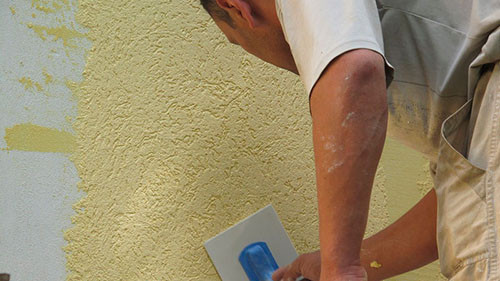
- Structural - have in the composition crumb Quartz or mica, due to which, when applied, forms chaotic scratches and lost. The popular plaster "Coroed", imitating the moves of the Zhuka-Koroeda, belongs to this type. It is noteworthy that for such mixtures you do not need to pre-align the wall - they will mask small defects. Structural plaster can create imitation not only a tree, but also cracked stone and even snake skin! To work on the balcony and inside the house it is better to buy mixtures on a water basis, as they do not have a sharp smell.
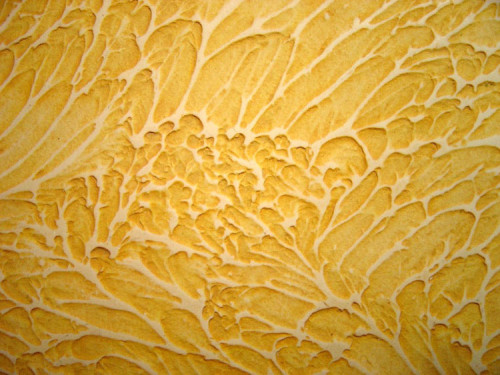
- Textured - have inclusions of granite or marble fractions, organic fibers ( linen, cotton). If you want to create a surface, reliably imitating natural stone, choose texture plaster. Also S. her The help can be "faked" the skin, velvet and wood.
- Flock– The composition contains small particles acrylic that help imitate silkova surface. This finish looks very impressive and rich, but Requires special care and careful circulation. To flock Plaster served longer, apply her On acrylic paint, and then cover with a transparent protective varnish.
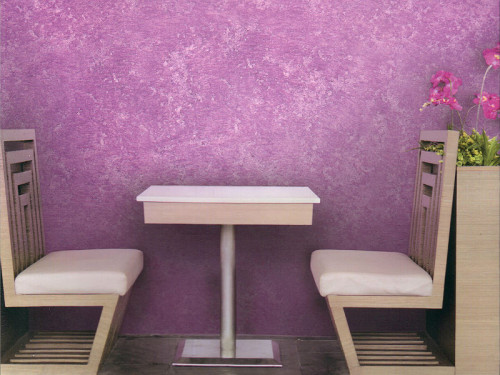
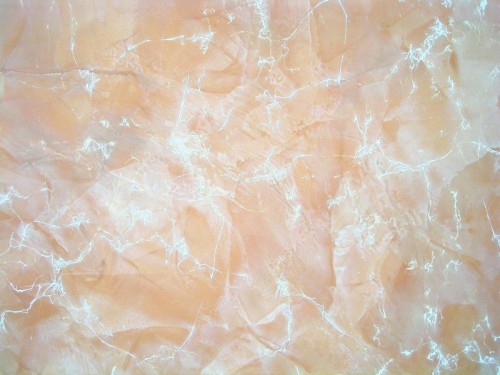
- Venetian - one of the most popular species. The mixtures are created on an acrylic basis with the addition of special dyes. Sell \u200b\u200bthem in the form of thick paste, in which you need to add pigment and mix. With the help of Venetian plaster you can simulate silk, marble, paper and even pearls.


Secrets of the original finish
As we promised, we will reveal several secrets of spectacular design finishes by plaster. SMS sl.the extended methods listed below is to further affect on plasterwhile she yet Did not dry.
Techniques for creating original relief:
- Sprinkle - Take a small trowel, jump out a bit of plaster and snap on the wall.
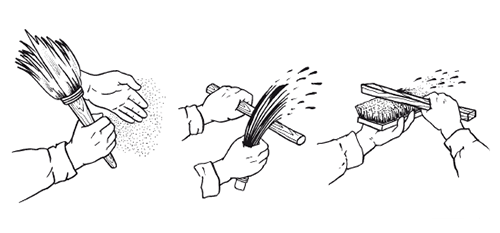
Yet option - to dip in the mixture of a broom, bring Closer to the wall And lightly knock on it with a stick so that small splashes shed surface. This technique is described in detail in the video below:
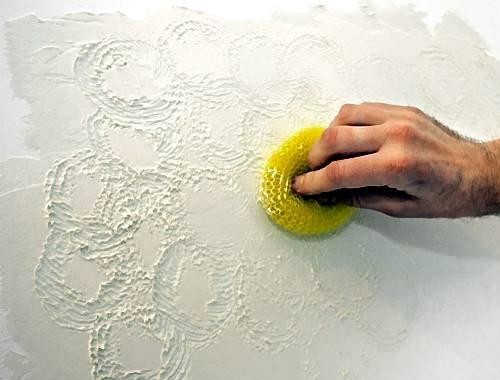
- Sponge - When you put the plaster with a smooth layer, take a sponge and slightly pressing the wall so that no spaces remain ( applyvangest). It is better to take a sponge of the hub (natural, not synthetic) to get a more natural and unpredictable imprint. Periodically rinse the sponge in soapy water.
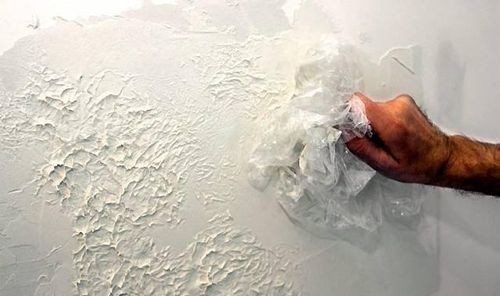
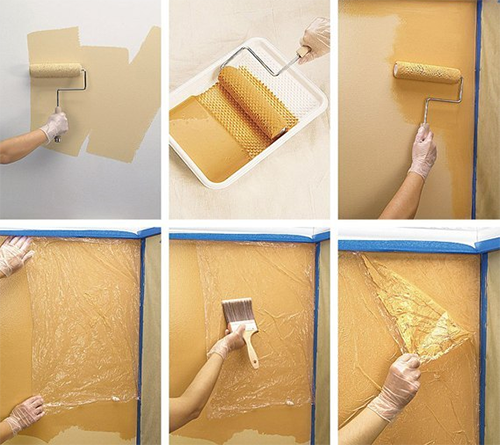
- Cellophane - to get the effect of mint paper, attach the cellophane package to just inflicted Plaster. Before this is a good doubt of the package (it is better to take large packages from durable cellophane). After drying the walls, go through all the folds to the spatula and do not be afraid that spoil the result - the spatula remove Only extra fragile elements.
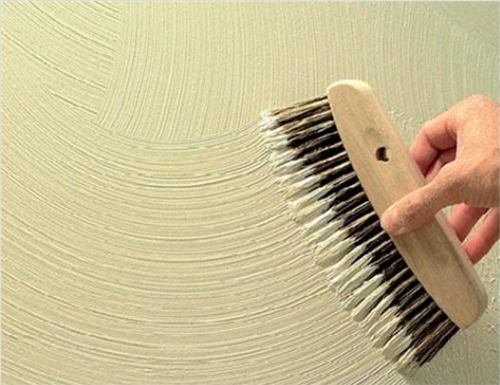
- Brush - Apply the plaster with a layer of 2 mm, then with a spatula with small portions, lay the mixture on the wall and smear her tough synthetic brush in different directions. Since the first layer yet not drying brush It will slightly slide along the wall and create beautiful "waves". To make walls more volume, after drying, go through according tothe top of the plaster on the tone of the plaster, making circular movements and rubbing the grooves.
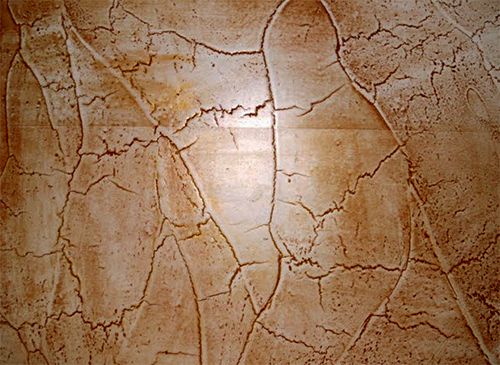
- Effect "Dry Earth" — Very beautiful effect, which is completely simple. To do this, wait until the plaster slightly grab, and then drive in hERE Wooden spool, so that cracks go from it and recesses were formed.
- Grooves - if you have an extra construction grater with gear edge, we recommend trying her in business. Apply Plaster Layer 2 —3 mm and spend on it terek., changing corner her Tilt to get grooves of different depths. More beautiful Total looks like a slightly untidy arbitrary relief.
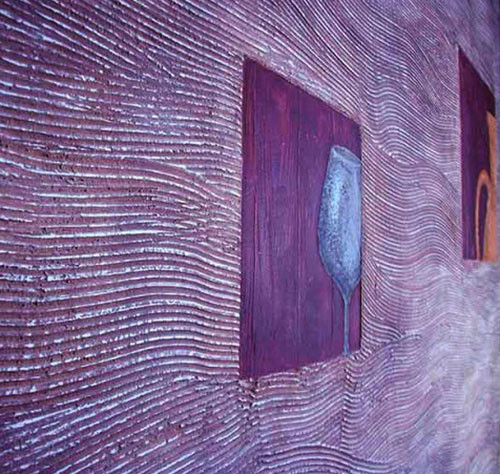
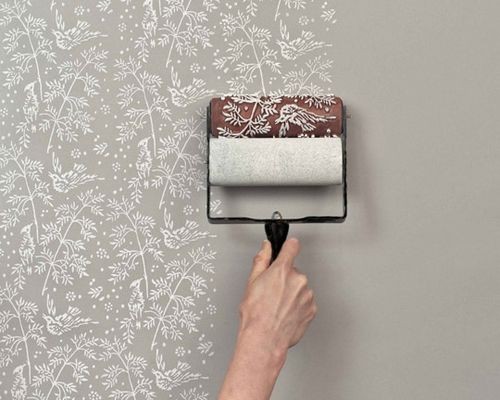
- Yet One original way to "revive" walls on the balcony - work a structural roller. In building stores, you can find rollers with different drawings - spend them in fresh plaster and get smooth neat prints. Purchased composition can be supplemented with your strokes so that it is not like everyone else. " — Wooden stick Add dots, lines, ticks or other elements.


Finally, we suggest you to see a useful video about the plaster of the balcony, where many ways are described. her Interesting and unusual application:
Stucco balcony finish: Photo