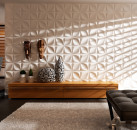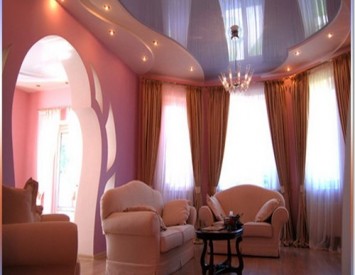
Recently, mirror ceilings were quite extensive distribution, harmoniously fit into any interior style, because they are carried out not only from pieces of traditional mirrors, but also from aluminum, polystyrene, PVC films and other materials. Often, decoration and decoration of the ceiling is made by combining mirror ceilings with other finishing materials (for example, with plasterboard), resulting in very interesting compositions.
Content
Advantages and disadvantages of mirror ceilings
Showy and decorative mirror ceilings are not the main factors of manifestation of such interest to them in the decoration of the premises, because the production of mirrored ceilings of different materials determines their features and drawbacks, allows you to choose a ceiling on the conditions of its operation and available cash. However, the advantages of all kinds of mirror ceilings are as follows:
- excellent wear resistance;
- resistance to the sun rays;
- resistance to the appearance of mold, fungus;
- speed mounting;
- unpretentious and ease of care;
- the ability to replace the damaged element without dismantling the design;
- durability.

In this case, such flaws are part of the advantages of mirror ceilings, as part of the advantages of mirror ceilings.
- ability to attract dust;
- excellent visibility of even small contaminants;
- when using the suspension method of fastening, panel or tiles are located either diagonally or directly.

The disadvantages of the general plan seem rather insignificant against the background of all the advantages. However, each type of mirror ceiling complements the list of general advantages or disadvantages, in many respects, determining the conditions of operation and the place of use of a mirror ceiling.
Types of mirror ceilings, their features
Currently there are several species of mirror ceilings that have certain features of installation, care, accommodation.
Whole mirror leather
The solid canvas on the ceiling looks not only very effectively, stylish, attractive, but also gives the surrounding luxury to the surrounding interior. However, the installation and subsequent operation of such a ceiling causes a lot of difficulties associated with the following features:
- the fragility of the material requires special skills and a certain qualifications of workers when installing;
- it is quite difficult to introduce, deploy and raise a solid canvas ceiling, especially large sizes;
- the severity of the solid canvas, even with a thorough installation, will eventually affect the mount, causing the danger to collapse to the floor.

In addition, the use of solid canvases, in relation to other types of mirror ceilings, is economically irrational due to quite high cost.
Mirror tile
The mirror tile appears as a result of dividing the solid mirror canvas into separate segments of square, rhombid, hexagonal shape. A similar splitting of the mirror on certain segments is achieved by the effect of an extraordinary, "cut" image, due to which the geometry of the entire premises is changing.
The variety of forms, shades, sizes of tile opens up ample opportunities for the flight of designer thought. At the same time, the outer side of the mirror tiles, in addition to a variety of shades, happens:
- glossy;

- matte;

- tinted;

- with a drawing of any complexity;

- with Facet, decoratively mowed floors. The light stream, refraarting about the face, illuminates the room with rainbow shades.

Features of the mirror tile:
- Installation and transportation of tiles require extreme accuracy, since the surface is easily scratched.
- Bad ventation of the room over time will cause darkening of the mirror surface.
Mirrored rim ceilings
Rush ceilings are represented by aluminum, less than steel panels coated with reflective spraying, so the reflection is somewhat distorted. In relation to the mirror tiles, the panels have low weight and quite high strength, which makes it much easier to install. However, before the acquisition and installation of the rush ceiling it is worth considering the following features:
- The thickness of high-quality panels should be at least 0.5 cm, since too thin raies are subject to deformation during operation, and during installation, small dents are easily left.
- Installation is carried out using a suspension system, so when replacing the damaged item, there is no need to dismantle the whole design.
- The decor of the ceiling with a mirror rail is a rather laborious process. In addition, condensate manifests itself on the ceiling in the form of spots, which requires constant care.

Mirror plastic panels
Mirror plastic panels are made of polystyrene, on top of which reflective film is applied. The surface of the panels has good shock resistance and can be smooth or ribbed. The fastening of polystyrene mirror panels on the ceiling is carried out by means of an adhesive layer, although it is used in its absence. However, such plates are inherent in their distinctive features:
- Polystyrene plates that do not have moisture protection coating can not be used to finish the ceiling in the kitchen, bathroom, so in the store it is worth asking for the presence of the required coating.
- Before sticking the panels sold in rolls, it is necessary to straighten the canvas under load and to withstand during the day in the warm room.
- It is necessary to have a smooth surface, although the flexibility of the material contributes to the hidiment of minor ceiling defects.
- Powerful lamps may well melt the ceiling, so it is worth paying attention to the manufacturer information about the safe power of the lamps for such a ceiling.

In general, mirror polystyrene plates, even treated with moisture-proof composition, are not recommended for cladding the ceiling in the bathroom. Condensate steam deposited on the ceiling requires constant panel care, and as a result of constant wiping of the surface, scratches appear on the film, which will soon spoil the initial type of mirror ceiling.
Stretch ceiling
The stretch blade - from previous species is distinguished by the blurring of the outlines of the interior, since a polyvinyl chloride film is used, which has a glossy surface, due to which the reflective effect occurs. However, the mirror stretch ceiling, the photo of which is presented below, is practically not inferior to a mirror reflection, and the cost of the stretch ceiling costs somewhat cheaper than other varieties of mirror ceilings.

In addition, when using stretch ceilings, there is no need for surface alignment, and in wet rooms such a ceiling prevent the condensation to collect, significantly facilitating care.
Molding Mirror Ceiling Methods
Installation of tiles to the base is made using:
- Special glue designed for mirrors. Printing tiles to the base having even minor protrusions will lead to poor adhesion of materials and broken reflection by spoiling all aesthetics. For this reason, it is necessary to carefully remove all the paint, plaster and other pollution from the ceiling. To obtain an ideally smooth surface, the ceiling is desirable to close with moisture-resistant plasterboard, or plywood and then move to the direct tile fastening.
- Self-timers. There are panels with finished holes without them. In some models, the ceiling mirror tiles are provided by cuts on the edges, fasting installation. When imposing the adjacent tiles on each other, the screw was screwed into the base. Thus, both two tiles are attached at the same time.
- Glue and screws. First, the tile is glued to the ceiling, and then fastened with self-draws, forming a more reliable design.
- Modular suspended system of increased strength, including framework, guides and decorative rails for hiding intercutric seams. In such a frame, it is easy to hide electrical wiring, ventilation holes.
Despite the variety of methods for fastening the panels to the ceiling, a mirror suspended ceiling occupies a leading position, since it is indisputable advantages, excluding the disadvantages of other fasteners.

Advantages of the suspended mirror ceiling:
- there is no need to prepare the foundation;
- lack of dust;
- ease of disassembling design;
- well hid well-visible ceiling defects;
- simplicity of replacement of damaged elements;
- the ability to hide ventilation, wires;
- the ability to build a multi-tiered design.

However, the fastening of mirror ceilings by means of screws, glue still remains widespread.
The role of mirror ceilings in the interior
The decoration of the mirrors of various interior items, the walls of the room can no longer be hit, but the mirror ceilings are completely, because the reflection of the totality of items in the zone of such a ceiling, at a different angle looks completely different, giving some mysteriousness to the surrounding interior. In addition, mirror ceilings:
- we create a visual increase in space space;

- ideally mask significant surface irregularities;

- are the source of additional lighting, since sunlight or light from the lamps is perfectly reflected from the mirror surface and is evenly distributed across the room;

- will complement any interior, thanks to a wide sample row, size and form of the elements produced;

- allow you to install embedded lamps;

- due to moisture protection, widely used to finish ceilings in rooms with high humidity;

- allow you to choose the most suitable option regarding the style and financial side of the question, due to the variety of models, execution options, as well as methods of fastening to the ceiling.

Options for using a mirror ceiling
The decorativeness of the mirror ceilings and the combination with various materials make it possible to build unique multi-tiered structures affecting indescribable beauty and sophistication.
In the bedroom
The place allotted for relaxation, sleep, should not be overloaded with a snow-white ceiling, entirely consisting of mirror tiles with a clear reflection.

At the same time, the insertion of mirror tiles in a drywall design looks pretty elegant and unobtrusively.

The most suitable option is the tensioning mirror ceiling of muted, calm shades.

Due to the multi-tiered ceiling design with various inserts from the mirror tile and stretch canvas, the bedroom will acquire a festive, romantic atmosphere.

A rather original view of the bedroom will betray the decor from the parallers.

Thus, the mirror ceiling in the bedroom allows you to significantly change the atmosphere of the environment.
In the living room
When choosing a mirror ceiling for the living room, it is quite possible to stay in any option, moving only to your own preferences.

Of course, stretching mirror ceilings firmly settled in the modern market and are used to build any ceiling designs.

However, the mirror insert in the drywall design looks no less attach.

Mirrored ceilings easily combined with many materials, so it is not necessary to restrain the fantasy. At the same time, mirror ceilings, the photos of which are present in the article, may wage to create its own unique combination of various materials.
On the kitchen
The busiest place in the apartment is a kitchen. In the process of cooking steam, fat splashes find an obstacle to the spread in the form of a ceiling, so the mirror tile and the panels for the ceiling decor in the kitchen are not used better because the stains are clearly visible on such materials and require constant care.

In this case, the blurring of reflection in the stretch ceilings for the kitchen will, on the contrary, the ideal solution.

Therefore, before choosing a mirror ceiling, it is necessary to initially think about the subsequent care of one or another type of ceiling.
In bathroom
Due to all the same high cost, the mirror ceiling in the bathroom received the greatest distribution. A large role in this is played by a small area and relative to money, and the subsequent care of the ceiling.
The bathroom has a great ceiling:
- from mirror tiles;

- from aluminum rails;

- from PVC film;

- from a multi-tiered design.

Thus, the reflecting property of mirror ceilings allows you to create wonders, visually turning a small room into a large one, while filling it with natural or artificial light. The main thing is to choose the right mirror material, taking into account all its features.