Mirrors are an interesting element of the interior, which can visually improve the space of the room, but may also spoil the design with improper use. In this article we will try to figure out the features of the mirror decoration of the walls, consider the use of similar surfaces in various destination rooms.
Content
What are mirror walls
The mirror wall is called the extensive area of \u200b\u200bthe vertical surface, decorated with reflective material. In this case, the mirrors may be almost a solid seamless fabric, and there may be a series of individual items. Mirrors are mounted in different ways: with the help of glue, special clamps or a predetermined frame. We will understand more, what part of the interior can be called a mirror wall:
- a composition of several mirrors enclosed in frames or without them;
- surfaces decorated with mirror tiles or mirror-colored wallpaper;
- doors wardrobes, width;
- walls decorated with mirror panels;
- mirror columns;
- facades of furniture, walls of cabinets or racks decorated with mirror material.
Mirrors, which are used in the decoration of the interior, differ in appearance. For example, the surface of such a material may be clean, and may have a sandblasting pattern, it can be corrugated or smooth. There are mirrors with an effect of or without matter, individual elements are concluded in the frame or are a homogeneous surface of tightly fitted parts.
As for the material of execution, the modern finish is available on sale by conventional glass mirrors or flexible made from acrylic.
When creating a mirror wall in the room, it is necessary to take into account the curvature of the working surface. If the base is quite smooth, then for the installation of the facing use special glue. It is better to install the mirror on the mirror wall with the help of fastening elements or mount the frame in advance.

Functions mirrors in the interior of the room
Visual expansion of space
Many know that the reflective surface can visually expand the area of \u200b\u200bthe room and make it lighter. This is especially true for owners of small apartments or narrow rooms. In a similar case, a well-positioned mirror wall can be a real "chopping-cutting wand", which, although it does not add to the premises of extra square meters, but for sure will make the home more cozy and not so cramped.
Tip: To make a small room lighter and more spacious, the mirror should be placed so that the window reflects. The room itself is desirable to arrange in bright color scheme.
Mirror surfaces involuntarily attract a look, sometimes it causes some discomfort. In such a case, reflective materials are recommended to separate the upper parts of the walls. This will be enough for visual expansion of space, at the same time, the reflection will not catch the eye. It is possible to place the wall with the mirrors from the ceiling to the floor, for example, behind the back of bed, armchairs or sofas, in the hallway or in the corridor.

Interior addition to interesting details
In bright and spacious premises there is no need to resort to tricks and visually increase the area. Nevertheless, even in such a situation, the mirror will not be an excess element of the design. Separate small details will give the interior of grace, sophistication, notch of luxury. In this case, you can use special mirror stickers on the wall or simple mirrors enclosed in the frame.
The mirrors of unusual forms decorated with drawings or ornaments are spectacularly found as accent details. When interior design, it is important to remember that the minimum number of furniture should be reflected in the mirror surface, otherwise the mirrors will act on the psyche annoying. It is better to use them in rooms where the number of interior items is minimal, and the walls themselves have a good finish and matte texture.

Effect of crushing
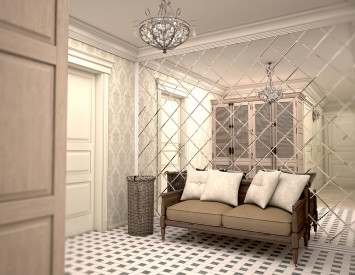
Mirror elements can be not a solid canvas, but a combination of individual fragments. This effect of crushing makes it possible to achieve a visual increase in space, at the same time, the reflecting surfaces will not act on the tenants as an irritant.
The gaps between the mirrors with similar design are different. In some cases, the distance is equal to the dimensions of the mirrors, no less effectively look at the narrow gaps between the wide mirrors and the wide distances between narrow elements. For each of these options there is a specific application. Equal gaps successfully look in small rooms, where there is a problem of insufficient space. Wide mirrors with small gaps can be placed in a spacious room, and narrow reflective surfaces located on a large distance from each other, perfectly emphasize the light interior.
Playing the wall with one of the above methods, you will create an original and unusual interior object that will have many interesting effects:
- reflect the light like a set of prisms;
- combine covers of different textures and reliefs;
- look originally and non-standard.

Where you should not use mirror walls
Unfortunately, the mirror wall is not always used as a decoration of the room. Consider several options when it is better to abandon such design:
- In a narrow, long and poorly lit room, a mirror wall can only spoil the already impervious interior. A wardrobe with mirrored doors, mounted along one of the walls in a narrow living room, will only reflect the opposite wall. Result: the impression of an elongated tunnel, littered furniture.
- Mirrors should not be decorated with a wall located opposite the door, desktop or bed. Reflection in such cases will constantly distract from work or interfere with falling asleep.
- In small bathroom areas, it is also unwanted to separate the walls with a mirror material, especially in the case of a combined bathroom. First, look at yourself, sitting on the toilet - the pleasure of doubtful. Secondly, in the wet premises to which the bathroom relates, behind the reflective surface will have to constantly take care, without tired rubbing it from dried drops and drows. In addition, in a dark, poorly illuminated bathroom, a mirror finish will not help achieve the effect of visual expansion of space.
- The mirror wall opposite the other is the same - another example of unsuccessful use of such material in the interior. The result of such a finish will be an infinite labyrinth of reflections, which last time will begin to act on the nerves.

Mirror wall in the interiors of different rooms
Bathroom mirror trim
The spacious bathroom with good lighting allows you to use a mirror finish without fears. In such a case, mirrors can be issued as part of the wall and the entire surface of the whole. It is very important that in the room there was enough light, therefore, before the start of the process, the luminaires should take care of the installation of lamps.
The mirror tile above the sink will replace the usual mirror. It looks quite successfully a mirror wall opposite the bath or shower, but not only opposite the toilet. Reflective elements can be decorated with drawings or facet, which will only add attractive tiles.
Remember that the mirror trim in the bathroom requires frequent care. Fortunately, traces of splashes and drops are easy to wipe with a conventional detergent for glasses.

Mirror Wall in the kitchen interior
Many modern designs provide for the creation of mirror walls in the kitchens. The reflective surface looks beautifully on non-core surfaces. For example, a mirror tile can be made an accent wall or a kitchen apron.
In a large kitchen, where the work area is located separately, the mirrors can be used to finish the dining area. Only reflecting details are preferably located at the top of the wall or where you will not see your own reflection.
To make the kitchen lighter, the mirrors need to be located where the windows will be reflected in them. As in the case of the bathroom, the reflective surfaces in the kitchen will often take care of. So that the finish is contaminated not so quickly, it should not be used for the design of the walls near the stove or shell.

Mirror design in the interior of the hallway
In narrow and oblong hallways, the mirrors should be used carefully. If you place them along two opposite walls, you can get a labyrinth of reflections. Someone will have such an effect in the soul, but it acts on the nerves to many. In the corridor of this type, the mirror material is desirable to separate only the wall fragments. To bring to the room more light, reflecting the surfaces are better spaced near the lamps.
Owners of spacious hallways there is no need to worry due to improper use of a mirror finish. In a similar case, the reflective tiles can be made of whole walls, from the ceiling to the floor. In the hallway, you can arrange a wide wardrobe with mirror doors.
In the interior of the hallway, a mirror ceiling is very original, which not only expands the space, but also multiplies the light emanating from the score and lamps. The use of mirrors in the hallway is quite common, since such a finish performs not only decorative, but also practical functions.

Mirrors in the living room
A mirror panel on the living room wall perfectly refreshes and decorate the interior. Facing such a kind can be used in the most unusual and unexpected places. In addition to the walls or ceiling, the mirrors often decorated arched doorways, niches, columns. Designed in this way, these architectural elements are rightfully becoming central accents of the interior. As for the finishing material itself, it is also possible to show a fantasy here, for example, by performing a mirror cloth from small mosaic parts or from different size and form of fragments. Mirrors can be enclosed in picture frames, and may have a beautiful ornament.
Reflective materials adorn not only the architectural details, but the furniture fronts. Closets, countertops coffee tables, doors, side cabinets wall - not a complete list of places where you can use a mirror finish.
Of mirror tiles on the walls of the living room, you can create original mural or painting, laying of the most incredible mosaic patterns.

Mirror finish in the bedroom
Bedroom, in the interior of which has a mirrored wall, it looks luxurious, elegant and stylish. Reflecting elements in this room makes the atmosphere more intimate and mysterious. And since it is in the bedroom is most often used original and interesting lighting, it is possible to play with the refraction of light.
Reflective surfaces often have in the headboard or on the ceiling. The bedroom is also appropriate to become a wardrobe with a mirror door. Can be tiled wall in the dressing table or for toiletries. Near mirror lamps and chandeliers also will fall by the way.

Types of materials for the mirror finish
mirror tiles
Interior decoration is most often used mirror tiles. To date, this material is presented in two views:
- based on polystyrene tiles. The outer surface of such a lining is covered with a special paint consisting of microscopic metal particles. It is this paint provides a mirror effect. Advantages of such tiles is considered low weight, thanks to which is provided by, and ease of installation. For facing surface material is sufficiently sticking. The second advantage - low price. The third advantage is that break this tile is impossible. Less similar finishes - worst fine quality compared to the same glass material.
- Mirrored glass tiles are considered a more expensive type of facing. It weighs much more than the polystyrene foam, so it is necessary to mount it on more solid and durable fasteners. Sometimes a dowel or nails are used to install glass elements, and sometimes create a special framework. In the process of installation and operation, caution should be exercised, as the glass is easily broken. But the decorative qualities of such material are very high, the finished surface is obtained smooth, smooth and attractive. A glass mirror tile is resistant to scratches and any chemical substances, it is not terrified by temperature fluctuations and moisture, and the care of the material is reduced to the simple glasses wiping.
One of the varieties of the mirror tile is a tile with facet. Facet is a decorative beep along the edge of a glass part that forms an additional face. These faces are beautifully refracted by light and play glare. Futset tiles are used as scattered elements or lay it on the surface of a solid web.
The mirror tile requires a neat and gentle laying. If the facing is a solid surface, its individual elements must be mounted with minimal gaps. To fulfill such work, it is better to use the services of professionals. But those who are confident in their power can try to perform the process alone.

Mirror wallpapers
Modern building market offers consumers innovative material - mirror wallpapers. The most important advantage of this type of cladding is its exceptional decorative properties. The interior decorated in a similar way shines magnificence and luxury, it looks expensive, stylish and representative. You can not pay attention to and another plus - no listening devices can be made through the mirrored wallpaper.
All can not afford a similar finish, since the price of it is quite high. In addition, glued wallpaper can only be glued on the perfectly aligned wall. If even the smallest irregularities remain on the surface, the reflection in these places will be distorted, which will be very noticeable. Mirror wallpapers weigh are much smaller than the tile, but more than paper analogs, therefore it is recommended to glue them for durable glue compositions intended for heavy wallpaper. No care does not require material, but it is necessary to handle it carefully, since the facing is unstable before scratches.
Mirrored wallpapers are made by applying the finest aluminum foil to the rolled base. For additional protection and greater glossiness, foil is covered with transparent varnish. The benefits of such a material include its rich assortment, presented not only with a variety of drawings, but also the color palette.
If you handle the mirror walls neatly, they will serve for many years. Although such a finish and afraid of scratches, it is resistant to moisture and ultraviolet.

Mirror wall stickers
An alternative to expensive metal wallpaper can be more affordable mirror stickers. On sale such stickers are represented by the most diverse sizes and forms, and if they are properly used, you can create a unique design, which almost nothing will give up the interior with wallpaper.
Unfortunately, the stickers with a reflective surface will not be able to perform the functions of full-fledged mirrors, since the reflection in them is somewhat distorted. But such stickers are no worse than the mirror tile, will introduce an additional light into the interior and cope with the functions of visual expansion of space. The decorativeness of such a finish is also at the height.
Stickers can be applied in any interior of almost any room, regardless of its stylistic performance. For example, such elements of decorative finish will look very well in the interior of a strict classic style, where negros are dominant and simplicity of forms. Mirrored stickers "revive the room" and a little "devoid" it.
In the interior of the bedroom, mirror stickers will also be appropriate, especially if you arrange from the head of the bed. However, such details can be decorate any corner of this room. If we are talking about a children's bedroom, you can pick up stickers of the corresponding forms for its interior. On the wall in the nursery, you can stick butterflies, different animals or fabulous heroes, marine inhabitants, etc.
No less elegant mirror stickers will look in the bathroom. In this case, the stickers can also be chosen in accordance with the theme.
The modern building market offers a wide range of products of this kind. The highest quality and durable is the stickers produced from acrylic glass. They are attached to the wall using special scotch and with careful handling serve for many years. One of the advantages of the material is that it can be glued at almost any foundation: plaster, wood, wallpaper, tile, etc. Cheap analogue is the vinyl film stickers. They are not so durable as acrylic stickers, and on decorative qualities, they are noticeably inferior to their dear analogue.
One of the functions of mirror stickers is the reflection of the most attractive details of the interior. This principle needs to be guided by choosing a place to locate a mirror composition. Successfully placed stickers beneficially emphasize the features and winning features of the style in which the room is decorated, complement the interior with new paints.

The process of finishing the walls with mirror panels
Make a mirror wall in the room with your own hands. Consider this process on the example of using a glass mirror tile.
Preparatory work
The main requirement for the working surface is its evenness. The mirror is a unique material, because it can emphasize the defects of the base at times better than any paint or the finest wallpaper. The slightest irregularities on the wall will reflect distorted, "broken." In addition, other requirements are also presented to the surface: dryness, cleanliness, sufficient roughness to provide adhesion with finishing material. Consider a step-by-step preparatory process:
- The working base is first cleaned from all superfluous: fragments of old cladding, garbage, dust, nails and dowels, surplus of solution, etc. After that, the surface is covered with an antiseptic and ground.
- When the primer dries, the wall is aligned with rough plaster. After pouring the solution, the base is again equal to the putty and polish before smoothness.
- The dust formed in the process of work is cleaned, and the wall is neglected again. If the surface for any reason is impossible to align the plaster, it is better to use plasterboard sheets for this purpose.
By purchasing a mirror tile, you need to consider a small margin, because in the process of work on the glass, chips and cracks can be formed, and the possibility of marriage is also not excluded. Even before the start of installation, the mirror tile should be decomposed on the floor as it will later be attached to the wall. Since individual details may differ from each other by 1-2 mm, fetching the tiles on the floor, they need to be installed exactly on the wall in the same sequence.
A set of tools for laying a mirror tile includes the following:
- diamond glass cutter or tiles;
- glass drill;
- building level;
- plumb;
- toothed spatula;
- rubber spatula;
- ruler and square;
- bilateral scotch and painting tape.

Selection of glue and mirror tile mounting
For decoration of walls with glass mirror tiles, ordinary tile glue is not suitable, because the amalgam darkens from it. Fortunately, on sale you can find special adhesive compositions based on silicone or epoxy resin. Among their components there is no acid that spoils the amalgam. Cement-based glue mixtures, as well as universal sealants for facing the wall mirrors cannot be used.
The process of mounting the mirror tile we describe step by step:
- Initially, the glue is applied with a layer of up to 1 mm and smash with a toothed spatula. The area of \u200b\u200bapplication should be equal to the size of one tile. If liquid nails are used as an adhesive composition, then the glass on the reverse side must be glued with double tape.
- After applying glue on the wall with the same composition you need to cover the back of the tile, and then sprinkle it with a thin layer of sand, to ensure the best grip of the facing material with the base.
- The first row in this case always stacked horizontally. Equality of masonry is checked by a building level. Between the individual elements, the even seams are observed that are made using plastic crosses. If the surface is perfectly smooth, the tiles can be stacked closely almost without gaps, but if there are small irregularities on the wall, it is better to make the seams wider. This will help break the reflection on fragments and distortion will be inconspicuous.
- If the glue dries quickly, the tile can be laid immediately into several rows. But if the mixture is dried slowly, for example, if you use liquid nails, then before installing the next row you need to wait for the previous one.
- For the facing of those places where one-piece tile does not include, the material can be cut to the desired size. To do this, the diamond glass cutter is best. The resulting edges should be seized with bars or fine-grained emery paper.
- The glue completely dries in about 4-5 days. After that, intercutric seams must be filled with sealant or colorless silicone. When this work is performed, the gaps between the tiles are first sealed with a painted scotch, then furrows cut through it, and then fill them with sealants. After that, the tape is sprinkled, and the tile is cleaned with a rubber spatula and a rag.