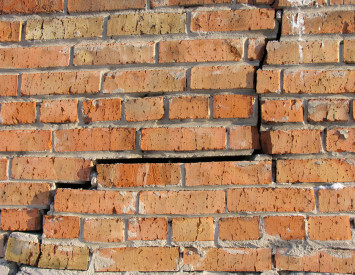
The crack in the wall is a problem with which residents are faced with both private and apartment buildings. This defect is able to entail a violation of the integrity of the finish. For example, squeezing paint or dug wallpaper. Therefore, it is impossible to leave this situation regardless of the crack size.
Content
How to close the crack in the brick wall
Brick masonry damage occurs for the following reasons:
- The soil having a non-uniform structure after a certain time is settled. This leads to cracks.
- The same consequences have deformation changes in the foundation, which are formed in the event of insufficient shocking or placement near the groundwater and an increased load on the walls from overlaps. For 12 months after construction, a building shrinkage occurs, which also provokes the formation of cracks.
- Problems may occur in the event that the laying technology does not meet the requirements established. And also when applying a poor-quality solution.
It is possible to determine the cause of the problem localization:
- cracks in the lower part of the building indicate excessive overlap pressure;
- the upper part is damaged as a result of the subsidence of the foundation.
Before closeing cracks in a brick wall, you need to make sure that they do not increase in size. In the opposite case, the work done will be unsuccessful. At the wall should be attached the guidelines from the paper and trace them for their integrity.

To eliminate a small crack to 5 mm wide, you can use the cement composition. Works are made in such a sequence:
- Initially, it is necessary to remove garbage from the slot and process it from the inside by a moisture.
- The edges of the gap before work should be knocked down with a hammer, because This will provide better adhesion of solution and bricks.
- Damage to medium-sized (from 5 mm to 10 mm) is also eliminated by the cement composition, but with the addition of an additional component in it - sand.
Cracks whose width exceeds 10 mm, are critical. The absence of timely intervention can have negative consequences. Eliminate such damage can be several methods:
- The damaged zone should be disassembled and replaced with a new material.
- Masonry disassembled from the top row. Bricks are stacked according to the "Brick Castle" method.
- Fragments of fittings are inserted into the laying, which overlap the crack.
- If there is no possibility to disassemble the masonry, the place of damage is sealed with a solution of cement.
- In the gap, you can drive T-shaped metal elements, which are fixed from dowels from two sides. The use of metal parts is not mandatory. But in this case, the wall of the building must be strengthened from the inside.
- Sealing cracks in the walls of the brick can be carried out by means of a mounting foam or a sealing agent. The cavity of the slit should be filled with foam, wait until it freeze and cut the material to a depth of 2 cm.
- The resulting space is filled with cement mixture. When using sealant, it is important to choose the proper composition. It is not necessary to use a sealing agent based on silicone, since this material does not have adhesion with plaster, putty and paint.
- It is necessary to prepare a special sealant for the processing of seams. It is placed in the gap through a construction pistol. The sealant for cracks in the wall has a certain advantage over the cement mixture. It has the ability to increase and decrease in sizes without cracking, which is unusual for the usual solution. This tool refers to the category of expensive materials, but its use allows you to get a qualitative result.
- A cracked wall is recommended to strengthen from the inside. This procedure provides for the seal of a damaged area and the imposition of a metal profile, which will perform the role of the lock. It should be placed across the crack to prevent its subsequent distribution. Anchors are used to fix this item. You can apply steel brackets. In this case, you need to pre-drill holes.
- If the cracks were formed due to incorrectly flooded foundation, it is recommended to install an additional concrete belt on it. Along the perimeter of the house you need to prepare a trench, the depth of which should exceed the depth of the foundation. This recess is placed concrete from which the belt is constructed.

How to eliminate cracks in a wall covered with a plaster mix
The risk of cracks on the plastered walls is not limited to an aesthetic defect. Damage may suffer both plastering and masonry. Preferably, this refers to the outer walls, where the finish is largely subjected to the negative effect of low temperatures and moisture. Through a crack in the coating the moisture penetrates into the masonry, which subsequently freezes. This causes the gap of the coating and breaking masonry.
These damage the plaster layer can be formed not only from the outside, but the inside of the house. It is a very thin cracks that are visually reminiscent of cobwebs and spread over the entire wall surface. This may be the wrong application of the composition, in violation of the proportions by mixing the components and failure to comply with requirements for cover care. can be isolated overlaying a thick layer of the solution among the most common errors. Cracks in this situation are the natural consequence of the violation of the technology.
Damage appear after finishing: wallpapering, painting or plastering. You can prevent this by using reinforcing elements, which are set to finish. For this purpose, use several materials:
- mortar;
- fiberglass mesh;
- fiberglass;
- fiberglass.
The most convenient option is considered to be the last material. Fiberglass is attached to the primed and dry surface with a special adhesive for fixing stelooboev. After completion of the work, this material can be covered with putty or paint finish.

The plaster mixture according to the destination is divided into 2 types:
- for the treatment of the inner surfaces;
- for exterior walls.
Different types of data components of the plaster, in their ranks. For exterior finishing solution was prepared based on cement, and for interior works are considered more suitable lime formulations.
To eliminate the cracks with plaster composition should be prepared:
- capacity;
- trowel;
- floats of different sizes;
- brush for plastering;
- brush;
- trowel;
- water.
Mortar can be done by yourself or buy ready-made. In the process of homemade need to monitor the consistency, because too thin plaster will stay bad. The process of repairing cracks is as follows:
- When a brush is applied onto the damaged area and then floated using wooden floats.
- If the plaster was applied on the wall by the rendering to the treatment area did not differ brush, to dip into the water and make the surface of Clap movement.
- The easiest way to eliminate shrinkage microcracks. They need to be treated with deep impregnation which penetrates the coating structure and strengthens it. Then cracks can be filled dispersion paint.
Solution for cracks in the wall, covered plaster composition must contain fillers and binder. As this element can be used building plaster, construction cement or lime. The most durable is a cement-based material. Indicators of its strength can be determined by labeling, for solutions mark 400 is used.
Building plaster will make the mixture more durable. This accelerates setting component composition. He has a distinctive feature - not a shrink. Building lime used for exterior applications, because it dries the air only.

How to cover up the cracks in the wall of plasterboard
Damage in plasterboard materials are formed due to several reasons:
- The most common is the violation of technology when installing the frame and the installation of sheets.
- The appearance of cracks can be triggered by improper putty and sealing the seams between the sheets.
- The reasons for damage include sharp temperature differences indoors, an increased level of humidity and contact with water.
Plasterboard does not differ good resistance to moisture. When interacting with this factor, the sheets are deformed and retain that form after drying. The only solution in this situation is the substitution of the material. You can get rid of cracks in drywall in two methods.
- The first option involves filling with a spacure or acrylic.
- The second method is to stick over the damaged area of \u200b\u200bthe glass cholester. Then the surface must be sharpened, after which you can proceed to the finishing coating.
The surface processing process looks like this:
- Before close the crack in the wall of the house, using a putty composition, it is necessary to remove the layer of plaster with a damaged zone.
- Next, through a vacuum cleaner, dust is removed.
- Then you need to prepare a spacion mixture in the following proportions: on 2 parts of the powder 1 part of the fluid.
- The resulting mass is applied with a layer of 2 mm using a spatula.
- In addition to cracking, the closest site follows.
- When using the reinforced ribbon, it must be placed in the slit and cover with a spacing composition.
- The putty dries for 1.5 hours.
- Then it is recommended to clean it and remove the dust from the wall.

Seeling cracks in concrete wall
The main reason for the appearance of defects in the wall of concrete is the violation of the ratio of cement and water in the preparation of cement-concrete composition. In the process of laying the solution, it needs to be carefully sealing through vibrators. The emergence of cracks can also lead to non-compliance with the rules of care. Fresh concrete is recommended to cover the cloth to prevent excessive evaporation of moisture.
A special danger represents the presence of cracks in the wall, which dwells under frequent temperature differences. At low moisture temperature, the crack falls into the cavity, freezes and increases the defect. Damage comes to reinforcement, the corrosive process begins, which adversely affects the strength of the building. In order to detect defects in a timely manner, the construction must be regularly inspecting. This will make it possible to eliminate cracks in the walls at the initial stage of development. It is impossible to ignore even minor defective changes in concrete material.
So, it will take:
- hammer;
- chisel;
- grinder;
- putty knife;
- metal brush;
- brush;
- vacuum cleaner;
- rake from wood material;
- trowel;
- water, sand, cement;
- adhesive composition;
- fragments of wire;
- smooth.
The workflow occurs in such a sequence:
- Using the hammer and chisel, the crack must be squeezed to a depth of 5 mm. This will help prevent the reproduction of the repair.
- Next, the damaged place is cleared of dust and moistened. With the help of a sponge you need to remove excess moisture.
- If fittings are visible, it must be treated with an anti-corrosion agent.
- The mixture is prepared on the basis of sand and cement, a ratio of 3: 1. The composition you can add PVA.
- If deep defects, they should be filling in stages, moisturizing each layer of repair mix.
- If necessary, the crack is reinforced with wire fragments.
- Then the surface must be aligned, for this it is applied ironing.
- After hardening the composition, the protruding zones are adjusted using the grinding machine.

Conclusion
Planning the wall repair, the sealing of cracks should be a prerequisite. This defect not only negatively affects the appearance of the building, but also threatens its strength. Today, the walls of houses are constructed from various materials, each of which requires an individual approach while eliminating cracks.
How to close the crack in the wall. Video: