Japanese style in interior design is becoming more popular. The reason is the great ease and brevity of images, natural textures and harmony with the natural start. Modern interior design trends are increasingly reduced to minimalist and ecological areas, and Japanese style combines both the one and the other. One of the essential attributes of this trend are the Japanese curtains. This is quite unusual and original interior, which are now heard by the revolution in its field. Today we will talk about what it is, you look at pictures of Japanese curtains in the interior and learn how to make their own hands.
Content
Japanese curtains - what is it
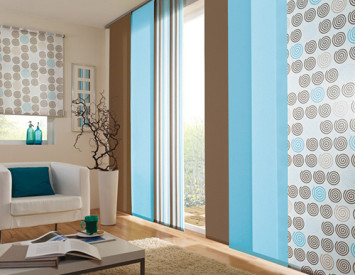
Japanese curtains quite unlike our usual sections of matter flowing from the eaves to the ceiling. It is a kind of screen, which consists of the holding element at the top, dense, but light material and weighting material at the bottom. Japanese curtains cover the window opening completely, and their principle of operation resembles the specifics of the vertical blinds - construction segments "hide" one after the other when folded. Curtains consist of several sections, the number of which depends on the size of any window, you need to close. Unlike Japanese curtains of vertical blinds is that their bar is much wider and made of special materials.

Each section looks into a rectangular web of fabric and can reach a width of 100 cm At the top of the web guide is attached to the -. Ledge special rails. Fixing is carried out by means of velcro, which is very convenient, because you can always remove the curtains for washing or change to other, more suitable to the interior. Cornice for Japanese curtains can be both single-row and multi-row. Recent often installed in the bedrooms, and one row consists of translucent sections and the other reliably covers the sunlight, giving the eyes a rest.
Another feature of Japanese curtains in the complete absence of assemblies at the top, all kinds of clamps, garters, fixtures and all kinds of grabs, some like to cling to classical curtains. This makes the fabric perfectly straight, smooth and clean, which further loosens the atmosphere and create a feeling of lightness.

Japanese curtains are in a close relationship with Roman and belong to the category of flat curtains. This means that every picture should have a rigid tension, so the lower end sections of the attached weight material. If you must wash cloth, weight material is removed. In some cases, to provide additional rigidity to the side seams webs insert special strips of fiberglass with non-woven sizing in order to avoid the appearance of wavy seams.
It may seem that the perfectly smooth surface of the canvases is boring and monotony, but it gives unlimited freedom of designer fantasy. Here can be depicted geometric abstractions and floral motifs, traditional painting or gradient from your favorite shades. Artistically decorated Japanese curtains in the interior are best looking at large surfaces, and monophonic and not overloaded with images of the canvas can visually expand the small room.

Advantages of curtains in Japanese style:
- permissible to use any colors;
- sections curtains only from natural environmentally friendly fabrics;
- lack of drapery - the canvas are absolutely smooth, which creates a feeling of lightness;
- due to the lack of folds on the canvases, dust does not accumulate;
- at any time, the canvas can be removed and wash;
- the features of the attachment of the canvases allow you to replace their curtains of another color or from another tissue, without dismantling the former holders;
- japanese curtains can be easily made with their own hands (just below);
- the ability to remote control system.
There are no shortcomings of these curtains, so many designers seek to use them as often as possible when drawing up their interior projects.
Management of Japanese Curtains
Curtains play a big role in interior design. Judge themselves - the walls occupy most of the premises, and the rest of the space is given to the windows. Curtains in a closed form act as another wall, the only difference is that you can control this wall. Japanese curtains can be opened and shut by manually or by mechanics. In the first case, the management process is identical to the appeal with vertical blinds - you need to pull the lace to shift the canvas to the side.
Depending on the type of design, the curtains can be collected from the left side, on the right or on both sides of the window. Remote curtain control symbolizes technical progress and creates the most comfortable conditions for life. Imagine that you forgot to close the curtains on the night, and the early Saturday morning so do not want to get up with the first rays of the sun! To fix it, just press the button on the control panel. The principle of operation of remote curtains in Japanese style is shown in the video below:
All models of Japanese curtains have eaves, and when opening one panel comes over the other. With a decrease or increase in the number of eaves, you can simulate the original design of the curtains for its apartment. The uniqueness of such cornices is that they allow you to change the design of the same curtains, making a variety of interior.
Zoning Curtains
The unusual structure and appearance of the Japanese curtain pushed the designers to the original solution - to use them not only for windows, but also as partitions. If you take a look at home in a traditional Japanese style, you will see, then there are no thick walls, and the whole interior is simplified as much as possible. The Japanese has no abundance of shelves with souvenirs, huge wardrobes and servants with eternal tea sets "for guests". According to traditional views, everything that litters your apartment, just as litters and your life. Accordingly, the easier and easier will be the situation, the free one you will feel yourself. Such a small excursion to the psychology of Japanese design is necessary to understand why instead of walls in houses use light open partitions, and why Japanese curtains are perfect for this role.

You can easily divide the room into two functional zones or, on the contrary, to combine into one. Such a solution is ideal for the studio apartment, where the living room is combined with the bedroom. Also, the Japanese speed as partition can be used when placing a room for two teenage children, each of which is vital to have a personal space.
Japanese curtains can replace the doors in wide openings. They perfectly fit into any modern interior or "refresh" the former decor, making an exotic note. Zoning space in this way can be very interesting to beat. For example, if on the one side the web will be painted in the color corresponding to this half of the room, and the shade on the other hand will complement the color palette of the interior of the second half. In general, color escort should be chosen very carefully, and before that it would be nice to inform about the psychological context and the effect of each of the colors. For example, the bedroom is better to decorate in neutral tones, not exciting psyche. In the children's room, the curtains can be bright color, but if they are located close to the bedroom zone, it is recommended to still pick up something quieter, otherwise the child will be capricious.

If you divide the room into two unequal parts, one of which is significantly smaller than the other, for example, is an office with a desk and bookcase, choose fabric light shades. In this case, a smaller part will not seem too close. With regard to the transparency of fabrics, they can be translucent and opaque. The first gives the room lightness, but the latter clearly followed its mission - to replace the wall.
Japanese curtains with his hands
As we have said, one of the advantages of Japanese curtains is the fact that they can easily do yourself, even without professional skills. But before you fill the sewing machine, you need to understand what kind of fabric for curtains Japanese can be used. It should be guided by one simple rule - the more natural, the better. Fabrics can be very different: transparent, lightweight, dense and opaque, translucent, etc. It all depends on what effect you want to achieve.

Color fabric should be selected on the basis of the general "mood" interior. Curtains can balance it, to join him various details, bright paintings "unload" the situation is too dark and bright image can revive the monotonous appearance.
Tip: If you want to create Japanese curtains with the image, choose not too broad picture so that it will fit entirely on the panel.
As for the material, sew curtains Japanese can use linen, cotton, natural silk, straw or header (a mixture of cotton with polyester). It is also permissible combination of several types of fabrics and other natural materials such as bamboo sticks. Bamboo - one of the most popular materials for the interior in the Japanese style. Very interesting look curtains, consisting of light and heavy fabrics.

Experts recommend the use of Japanese curtains to sew their own hands dry and hard tissues that do not stretch, and still maintain the natural shades. However, the store Japanese curtains you can find a lot of models made of synthetic materials in many colors. What to use, it's up to you, but always remember that the house is better to choose only eco-friendly interior.
How to make canvas for Japanese curtains:
- Start sewing Japanese curtains with panel cutting. Measure the width of the window or opening if you are going to use the scope as partition.
- Divide the obtained value by 60 cm (standard panel width) to find out how many panels will be needed to close the opening. For example, if the width is 3 m (300 cm), then it will take 5 panels for it 60 cm. However, it should be borne in mind that this calculation option is suitable for the curtains in which the panels are located. If you want the panels evenly overlap each other, you will need to add another piece.
- Measure the length from the floor to the ceiling and add to the resulting value of 10 cm, which will go to the allowance and processing of the edges.
- Multiply the length of the cloth for the required width to find out how much fabric will need to buy. In that case, if the width of the fabric is twice the width of the panel, reduce the desired length halfway to not buy an excess fabric.
- After cutting pavements in accordance with the sizes, carefully treat the sides, lower and top parts.
- Scroll through each panel Iron.
- Unfortunately, make the cornice and other elements of the Japanese curtains do it with their own hands, so they need to buy in a specialized store. When buying accessories, please note that on the upper bar, which must be mounted on the eaves, there is already a velcro.
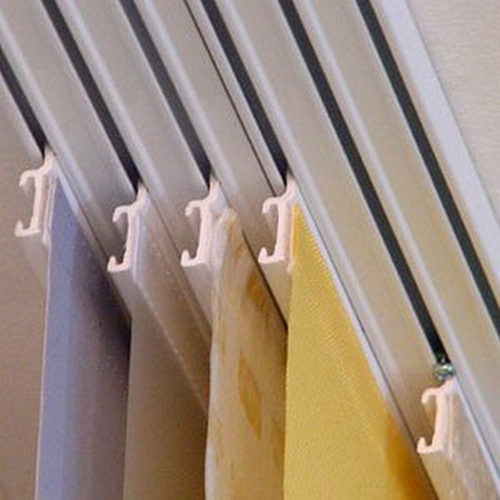
- To the bottom of each tissue strip, the tricks are weightlifiers, which also need to be purchased separately.
- It remains only to install the eaves and hang the canvas.

Japanese curtains panels do not need special care. To do this, it is enough to erase them in a delicate mode or vacuum, without removing. When washing, consider the characteristics of the material from which the curtains are made.
Useful advice: To keep the canvas every time, put the curtains, peel and hang on the place slightly wet - they straighten under their own weight, and you will save a lot of time.
For curtains made of bamboo or rattan, there will be enough treatment with a vacuum cleaner, and the plastic panels can be simply wiped with a damp cloth with a liquid for washing windows without alcohol.
Japanese curtains are becoming more popular, and now you understand why. This is a beautiful, convenient and practical element of the interior, which can be much more than just protection against direct sunlight.
Japanese curtains: photo