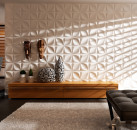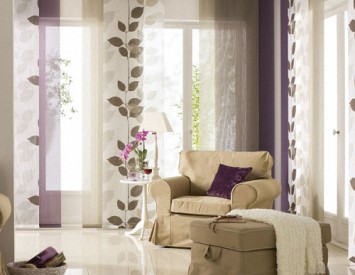
Many fans of Japanese culture admires their lifestyle, preferabity, hard work, equilibrium, as well as their food, aesthetics and technical innovations. The most interesting style of the interiors of the rising sun country: low furniture, sliding doors and narrow Japanese curtains. Lifestyle on the islands that regularly shakes and flushes, encourages how to make a modest housing arrangement even with solid delta. Japanese minimalism is very in demand from the famous designers of the whole world, and simple and amazing curtains can be made independently for the European interior.
Content
Features of Japanese curtains
Japanese traditional curtains are not like our curtains and curtains. They are deprived of folds, ruffles, fringe and other decorations, and more resemble tissue narrow panels, which are made from a dense and light translucent material.

Although there are no special taboos regarding print or color for Japanese curtains, the Japanese themselves love natural careless tones. The color of them, most often, has a poetic definition - the shade of blooming sakura, gentle bamboo shoots, etc. But Japanese curtains have width restrictions - no more than 60 cm for each cloth, which can be somewhat, moreover with different patterns. Because of this, large prints are not too wide, and if they are conceived from different panels, no more than 2-3 types of tissue are used, which among themselves harmonize and complement the image.
Browsing the samples of Japanese curtains in the photo, it is obvious that the eastern symbolism or hieroglyphs is not required here, although they are not excluded. The colors and attributes of the Japanese flag are rarely used, but red in combination with white is very appropriate. If necessary, man-made hieroglyphs are created on the panels, which are easiest to launch from the braid or stignify with printed print. Although the tissue strip is assumed not more than 60-90 cm, wide windows or a whole wall closes a combination of several sliding screens.
Japanese curtains are always the same length - almost to the floor. They are stretched without folds on special cornices. They do not move along ordinary, that is, they are not neurmed in the usual understanding, but only move along the window. That is why they are sometimes called "screen" or "panel" curtains. At the top of their perfect tension helps cornice, and they contain rigid inserts below.
They resemble wide blinds, the principle of fastening is about the same, and it is the Japanese curtains that they served for them. Such curtains can be completely fixed, combining transparent and dense panels, similar to the two-layer curtains for us. There are remote-controlled sliding designs and shuttered with a cord, like blinds. And although the curtains are removed symmetrically on both sides of the window, only one half can be caused by one half, for example, at the balcony door.
Fabric after tailoring of Japanese curtains braids well and stretches, like the screen. Usually they do not touch them, and in this form they serve for a long time. They are easy to add, holding down, but the capacity of the vacuum cleaner must be minimal. As the curtains are polluted, it is easy to remove, wash and hang it again. Sometimes to update the overall design, the part of the cloth is changed, creating a new look of Japanese curtains in the interior.

Decorative solution
The popularity of the design of Japanese curtains is explained by their multifunctionality. Shielding with rectangular tissue tunnels is used not only in the form of window curtains, but also as a screen or panels for the zoning of the interior, as well as for decorating the wall. For example, they can separate a personal space in a room for 2-3 children, hide the shelves for needlework or a place to rest an elderly person. In addition to windows, Japanese curtains can be used for door openings or to close the shelves and niches that have no door.
Adherents of Japanese minimalism and ecosil use Japanese curtains in the interior to hide from universal ferris, those things that do not fit into the overall concept. For example, a feed supply with aquariums for the breeding of fry or a corner with a sewing machine. When choosing materials, preference is preferred by natural tissues or a combination of tissues of different textures.
The canvas for the Japanese curtains in most cases are limited to 60 cm wide - there was an earlier standard of the drier of the canvas, but they have adapted special eaves.

Advantages of Japanese curtains
Japanese-style screen curtains have become an interesting alternative to European aesthetics in the design. They have a number of indisputable advantages:
- elegance and simple geometry, calm shades;
- they are suitable for windows of any width due to its combinators;
- sew the Japanese curtain set can anyone who owns the basics of work at the sewing machine;
- curtains save space;
- even budget fabrics are suitable for them;
- the curtains help to adjust the stream of natural light and air even in a primary form;
- help create a creative appearance in the apartment;
- do not require expensive fittings;
- they have no restrictions on the choice of fabric texture;
- on Japanese panels there are no folds and the possibility of dust accumulation;
- create a natural barrier to penetrate insects;
- they are rarely erased, it is convenient to clean them with a vacuum cleaner;
- special eaves will provide ease of use, including remotely;
- they do not need difficult care after washing and in stroking, fabric is repeatedly hanging and removed;
- ready cornices can be bought in catalogs or in stores;
- it is possible to use the advice of professionals - Japanese curtains master class.

Selection of fabric for sewing Japanese curtains
In the author's interior there will always be a place for creative accessories, such as Japanese curtains. They will benefit not only the Japanese interior, but also any modern design, depending on the color combination of the panels and the texture of the material. It is very interesting to alternate the soaked white panels of translucent texture and dark jacquard on wide window openings.
An excellent choice is to hang Japanese curtains between the kitchen and the dining area in the studio apartment, and you can separate the hallway and living room. The canvas from the washing material according to the type of Japanese curtains can also be used in the bathroom or in the bathroom.
Japanese curtains in the interior always emphasize the originality of the idea - from the conservative-classic to the most futuristic style, especially if they somehow beat them out. When choosing a fabric in color, density and texture, it is important to take into account the width of the cloth so that a large figure fit into the cloth without trimming. Monophonic contrasting canvases will help you to beautify the business office.
Usually, light fabrics, transparent and translucent for the screen type, the curtains are selected. It is important that they paste enough light and air from open framuga. The width of the cloth is limited to a special Japanese cornice, and in order not to practice the sidewall, it is easier to immediately buy a width cloth exactly 60 cm.
However, if they are attached to another way, for example, on the ceiling cornice, you can buy a cloth wider - up to 90 cm. The length of the eaves over the window opening will divide the number of intended cloth if the fastening is unconventional, for example, a bit of brass.
When calculating how much fabric is required for curtains, it is important to navigate:
- on the possibility of Japanese eaves;
- to the height of the wall and the required number of screens.
Next to the length of the cloth, approximately 10 cm per battery under the treatment of fabric from above and below. Remember that a rigid part is inserted into the bottom to maintain the form. There are 5 cm with cuts on the sides of the panels and on the side seams.

For classic Japanese curtains, narrow canvas are selected from natural fabrics, such as flax, cotton, silk or traditional canvas from bamboo fibers. You can also use jute and fabrics with the original weave of coarse threads. For modern eclectic design, you can make Japanese curtains with your own hands from those tissues that will be most appropriate in the overall idea.
Hard tissues are best kept form, do not stretch and not deform with long use. Under the planks-weighting agents for the bottom of the curtains hide a tree or metal, it is important that they fix the traditional form. Regarding the picture - it is better to take a nonsense picturesque print with the image of plants and animals, hieroglyphs and oriental symbols.
Japanese style classic - delicate and calm tones: white and blue, beige and brown, light green and sand, gentle pink or peach. Bright monophonic panels are designed to contribute to the traditional Japanese interior, cleanliness and general harmony. 3-2 bright canvas of yellow, red or orange are added to create an optimistic and cheerful mood.

Multifunctionality of Japanese curtains
Japanese curtains - original and multifunctional design solution:
- the window completely closed by a transluper
- when zoning the space, the curtains are used to separate different parts of the dwelling;
- experiments with texture and color helps to create a special coherent for the separation of personal space, emphasizing the personality of tenants;
- it is possible to use curtains for shielding jobs in a large office space;
- curtains help to create original design of doorways;
- well hide parts of the room to hide from universal ferris;
- act as natural protection against insect penetration;
- it can be used to design a nursery so that the falling care of the child is not distracted by the movement around the apartment of other family members.

Cornices for Japanese curtains
For Japanese curtains, ordinary eaves are not used, as they do not support the shape of the on-screen panel, and the movement of the stretched canvas is difficult to manually exercise. Thanks to special controlled eaves, Japanese curtains with a metal weighting agent on top are fixed on a velcro to rake moving with the help of a control device. The cornice has a different amount of controlled panels, it all depends on the maximum length of the cornice itself and the width of the panels attached to it - from 3 to 6. Correspondures consist of rails for which the panels are moved to the right and left.
Management of classic Japanese curtains was provided on a special cord that moved the panel. The system resembles blinds, and here you can use glass cables. But today they prefer the automatic control of the cornice with the remote control. However, Japanese curtains can not close for a long time, especially when the fabric is chosen in such a way that the curtain passes through a lot of light, but hidden visibility from the outside of the window.
There are different options for curtains for curtains, for example, on the screen of three or five panels there is a sufficient 3-band profile, and the 4-band profiles can be attached to 6-7 cloth. The maximum length of the eaves for Japanese curtains is 8 m, but if desired, it is possible to zoom in a row 2 cornice.

Curra and sewing of Japanese curtains
Japanese curtains master class is a workshop that helps competently make Japanese curtains do it yourself. You can find out the advice of professionals on video or study step-by-step instructions.
- We start with the purchase of a cornice required length to determine the amount of cauldons.
- Buying the fabric of the necessary pattern depends on the length of future screens, their quantities and points on the seams of 10 cm.
- The cutting strips of 60 cm depends on the width of the tissue - if the fabric is more than 130 cm, then you can carve 2 canvases from one piece at once.
- Natural fabrics give shrinkage, so it is better to make a slightly more cut. Then you need to wet, dried and stroke. If you wash the curtains in hot water, and rinse in the cold, shrinkage will be more.
- Side allowances on the seams make less than below and on top.
- The processing of seams begin on the sides, then flashing up to velcro. From the bottom it is necessary to sunmate quite widely to make the scene for a weight loss.
- To save time, it is more convenient to perform the same operations at once on all panels.
- Velcue's battery makes a small, up to 2 cm, and under the scene - 4-5 cm.
- The stitched chart is ironing first, then the velcro is attached. By the way, wet stroking in itself gives shrinkage. Especially carefully ironing the seams.
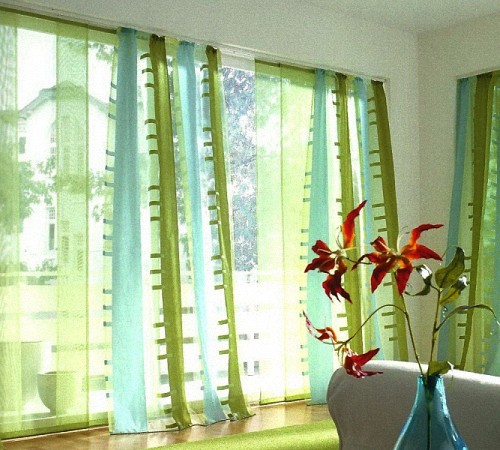
- On the upper slice of the canvas is applied by the front side of the velcro, evenly fastening the pins, and string. Then flex inside out and flash again.
- If the tissue is soaked, then all the cloth is not ironing, but only a little suture a little, laying a wet towel below.
- Now you can hang the Japanese chart on the cornice and to go craylers in the scenery. If there is nothing suitable for this purpose, you can hook a wooden stapper or a long steel knitting needle.

Tip: The difficulty of sewing is to make all the curtains of the same length. If there is a small difference, it is possible to correct on Kulisk.