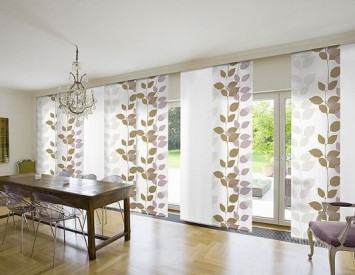
If you like non-standard solutions and want to realize your dreams to reality - to decorate the room with the help of Japanese curtains, then you need to think about choosing and installing cornice for Japanese curtains.
Content
Japanese curtains have recently been gradually gaining popularity - it is not only fashionable and stylish, but also practical. With this type of curtains, not only window openings can be reapged, but also decorate a niche, as well as divide a large room into several zones. It can be said that Japanese shores are a universal solution suitable for any room. No wonder they say that the Japanese are a very practical people, they try to think over every step in advance and therefore the design of Japanese curtains, like eaves, is a rigor and nothing superfluous. How to choose this important and practical part of the interior?
What is eaves and what is it necessary for what
First, let's deal with what is a cornice and why it is needed. The cornice is a special device attached to the wall or ceiling so that the curtains can be attached to the eaves.
It would seem that there is a difficult? Choose eaves - this is so simple, but in fact it turns out everything is much more difficult. It is important not only to choose this necessary attribute, but also to know how to attach it to correctly. Eaves are indispensable for any premises where there are windows or large openings, as well as niches. The cornice is used everywhere: both in residential premises, and in public (offices, banks, cafes, hospitals, educational institutions). In order for the interior of the room harmonious, it is very important to choose the right cornice. Since we are considering the question of how to choose a cornice for Japanese curtains, consider the types of cornices.
Correspondure designs for curtains:
- The design is simple, differs only by the number of guides. The two-row system consists of 2 tracks, which "go" canvas or curtains. The simplest option is great not only for the design of the window opening, but also in order to make a partition in a large room and visually divide the room into 2 parts. The panels can be placed both together, combine each other and do independently. If you connect both halves, then the curtain will move only one way.

- A cornice consisting of 3 rows is intended to strengthen several tissues (3 rows). The option is universal, you can approach the design of the room with a fantasy and lay curtains in different directions. Such a cornice will become an ideal find if you want the curtains "watched" each other or if your idea is to purchase several variants of Japanese curtains from different materials (for example, bamboo, rice paper in combination with linen canvases).

- A cornice consisting of four rows or tracks is designed to arrange several cloths on the eaves at the same time, ranging from light curtains and ending with heavy curtains. If you want to hide from prying views, then you should pay attention to such eaves with the ability to position in each row curtains with different material density. Four-rowed eaves are perfect for the design of basement and basement floors.

- The five-row design is more suitable for the design of large window openings. No exception - and wide doorways when you need to separate one room from another or visually reduce the space. With the help of five rows, various canvases can be combined, combining thin tissues, with more dense and heavy.

Correspondures for Japanese curtains. Photo:


How to control the eaves. Options
To fully understand the eaves control mechanism, it is necessary to have an idea and know what Japanese curtains look like. This is not quite familiar to many cloths fabric. Variations of Japanese curtains are a lot: it can be a thin tissue fabric, and any other, more dense material, only the way of hanging is somewhat different. Curtains are attached to guides that look outwardly resemble the screen. The lower part of the fastener of the cloth is a bit harder than the top - it is normal to create a small stretch when the curtains are deployed. You can control curtains using a special device - a special guide for a curtain or cord. If you are among those who love new items, then it is worth considering innovative civilization technologies - curtain management with automation.
Consider each option individually:
- Curtains on the eaves manually - when panels are independent of each other. You can move each canvas individually, the canvas (1-2 or more) during the movement of the neighboring canvase remain fixed. This is usually the 1st and last panel (front or rear), and the central can be moved manually.
- Dependent manual control - when each panel depends on the adjacent, that is, they will be moving only in pairs or groups. Suppose if you pull the hand for both cords (first-second or both panels), then these web curtains will close or open at the same time.
- Control of the eaves with the help of automation is an excellent solution for a large window opening with wide canvases. Such control will be as it is impossible for the combined curtains consisting of 3 or more strips (up to 5 pcs.). Manage such curtains is simple enough - you need to take a remote control panel and click on the button. The electrical wire itself does not significantly lose all the design, but here you need to be prepared for the fact that the wires will perform a little outside the eaves and if you look at, you will see the protruding wiring.

Materials
Currently, you can simply get lost if you go to the store for the cornice for curtains, without prior preparation. What should be the cornice for Japanese curtains? Of course, not only functional, but also beautiful. Materials for the manufacture of these devices are used different: ranging from standard and inexpensive plastic of light shades and ending with heavier materials, for example, metal. Correspondures can be not only plastic and metal, but also aluminum. A rich selection of colors and materials makes thinking. How to make the right choice?
Let's start with the fact that we consider the easiest and most affordable option - plastic cornices for Japanese curtains. The price of this adaptation is low, so the demand remains consistently high. To install karnis from 2 or from 3-weems, just plastic is the most suitable option. Suitable such cornice for a small window opening. It is best to manage curtains manually.

If you have conceived to arrange window openings using the curtains of different density and in several rows, then you need to consider a more durable version of the eaves, for example, aluminum or metallic. Such a cornice will withstand a large load and is not deformed even after a few years of operation.
If you wanted to install the automatic control system of Japanese curtains, then you need to purchase a durable metal cornice. This material is tested by time - it is processed by a special coating that pushes moisture, so even after 10 years of operation your eaves for Japanese curtains will look like new.
You can buy Japanese eaves in specialized stores, construction hypermarkets or order a suitable option on the site.
Mounting eaves with your own hands
You can cope with the installation of the cornice for Japanese curtains yourself, it is forces anyone. No need to invite specialists. The most important thing is to immediately decide on the location of the cornice, because you can fasten the fixture to the ceiling or install a wall-mounted cornice for curtains.
What you need to prepare for work:
- screwdriver;
- fasteners (usually included with the cornice);
- electric or manual drill;
- perforator (if you have to fix the cornice to the wall);
- rule and pencil.
Your actions perform in such a sequence:
- First you need to mark the markup so that the eaves can be set as soon as possible.
- Browse first attentively to the mounting place, step from the wall or pipe of heating (any other heating elements). Note that the curtains should freely be free and not to concern other items (windowsill, heating radiators).
- Pay attention to how the windows on the ventilation are opening and consider this distance when installing the cornice.
- According to experts, it is necessary to take a step between the mount from 0.5 m to 0.7 m, but here it is necessary to approach the solution of this issue individually. So, if the size of your window or door opening is greater, then the load on the eaves itself will also be big. Therefore, the step between the mount must be made every 30-50 cm. If the opening is small, then drill holes for fasteners of the eaves every 70 cm.
- Drill holes for fasteners and strengthen the cornice on the wall or ceiling, according to the designated markup in advance.
- Cornery, check your work - you need to push the bracket slightly stronger to enhance the load - if everything is in order, you can begin to the final stage - the curtain rip.
- After the curtains are in their place, you need to insert weights to the lower edge of the curtain and check the work of the eaves in action. Try to close and open the curtains several times to make sure that there are no noise - the curtains open freely and do not cling to anything.

As you can see, installing eaves for Japanese curtains and panels - the task is not complicated. Another thing, if you want to make Japanese curtains with your own hands - you will have to read more in the subtleties of this difficult process.
Eaves for Japanese curtains do it yourself
It is also quite realistic to make your own eaves for installation of curtains, it is also possible, in addition to the above-mentioned tool. Buy a ribbon plastic cornice (ceiling), you can immediately take on 2 or 3 bands. The cost of such a fixture is low, so it is quite accessible to each consumer.
Let us dwell on the choice of the length of the eaves: the room will look harmonious if we make curtains to the entire width of the room. Fabric for sewing Japanese curtains Choose a simple and not too heavy. For a large room (bedroom or living room) three-penetrating cornice is suitable.

As a strip, on which we glue the velcro, there will be an ordinary plastic transparent line. Since the width of each panel according to the standard is 60 cm, then find the same ruler will be problematic. It is necessary to buy the longest ruler (1 m), and then cut off unnecessary. By the way, if you planned to acquire an opaque cloth for curtains, then you can buy a line of colored plastic or metal.
We have 2 options for the manufacturer of the eaves: drill in the hole line, to turn the hooks (they can also be made independently from the wire), and then glue the rigid velcro to the line. Only glue should be used quality, PVA is not suitable. Or another option: to attach velcro on the hooks to attach the curtains on it (suitable for light fabrics).
All, the cornice is ready. It remains only to shoot the second part of the velcro to the curtain and check the cornice in action. Only after you attach guides (strips with velcro from a ruler or any other suitable not heavy material), you can fasten the cornice to the ceiling or wall.
Of course, this is the easiest option to create a cornice for Japanese curtains. Move the fabric will have to be independently, but you can actually save money and improve the appearance of the room.
Advantages and disadvantages of cornices for Japanese curtains
Functionality is the first and main plus of eaves for fastening Japanese curtains. You can choose a few bands to attach the curtains into several rows. In addition, it is important that you can independently adjust the direction of movement of the cornice and the system of spreading and shifting the canvas.
It also remains important that the curtains can be installed not only symmetrically, but also adhere to another direction.
It is very easy to care for the eaves, it is necessary to wipe the surface with a practically dry cloth to brush dust. Specially clean the eaves are not needed: metal, aluminum or plastic is easy to care.
From the minuses of eaves for Japanese curtains, only one thing can be distinguished - the complexity of the structure itself can be distinguished, but this lack of full is covered by other positive qualities of this important and necessary adaptation.

Choosing a cornice for curtains, it is important to pay attention not only to a spectacular appearance, but also to take into account that extra details in the room will be inappropriate. Japanese style is simplicity and nothing superfluous.