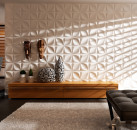
Linoleum is one of the most sought-after flooring for apartments and public buildings. It is inexpensive and durable material presented in a wide range. There are several types of linoleum, which are different not only in color, but also thickness and cost. In this article we will tell you how to choose a linoleum for a home or office and at the same time not to overpay for the finish.
Content
Characteristics of linoleumum
Initially, the linoleum was made of cork (wooden) flour, linseed oil, coniferous resins, lime powder and various natural pigments. The mixture of these components was applied to natural fabric or nonwoven material. With the development of technologies, some of the natural components were replaced by synthetics, but the technology, for the most part, remained the same. Due to the invention of new materials, linoleums have become more durable, durable and resistant to mechanical stress. Today in the market you can buy a linoleum for any needs, ranging from the floor covering in the living room, ending with the trim in the industrial premises.

The most important advantage of any linoleum is its low cost compared to other types of flooring. But he earned its popularity not only by this - the material is simple in laying, it is easy for it to care, and the variety of colors allows you to choose an option for any interior.
Linoleum characteristics:
- resistance to moisture and temperature drops;
- convenience in operation;
- low cost;
- almost does not require care;
- easy to put it with your own hands, even without professional skills;
- provides additional sound and heat insulation;
- serves from 20 to 50 years, depending on the type and operational conditions.
Linoleums are literally used everywhere, because it can be cheap and quickly create a comfortable flooring. There are several types of linoleum for sex, characterized by the scope of application. So, for public premises with high passability use general purpose coverage. In places with high humidity, for example, in pools or bathrooms it is better to lay anti-slip linoleum with special additives. And for gyms and gymnastic sites, sports linoleum tiles capable of absorbing falls are suitable, to provide a high-quality clutch of sports shoes with a floor and give the best rebound of the ball. There is even a special antibacterial linoleum for hospitals that prevents the spread of pathogenic microorganisms indoors. For residential buildings and apartments, it is recommended to choose heat-sounding products.

The operational features of each of these types of linoleum depends on which components are formed by its composition. So, we have already said that initially linoleums were made from natural ingredients, which then applied on the natural basis, but over time synthetic products appeared.
In addition to the natural and synthetic polyvinyl chloride linoleum, we will describe in detail below, there are also the following types:
- Gliptella - linoleum on a tissue basis with an alkyd mixture applied to it. It has higher heat and noise insulating characteristics compared to the usual PVC product. The peculiarity of the material is that over time the length of its fibers is reduced, but the coating increases into width.
- Nitrocellulosic - mostly subtle unduminarious coatings, characterized by good moisture resistance and elasticity. However, due to the lack of fundamentals, they do not have depreciable, heat or sound insulation qualities, as well as unstable to ignition.
- Rubber - reinforced linoleum, which has exceptional moisture resistance and high elasticity. The lower layer is represented by the pressed rubber crumb, glued with a bitumen, the top - a mixture of rubber, fillers and dyes.
Natural linoleum
About natural and polyvinyl chloride linoleums should be described in more detail, since these species are most often used for repair in residential premises. Natural linoleum is primarily good in that only natural components are used for its manufacture, which means it is completely safe in an environmental plan. For a natural linoleum, they make from jute fiber or nonwoven materials.

One of the main advantages after environmentally friendly is resistance to fire - it does not contribute to the spread of the fire. It is easy to clean even dry, and the service life is calculated by decades. At the same time, high-quality natural linoleum will not fade and does not lose its decorative properties for many years.
The material is not able to accumulate static electricity, since linseed oil is present in its composition. Because of the natural composition, it also has minor bactericidal abilities.

Important: Natural linoleum is resistant to domestic cleaning agents without alkali.
The only drawback can be considered a small plasticity of the material. For this reason, during transport, there should be sharp geeks, otherwise the cloth will crack.
PVC Linoleum
Synthetic polyvinyl chloride linoleum costs at times cheaper than natural and most often used when decoring residential premises. There are three types of PVC linoleum: classic, foamed and dubbed. The first is made on a jooty, felt or polyester. The foamed linoleum can be immediately recognized at its density and fortress, and in the width of the canvas usually range from 1.5 to 4 m. Duplicated material is usually made from vinyl on a nonwoven based.

Since PVC linoleums are pretty cheap, many choose them without failing to calculate the shortcomings. Meanwhile, all such products, with the exception of foamed linoleum on a fiberglass basis, give a shrinkage to 2% at high temperatures. Also, do not forget that these are synthetic products, and therefore consisting of unhetric components, therefore, there can be no speech on environmental friendliness. This can immediately be determined by the specific smell of a new linoleum (over time it is weathered).
For an apartment and at home, it is recommended to choose multilayer linoleums, as they have better heat and insulating indicators. The basis of such coatings is usually made of fiberglass impregnated with polyvinyl chloride mass. PVC-composition is put on the front side of this mass, after which the drawing and a protective coating of transparent PVC are applied. On the back of the base, they glue a special substrate from fabric, jute fiber foamed PVC or polyester. The role of the substrate is very important - it does not allow the linoleum to deform, shocks the blows when walking, absorbs the sound and protects against the cold.

Useful advice: Linoleum with a pattern applied by mechanical means will serve longer than the product painted by a chemical way.
Types of Linoleum Foundations
Above, we considered the varieties of linoleums, characterized by the composition of mixtures applied to the basis. But the foundations may be different, which also affects the operational qualities of the floor covering.

Types of linoleums depending on the basis:
- Homeless - Linoleums made without base. This is usually a single-layer material with a thickness of 1.2 to 1.6 mm, recommended for use in rooms with high humidity. There is such products cheaper than other species, however, because of a small thickness, it needs to be laid on the most accurate foundation, otherwise all potholes and tubercles will be noticeable. Sick up the undertaking linoleum is needed throughout its area, which means the glue will need more. The service life of such a coating is very short and is only 5-10 years, depending on the conditions of use and care.
- Foam - linoleums consisting of several layers and reaching from 2 to 3.5 mm in thickness. Usually such products are laid in the kitchen, in the hallway or living room, that is, in rooms where you most often need to carry out wet cleaning. The service life is 8-12 years. When installing it does not need to be sampled over the entire surface - only on diagonals and edges.
- Insulated - such products are best suited for bedrooms, children's rooms and other premises and a normal level of humidity. The base may consist of natural fiber or synthetics, but the thickness of the linoleum reaches 5 mm. Such a coating is well kept warm and absorbs noise, it is simultaneously soft and enough elastic. Specialists are recommended to carry out insulated linoleum labeling without joints - a solid web. Over time, the coating can expand slightly, which should be taken into account when laying and leave a strain clearance of several millimeters between the wall and edge of the canvas. Otherwise, linoleum can go waves.
How to choose linoleum
When choosing an outdoor linoleum, it is necessary to repel from the operational features of the room in which it will lie. So, if it is a kitchen, you need a moisture-resistant durable coating, resistant to frequent mechanical cleaning and applied by household chemicals. For the bedroom and baby it is better to take the highest possible linoleum from natural components.
What to pay attention to when choosing:
- thickness;
- composition;
- resistance to moisture;
- thermal insulation;
- resistance to mechanical stress.
Watch on decorativeness and cost is also needed, but last.
Take into account the future location of the linoleum, more precisely, the character of the load that will be on it in the future. For example, if you choose a coating for an entrance hall, it is necessary to focus on resistance to abrasion, since this is part of the house with increased permeability. The kitchen is also a popular place in the house where all residents are gather, but they usually go or barefoot, or in a soft home shoe, while in the hallway go to street shoes, which means the impact on linoleum is tougher.

There is a special classification that makes it much easier to choose a linoleum. It provides for the type of room and the degree of loads with which the material may rule. Each type of linoleum is assigned its two-digit number, the first figure of which means the type of room, and the second is the load value.
Types of premises:
- 2 - residential;
- 3 - office;
- 4 - production.
The load is determined by ascending, where 1 means that the material is not intended for serious loads, and 4 - linoleum can be laid in rooms with severe operational conditions. So, if you need to choose a kitchen coating, look for a linoleum with marking 24 (residential room with high loads), and linoleum 21 is suitable for the bedroom, because the loads are minimum there. The more people live in the house, the higher the load number.
Useful advice: If you choose a linoleum for residential premises or offices, where people will be most of the day, give preference to natural material, let it cost a little more expensive. At the same time, pay attention to the smell - if the linoleum exudes a sharp unpleasant smell, and the seller assures you that the product is environmentally friendly, it is better to refrain from such a purchase.
For any room, it is best to lay a solid piece coating so that the linoleum width corresponds to the width of the room. To do this, it is necessary to make preliminary measurements, given the deformation indents from the walls. When buying a linoleum, make sure that it has a certificate that confirms the safety of the finishing material for human health.

One of the most obvious advantages of linoleum is the widest choice of colors and designs. Modern manufacturing technologies allow you to create coatings with imitation of any surface and with any drawings, be it tree, marble or art mosaic. In the production of high-quality linoleums, pigments are used, retaining their saturation for many years and non-burning under direct solar rays. The most diverse in this regard are synthetic polyvinyl chloride products: linoleums for laminate, wood, stone or ceramic tiles.
The imitation of the elite piece parquet and the parquet board is especially popular. A detailed drawing on linoleum is able to reproduce the texture and color of the wood of beech, cherries, nut and other exotic rocks (Merbau, bamboo, rosewood, etc.). In this case, not only believable drawing can be reproduced, but even the texture.
Linoleum care
In order to maximize the life of the linoleum, it is necessary to start to care for him before the installation. To do this, it is necessary to provide careful transportation, especially if we are talking about a natural product that can crack. Store linoleum before laying you need in factory package or cuts, rolled into rolls. Put them on the ends in a dry and not too cold room. A few days before the laying, expand the rolls and allow the linoleum to be searched in the room where the repair will occur.

Useful linoleum care tips:
- Any linoleum reacts sensitive to a decrease in temperature and exposure to ultraviolet, so they are better not to store them on the balcony and not stack.
- Do not go on linoleum in shoes with rubber sole - it leaves complex spots.
- Although Linoleum does not miss moisture, pouring fluid is better to wipe it from it as quickly as possible, otherwise there is an unwanted spot in this place.
- When installing furniture on linoleum, put rubber washers under the legs so as not to damage the coating.
- It is not necessary to wash the linoleum hot water - so the drawing will sweep faster.
- Do not use sustainable cleaning substances or ammonia alcohol to eliminate stains, if you do not want to spoil the linoleum.
- In the first month after laying, try not to wash the linoleum wet rag, and wait for it to complete shrinkage. After that, you can wash it with water temperature with the addition of liquid detergents specifically for linoleum or parquet.
- To "refresh" the appearance of the linoleum, wash it with water divorced with milk in proportion 1: 1.
- In order to extend the use of linoleum, once a year, wipe it with sunflower refined oil odorless or oil.
Linoleum: Photo.