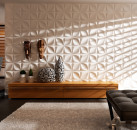
The use of stone finishes - phenomenon is quite popular. The building looks good, the service life of rock decorative parts is very long. The only drawback, in fact, is a high price. Artificial stone- excellent solution for the limited budget.
Content
- Interior elements that are performed from artificial stone
- Advantages of artificial stone
- Disadvantages of synthetic stone
- Types of artificial stone
- Glue, recommended for decoration of the room with artificial stone
- The most popular offers from artificial stone manufacturers
It is much cheaper than natural, but, at the same time, it is absolutely not inferior to a natural analogue, neither on decorative qualities or physical properties. And sometimes, the synthetic stone even exceeds in its qualities natural. So, for example, it is 1.5 times lighter than natural. Moreover, cracks and chips are found in the structure of natural stone, which is not typical for artificial materials. 
Artificial stone - composite material obtained from metal oxides and acrylic compounds and imitating natural stone, similar to it visually and physical characteristics. Materials of artificial origin are quite often used for interior decoration and for external decoration of buildings.

Interior elements that are performed from artificial stone
- Tables and countertops.
- Sculptural compositions.
- Fountains.
- Benches.
- Window sills.
- Mosaics and wall panels.
- Fireplaces.
- Decorative fences.
- Tile for sidewalks.
- Priest sides.
- Bar racks.
- Washing.
- Panels for wall decoration, etc.


Advantages of artificial stone
- Impact resistance.
- Lack of pores and cracks in texture.
- Low weight.
- Large service life.
- Hydrophobicity.
- Resistance to temperature changes.
- Resistance to the effect of chemically active substances.
- Easy installation.
- Low price.
- Aesthetics.
Disadvantages of synthetic stone
- Exposure to the influence of abrasive cleaning agents.
- The fragility complicating the process of transportation (characteristic only for some species).
Types of artificial stone
Methods for the production of artificial stone
Clamp production
This method implies the formation of a stone from a multicomponent mixture, followed by high temperatures on it. The derivatives obtained from the burned clay (ceramic) are used in the construction industry to create road surfaces, the construction of walls, the creation of foundations and overlaps, for masonry of fireplaces and furnaces, smokentying moves, for decorative floors of floors and walls.
Types of firing (ceramic) building materials
- Products of increased strength (solid). Suitable for the construction of walls, paving bridges, etc.
- Combined (porous-hole). It is advisable to use them in the insulation of heating planes, as well as for the arrangement of the premises inside and for finishing the external facades of houses with moderate humidity (but walls, it is still better to fly and bind, due to the presence of elevated hydrophilic properties of this material) and to fill the frames of high-altitude houses .
- Hollow. This type of building materials is made of particularly clean and more plastic clays of exceptional quality. Hollow bricks are usually burned at higher temperatures than solid. Such ignorant products are also used for the construction of walls and rebels, to fill the framework of high-rise buildings. It is advisable to choose such a hollow brick when laying hidden wiring, telephone and other communication cables.
- Hollow (multi-line) brick. In such cavity bricks, perpendicular to the working surface can have a different form. Hollow brick is much easier than standard.
- Ceramic wall blocks. The dimensions of such stone blocks are several times more than the dimensions of standard bricks. Void in ceramic blocks can be internal and through. On smooth lateral surfaces sometimes make grooves, which greatly facilitates the subsequent installation process.
Burst production method
This method is based on the natural thickening of the formed raw materials, or to frozen in special chambers when exposed to heat and steam. Another way is the fill of hot raw materials.
Types of artificial stones obtained by a leisure way
Silicate building materials
Basic raw materials for the production of such a type of materials - a mixture of quartz sand, water and lime. Silicate materials are five degrees of strength (75, 100, 125, 200, 250). Silicate materials are used in all the same building processes as ceramic. The difference lies in the unacceptability of the use of silicate products in rooms with high humidity (bathrooms, pools, saunas, gyms, etc.). You can not use them for finishing the heating surfaces (furnaces, fireplaces, etc.). By its structure and dimensions, silicate building materials are classified as follows:
- Bricks are single 65x120x250 (full and porous fillers).
- Thickened bricks 88x120x250 (full and porous fillers).
- Bricks hollow 138x120x250.
- Blocks wall silicate concrete. Such blocks greatly simplify the process of creating foundations, walls and partitions. There is such an overall and textural gradation of these products:
- whole - 188x190x390;
- longitudinal half - 188x90x390;
- partitions - 188x90x590.
Concrete materials
A basic mixture of such artificial stone building materials consists of a binding substance, aggregates, water and additives. This mixture is easily mixed, quickly thick and stone. To enhance the strength indicators, concrete can be reinforced with steel or synthetic fibers.
According to the applied binder, concrete is divided into:
- Gypsum.
- Cement.
- Silicate.
- Polymer concrete.
- Asphalt concrete.
Fillers involved in the production of concrete (gravel, sand, ceramzit, pempes, rubble, slag, rikushnyak, etc.) should be cleaned of third-party impurities, such as humus and clay.
Types of stone most popular in the construction sector
Ceramographic
Strong material, resistant to both high and low temperatures, visually more similar to the glass-ceramic, rather than on a stone. It is obtained by pressing method, under the influence of vibration and high pressure using the subsequent firing. Basic raw materials: clay of several species, spam field, mineral additives and dyes. Polished, glovenic, glazed, embossed, matte, glossy, structured tiles are often chosen for decoration of walls and floors, to build ventilated facades, etc.
The composition allocate:
- Homogeneous porcelain stoneware with a uniformly colored texture, which retains brightness over time and practically does not grieve.
- The scrolling porcelain stoneware, the structure of which is composed of two sucks. The first is basic, the second (thinner) pigmented. This method of creating a material allows to reduce consumption of fairly expensive painting pigments.
- Glazed porcelain stoneware is the same decorative tile, only on a porcelain strategic substrate.
Agglomerates (conglomerates)
Ideal imitation of such natural materials such as jasper, granite, marble, onyx, slate, lazuli, etc. Durable, frost-resistant materials, resistant to deformation effects. The main components of conglomerates are polyester resin, filler (marble crumb, quartz sand, granite, limestones dr.) And dyes. The disadvantages of agglomerates include susceptibility to abrasion, the effect of ultraviolet and acids. This material is not suitable for the arrangement of "warm" floors, because Resin, which is the base component, can melt under the action of high temperatures. True, today special conglomerates for such floors have been invented, where the resin is replaced by cement. Therefore, various products from agglomerates are particularly popular in construction. Decor elements, countertops, bathrooms, diverse facing (facades, walls, floors, ceilings, stairs, pools and bathrooms). This is not a complete list of areas of use of this type of artificial stone.

Artificial stone based on concrete
The most popular material for internal and facade finishes. The main components of such raw materials are cement (ordinary or portland), sand, plasticizers, filler (clay, pumice, ceramic crumb), reinforcing additives, hydropobicators and dyes.

Glue, recommended for decoration of the room with artificial stone
For interior decoration
- Tile glue on a cement basis.
- Acrylic sealant.
- "Liquid Nails".
For external work
- Frost-resistant and moisture-resistant cement-based glue.
- Frost-resistant glue "Liquid nails".
The most popular offers from artificial stone manufacturers
Corian.
Artificial stone Corian, created by Dupont, as a material that is ideal for home work surfaces. And this producer certainly happened. Characteristic features can be called a wide range of shades, the possibility of processing, the absence of visible seams. Corian is one of the types of artificial stone, widely used for the production of window sills and countertops, as well as for the decorative decoration of walls of the kitchen, bathroom and other economic premises. This material is often involved for construction work and in public areas (laboratories, sports halls, medical clinics, beauty salons, cafeterias, train stations, hotels, etc.)
Polystone
Artificial stone Polystone is a spectacular and durable analogue of a natural stone with advanced physical properties obtained from acrylic resin with the addition of aluminum hydroxide and dye substances. Such a combination provides a homogeneous texture without cracks and emptiness, i.e. The material does not absorb water and smells, does not rot and does not mold. This indicates that its use in places with high humidity level is quite justified. That is why Polystone so recommends connoisseurs for finishing the premises in hospitals, public catering sites, hairdressers, etc. This artificial stone is easily processed (cutting and polishing) at joining does not form a rough seams, a perfect match with wood and metal, which makes it possible to create exclusive items for interior decoration. Polystone resistant to mild acids and alkalis, ultraviolet radiation, as well as household products. He is perfectly safe, not radioactive, does not emit odor.
Montelli
Another Corian DUPONT from the company, which is constantly looking to expand its consumer sector, developing a new, more accessible products. So, Montelli - it is cheaper counterpart already described above Corian stone. Reduced prices due to Chinese production, which enabled cheaper wage labor than in the US. At the same time, it is quite sturdy surface that damage can be restored by grinding. Excellent hygienic properties and Montelli reasonable price you can use it in bathrooms and kitchens srednestaticheskogo inhabitants.