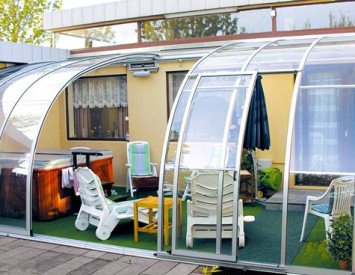
Most urban residents are owners of country sites - a quiet and cozy monastery for recreation away from noisy highways. And so that the rest in nature was not only useful, but also comfortable, you need to create suitable conditions. For giving the best option will be the arrangement of the veranda - a small room with a good overview, comfortable furniture and a relaxed atmosphere. The veranda can be built from almost any materials, but polycarbonate has been used by special demand. In this article we will tell why this material is ideal for the construction of the veranda, as well as consider the technology of the construction of the attached veranda to the house from polycarbonate.
Content
Product specifications
Polycarbonate refers to synthetic materials with a list of highly efficient qualities, and therefore - a wide area of \u200b\u200bapplication. It is appreciated for the convenience and simplicity of installation, the ability to withstand excess exertion and a large selection of forms and colors.

The advantages of polycarbonate as a building material:
- Can withstand strong temperature differences from -45WITH before +100WITH, So it is used in all regions of the country, even in the far north.
- It does not break from heavy shock loads. polycarbonate stronger glass dozens of times. Even if you get it to break (which is very difficult), the material does not shatter into fragments with sharp edges, and simply rip into several fragments, which is almost impossible to cut yourself. This eliminates the high traumatic compared to glass.
- Small weight polycarbonate can be used for the construction of structures on lightweight foundation, which significantly reduces costs. It weighs 15 times less than glass, but at the same time remains very durable.
- Polycarbonate does not burn or support combustion - in direct contact with fire it melts and self-extinguishing, preventing the spread of fire. Ignite polycarbonate in household conditions is unrealistic - its ignition temperature is 570S.
- The material is resistant to aggressive external environment - it does not pass water, does not burn under the scorching sun, frost does not crack.
- It is well pass light, while protecting from the scorching sun . light transmission polycarbonate ability can reach 86% (depending on the color and thickness). He partially absorbs ultraviolet radiation, protecting the skin from burns, so on the veranda of the polycarbonate to be comfortable even on a hot sunny day.
- With all his strength polycarbonate remains enough and flexible material allows you to create interesting architectural design. You can bend the panels at the desired angle on the spot without the use of special equipment, so the polycarbonate is very popular among the masters of self-taught.
From all of the above it is seenThat polycarbonate is ideal for the construction of the porch. Usually used for this purpose sheets 8 —10 mm thick.

I wonder: Did you know that the polycarbonate came up with the same man, who opened the Novocain? They were the famous German chemist Alfred Einhorn, who worked in the XIX century in the University of Munich.
types of verandas
Any construction should start on paper. First of all you need to do a project of polycarbonate verandas, and in your power to give any form of construction. Not necessarily limited to the usual geometry - make annexe oval, round, wave-like or any other form - polycarbonate opens up new horizons for the construction of their own hands. With it one can become an architect and designer.

There are built-in and attached verandas. The first is often erected simultaneously with the house on a single foundation and often under a single roof. In the second case, under the veranda, it will be necessary to equip a separate foundation. Among the attached verandas are very popular terraces. Often these are open designs typewhich visually increase the area of \u200b\u200bthe house and perform useful functions. So, the terrace is both a place to relax, and the porch, and the protection of the walls and the foundations of the house from precipitation. Polycarbonate for the construction of an open veranda is suitable as it is impossible. It makes space yet more easy and air. For the roof, a more durable cellular polycarbonate is used - this is a sheet inside which there are ventilation gutter, accusing strength and not allowing to form condensate.

If you live in a cold climatic zone, it is better to give preference to a closed veranda, making the walls of the same cellular polycarbonate. In addition to protection against rain and wind, it will help maintain heat inside the room, due to its air layer inside.
Dignity and disadvantages of material
To summarize all the information outlined above, we propose to designate the advantages and disadvantages of the attached polycarbonate veranda. The first and most important thing - construction from this material costs much cheaper than from any other. This is poured not only in the price of polycarbonate, but also the installation method and low load on the foundation. For very small and lungs Veranda Some do not even make a "real" foundation at all, but simply put on a drainage pillow in the ground the usual fence or road slab from concrete on which I mount the framework.

Even you arewe took a practically transparent light polycarbonate, in the summer on such a veranda will not be very hot, because the material dissipates most of the rays. And in order to provide the influx of fresh air into a closed room, several ventilation hatches can be made in the polycarbonate ceiling. To create a dense cool shadow, use blinds. In the case of polycarbonate, even the most ordinary plastic models will look harmoniously.
To heat such a veranda in winter, it is enough to use infrared films. In the daytime, they will help to save a lot on heating. In other words, make a microclimate in a polycarbonate veranda is comfortable not so difficult and consistent.

Of the disadvantages of such buildings, it is possible to distinguish the fact that in winter, the roof polycarbonate veranda needs regular cleaning from snow, moreover It is necessary to do it very carefully. Do not use iron scoops, brushes Or shovels not to scratch the surface. Otherwise the material will lose the same svetopropuskaya Ability and protective characteristics. Wash the walls of the veranda can be only delicate means that are not containing alkalis and caustic acids.
Pluses the polycarbonate veranda is much more than the minuses, so throw away all doubts and proceed to construction.
Build a veranda
Build a veranda of polycarbonate with your own hands is much simpler, cheaper and faster than from any other material. But first you should clearly Representing what you will use this room. So, from the veranda, it is not only a place to relax and leisureBut also a functional pre-banker. Adjust her to the entrance to the house and in nem. It will be much warmer even the most severe winter. If you like plants, you can make a greenhouse from the veranda or even a winter garden. Then, of course, an additional ventilation system will be required that you need to consider in the project.

Important: The area of \u200b\u200bthe room should be more than 12 m². If you do less, the veranda will be too tiny and inconvenient, it will be difficult to get difficult and accommodate the necessary furniture.
Polycarbonate mounted on a pre-prepared frame. For its construction, you can use wooden bars with a large cross section or metal rental (steel or aluminum). It is very important to organize the right bias of the roof - it should be at least 30 °. The slope is calculated individually for each climatic zone and depends on the number of seasonal precipitation, wind load and other factors. This information is described in more detail in the appropriate SNIP.
Foundation for greenhouse
As we have already spoken earlier, the polycarbonate is distinguished by low weight, so it is at all necessary to put a powerful expensive foundation for the construction of it. In this case suitable lightweight (small-breed) Ribbon, columnar or pile option. When choosing a foundation, consider not only the weight and dimensions of the future veranda, but also her Purpose. For example, if you are planning to place inside heavy Furniture or many pots with plants, it will give an additional burden on the base.

What types of foundations are suitable for the veranda:
- Slab - for large and heavy veranda. The most expensive version but Provides an even base and guarantees the durability of the design.
- Tape small-breed - most common solution. Make such a foundame nT seeeven an inexperienced builder. From the materials you will need only rubble, cement, sand and formwork boards.
- A columnar foundation is more applicable for open or small closed veranda.
- Pile - very common Type of foundation lately. Installing piles by professional workers takes only a few hours, after which you can immediately start montau Frame and Polycarbonate Polycarbonate. Thus, the veranda can be done in just 1 —2 days.
Consider how to equip the foundame nT DLi am a small veranda. Support poles can be made from concrete, brick, wood or pipes. The main advantage of this type is that the base is completely autonomously and does not come into contact with the foundation of the house, it can be attached from any side and increase if necessary, only adding the required number of columns.

Progress:
- If You make pillars from pipes, cover them before mounting an anti-corrosion agent; if From wood - antiseptic, plus a dear one centimeter with liquid bitumen or mastic.
- Make marking at the site of the construction of the veranda and dig the pits around the perimeter. The depth of the holes should correspond to the depth of the main foundation, and the diameter is slightly larger than the diameter of the pillars.
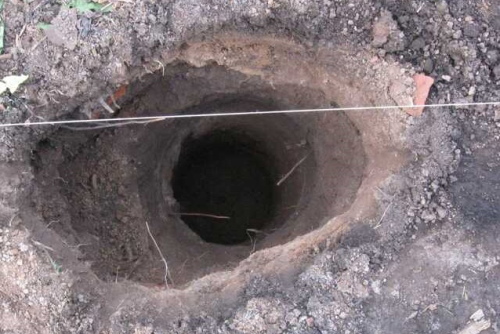
- Pour on the bottom of each pit 15 —20 cm of river sand and thoroughly confuse. Such a drainage will not allow underground and sedimentary waters to destroy poles.
- Install the pens in the pits strictly vertically, checking the position with the help level. If you make concrete supports, then a wooden formwork is first installed in the pits, after which hERE Poured concrete. To increase strength to the center of each concrete column, a thick reinforcement rod is placed.

Screw piles are convenient because depending on the specifics of the landscape, you can adjust their height without additional difficulties, soil alignment and etc.. If your site is on the slope or has a hilly relief, it is better to make a pile foundation than spending time to create a flat site.
Installation of polycarbonate
The glazing of the veranda polycarbonate can be made both vertically and horizontally on wooden bars or metal profiles. If you make an open extension, then you need to install only print For roofs on support pillars. If you want to close the veranda polycarbonate, okeekhet (Frame) is required not only for the roof, but also for walls. Polycarbonate - a very durable material, but to a veranda lasts a long time, it must be properly fastened. To do this, set the beams lathing steps from 60 to 80 cm, and the supporting columns should be separated by a distance 1 to 3m (Depending on the sheet thickness and verandas dimensions).

Attaching the polycarbonate to the frame are two methods - wet or dry. In the first case, only use screws and other fasteners, the second is added to the silicone sealant.
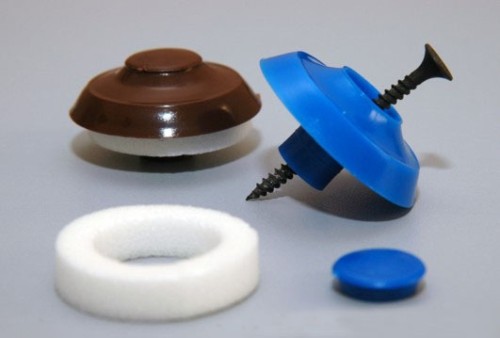
Important: Before how set polycarbonate sheet, it is necessary to make a layout for fixtures, drill a hole with a diameter slightly larger how screw, and only then fasten to sheathing. Be sure to use protective pads (thermowashers), so as not to damage the surface of polycarbonate with metal fasteners. Do not overtighten the screw, otherwise the material let's got Treschina, or he sag and start collect moisture in this place. Observe the distance between the anchorages 30 —40 cm. The picture shows how correctly screwed screw in the polycarbonate:

How to make a porch made of polycarbonate:
- Begin with the installation of panels from the left edge of the wall. leave a small gap between adjacent panels 3 —5 mm - then it will fill the sealant. If you are using honeycomb panels, stack them vertically and do not cover the lower part, so that condensate can drain freely through the channels inside the sheet and go outside. For the isolation of the lower end of the panel, use a special perforated tape. She will not let dust and debris to get inside and will not retain water.
- Before installation, each panel should be a special glue continuous tape, covering the upper end portion, to go no water, dust or small litter. Also for this purpose, protective strips.
- Do not remove the film with polycarbonate to complete the installation work! Place the panel so that film located outside the room.
- Make markings for IU article crepleniya on the frame and on the panels. Use self-tapping screws of stainless steel, or after the first rain they start to rust. For fixing the monolithic slabs to the frame using metal profiles or weather-strong glue.
- After the installation of the walls and the roof, the joints between sheets fill transparent silicone sealant or cover trims, linings.

As you can see, the work very simple And for the successful outcome of the case, you only need to deal with the features of the fastening of sheets. Finally, we suggest you to view an interesting video about the assembly of polycarbonate veranda:
Polycarbonate veranda: Photo