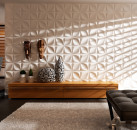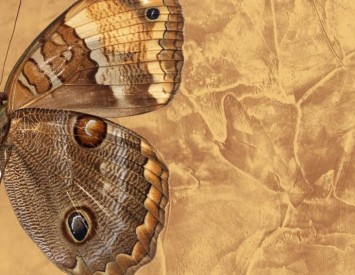
Venetian plaster is a special finishing material for the decoration of wall surfaces, columns, partitions, etc., which gives them a specific and spectacular look. In addition, the plane processed in this way has unique physico-technical properties.
Venetian plaster on their own? Our master class will make the embodiment of this idea to reality. But for a start, a bit of theory.
What is Venetian decorative plaster?
This type of building material is used to finish the wall structures and receive it from the waste of various breeds of natural stone.
Such a special crumb base can be obtained from:
- Granite.
- Marble.
- Quartz, etc.
What the interior, created using Venetian plaster, will clearly demonstrate the photo:


Composition
The proportions of the compositions, the size of stone particles and complementary components may vary, but the basic components of modern Venetian plaster is unchanged:
- Crumb produced from stone raw materials. The less the diameter of the stone particles, the better the material falls, and the easier it is to apply it.
- Binder. Initially, harated lime was used as such a component. Today is acrylic.
- Painting component. The ideal option is considered natural dyes on mineral base. However, today they almost replaced artificial analogues. Dyes should be entered into a suspension shortly before applying.
- Water.
Consistency
After mixing all components, a creamy substance should be formed.
What surface can be separated by Venetian plaster?
- Concrete.
- Wooden.
- Brick.
But, unambiguously, this surface must be clean, smooth and smooth.
Properties that are highlighted by Venetian plaster for wall decoration
- Transparency.
- Moisture resistance.
- Strength.
- Air permeability.
"Pros"
- Stunning visual effect, imitating natural textures.
- Durability (service life of approximately 15 years).
- The solid breathable protective layer is not destroyed under the influence of moisture.
- The ability to create a decor of any color and texture, taking into account your personal tastes and preferences.
- Ecology and fire safety.
- The possibility of restoration of the coating.
"Minuses"
- The need for particularly thorough preparation of the decoration plane (due to the transparent texture of the coating created).
- The complexity of application.
- Horregious.
True, if you still decide to apply Venetian plaster yourself, the cost of decorating will be reduced at times.
Technology of applying venetian plaster
This process, of course, is not for complete profans in the field of construction and finishing. The presence of elementary knowledge, fantasies and basic skills are welcome. In order not to start fulfilling the task to blindly, we offer to view the selection of rollers on the topic "Venetian plaster. Video lessons on applying ":
What needs to prepare, starting work?
- Wide spatula (200 mm).
- Narrow spatula (60 mm).
- Trowel.
- Sponge or suede fabric.
- Dishes for mixing components.
- Rag.
- Construction mixer or drill.
- Sand paper or grinding machine.
- Stone crumb.
- Binder.
- Color.
- Putty.
- Grinding with quartz filler.
- Wax.
Nuance! The edges of the spatulas should be rounded and carefully polished, so as not to create unnecessary defects on the decorating surface.
Pre-processing of the wall plane before applying plaster
This stage for this decoration technology is very significant, because The layer of the coating of a small thickness and any defective defects will be visible. Therefore, this preparation is responsible.
- Clean the surface from the garbage and the remains of the previous coating.
- Survey it for possible cracks and chips.
- Sharpen all defects and irregularities.
- Give dry.
- Severy, leveling and smoothing the surface.
- Scroll. You can add that color to the primer, which is going to enter into a decorative plaster later.
Creating a decorative mixture
- Mix all components (crumb, binder and dye).
- Slowly thin flowing pour water, stirring all the time to the consistency of sour cream.
- You can experiment with proportions using small volumes of materials for this. By the way, the process of application itself is also better to preliminarize on a small table.
Another option:
- Buy the finished dry mixture.
- Dilute it with water.
- TOOLS SHAVE, OPUGE OF CONSTRUCTION MIXER.
- Let break some time.
- Stir again.
- Enter the dye, stirring.
Nuance! To create more homogeneous mass, use water, not colder than 10 ° C.
Process application
- Plaster Apply a few thin layers with a thickness of about 3 mm.
- After creating each layer, carefully dry it and grind it.
- The first layer is the main, defining the tone of the entire coating, the remaining layers are decorative.
Final processing
Using Venetian plaster, you can get a glossy surface or matte. In the first case, the wax treatment is used to achieve the desired visual effect, in the second - smoothing of the material applied by a special spatula. As a result of friction under the influence of heat, the formation of a durable polymer crust occurs.

There are many different ways of applying Venetian plaster. From what you choose, the final result will depend on. Describe this process is in vain. This is exactly the case when it is best to see than hear than a hundred times. Look in the video video, look and learn! And remember, everything will succeed!