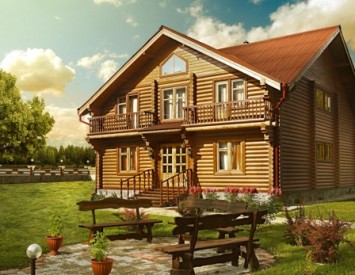
Since ancient times, wooden houses and buildings from the church of the tree have a special value. They are beautiful and durable, and most importantly - absolutely safe for the environment. Recently, more and more often the owners of the cottages are chosen for the construction of country houses a tree.
Content
Most of us dreams of resting away from the city bustle not only in the summer, but in the cold season. Relax in a wooden house in winter is unlikely to succeed, because centralized heating is not provided in such houses. That is why the insulation of the walls of a wooden house is considered very relevant.
Many believe that if the house is built from a natural tree, it should not be insulated. On the contrary, it, as a brick, requires insulation of the walls, because wood can not provide a good level of heat shields.
When the walls are insulated outside the wooden house, the hosts will receive maximum comfort. And if the house will be protected by temperature drops, its operational period will be significantly higher.
With a positive solution to the insulation of the house, many people appear questions - starting with what kind of insulation to give preference to which choose materials and how to perform independent work on the warming of a wooden house.
On the advantages and disadvantages of insulation
Often when it stands about the insulation of wooden residential buildings, then experts advise to warm the house outside.
This is due to a number of reasons:
- the inner area of \u200b\u200bthe house does not decrease;
- a wooden timber is protected from the effects of atmospheric precipitation, as well as from temperature drops;
- through the layer of insulating material, the moisture can freely circulate and go out;
- inside the house will continue the unique aroma and the texture of natural building material.
Of the shortcomings of the insulation of the inner walls of wooden houses, experts note the following:
- the area of \u200b\u200bpremises inside the house becomes less;
- condensate often accumulates between the insulation and the wooden wall in a cool time;
- if the insulation is located incorrectly, the wall will be in a cold atmosphere - which means that it will later begin to crack, and the tree will split.
In addition, it is necessary to warm the wooden houses according to a certain technology. So, insulating materials must be located on this principle - "to bring out the moisture from the inside - outside." Therefore, the first layer of the insulation must be vaporizing so that the flow of wet air does not fall into the room.
After laying the first layer, the second - thermal insulation should be installed. It will contribute to the preservation of warm air inside the house. The third layer is waterproofing, will allow you to keep moisture and will skip steam.
Warming from the inside or outside?
Before you begin work, you need to decide how to insulate the house - from the inside or outside. The insulation of the walls of the wooden house from the inside is recommended to be performed if the owner of a wooden house does not want the walls to lose their natural look. But at the same time, the method must be remembered that the main wall that is under the insulation will be in the low temperature zone. At the same time, the likelihood that condensate will appear between the insulation and the wall, which can promote the reproduction of mold fungi.
In addition, it is worth paying attention to how the wooden ram of indoors is laid. If round overlaps are not tightly adjacent to the wall, then in these places it is impossible to install the insulation. Language builders This term is called both "cold bridges". In these places, heat will be lost very quickly, and the heat loss factor often exceeds heat performance throughout the wall perimeter.

With the outer insulation of a wooden house, you can get a uniform temperature distribution in the area of \u200b\u200bthe entire wall. The temperature and accumulation of moisture affects the selection of thermal insulation materials. So, dense materials will not pass water vapor inside the room. Lightweight and porous must be installed outside. If the wall is insulated outside and high-quality materials, it will allow to obtain high thermal insulation properties.

Types of insulation
Popular views of wood houses insulation:
- Mineral wool.
- Equouthat.
- Styrofoam.
- Penophol.
Minvata is an easy, fast and relatively inexpensive insulation.
Benefits of mineral wool:
- does not burn;
- good "holds" heat;
- soft;
- elastic;
- just stack;
- withstand large temperature differences.
For the insulation of wooden houses outside, the owners often use mineral wool. It is produced in several versions: mats, plates and rolls.
This material fills all empties well. First, the frame is formed, which is filled with rolled cotton. Additionally, it is not necessary to mount the minvat to the carrier frame, it will keep well.
From above on the insulation, you can heal a new board and, if you wish, perform the lining of the house by siding.

Equata consists of antiseptic and natural fiber - cellulose. It successfully withstands the test of harsh frost and strong winds.
Among the advantages of this insulation are marked:
- environmental friendliness;
- prevents the formation of mold;
- this material will not bite the mouse and other rodents;
- used to insulate the room outside;
- the wall under the insulation "breathes";
- the material is not lit, but only the tweet, it does not allocate toxins.

The inner walls of houses are squeezed by foam. Warm walls are not recommended from the outside of the house with this material, because the foam does not let the air. Therefore, when the walls of the walls inside a wooden house there may be condensate, mold mushrooms, and the tree will become subjected to rotting. With the insulation of the walls of the wooden house, the foam is first installed the framework of the rails to ensure the air layer, and then fasten the foam plates (the thickness of one plate is five centimeters) with special solutions or fasteners.

Wall insulation methods
On this photo you can see the order of the insulation of the walls of the house outside:

The sequence of work is as follows:
- Vaporizoation. This layer will allow ventilation under the film. If the facade of the house is composed of a round log, then the material can be attached immediately to the tree, but there will be large gaps. If the surface is smooth, then the rails are nailed to it (the thickness of the wooden rail - two and a half centimeters). Distance between each rail should be about one meter. For vaporizolation, it is necessary to prepare rubberoid, foil and a special film. Materials are fixed on wooden rails, providing at the top and bottom of the opening for the free air flow. The diameter of the holes is two centimeters. Attention! In places of attachment of nails or brackets require additional sealing.

- For the arrangement of the wooden frame, a wooden board is used with a width of ten centimeters and a thickness of not more than five centimeters. The boards should be knit vertically at a distance of one or two centimeters from each other. So you can prevent the formation of emptiness and cracks.

- Laying the heat insulating layer. If you chose EcoWhat as a insulation, then additional use of the jilling machine, which will allow you to apply the material on the wall to the smooth layer. Remember that in this case the laying of the vaporizolation film will not need. When using boards, they should be tightly put in a wooden frame. To achieve this, you should choose semi-rigid plates whose density is one hundred twenty kilograms per cubic meter. To ensure the density of the fitness of the material, it is necessary to lay the plates in the "chess" order.

- Laying a waterproofing layer. To do this, you must purchase a vapor-proof film, which will skip pairs, but avoid getting it on the heater. Installation of the film is the same as the installation of a vapor barrier layer. After the completion of the board should be installed, which will allow to evaporate condensate falls on the waterproofing layer. In this case it is possible to use wooden slats thickness of two to three centimeters wide - five centimeters.

To provide additional protection against insects and rodents, it is necessary to set fine-mesh metal grid. And in the case of laying mineral wool, this condition should be done necessarily.
After the work on the outer insulation of a wooden house, it is necessary to define the outer skin. You can fill the top wooden planks, battens of pine or oak. In this natural building material to be processed and lacquering.
Method mezhventsevogo home insulation
Mezhventsevy insulation improves thermal insulation of the house, protects from damage and extends the life of a wooden house. A distinctive feature of this type of insulation is that it must be laid between the wooden beams in the process of building a new home.
For insulating tape insulation is applied. It consists of natural materials - flax, which combines perfectly with the tree, and at low temperatures does not lose its properties.

It prevails that the natural material is able to fill the timber irregularities Among the advantages of this type of heater. If the voids are large, then in that case you can put two layers of insulation. You can also fill in the gaps that appear during the installation of windows and doors.
Advantages of the material:
- it possesses sound insulating properties;
- resistant to moisture;
- does not rot;
- it does not constitute a mold;
- elastic;
- it has a high strength.

Among the deficiencies noted the high cost of a heater. In addition, if the house is located in an area with harsh climate, in this case a natural heater is not enough and should be additionally insulate interior walls with foam or penofolom.
Wall insulation wooden house penofolom
Penofol - a multi-layered material, which belongs to the class of reflective insulation. It consists of polished foil (up to ninety-seven percent reflectance) and foundations. The base can be of varying density and structure.
The thickness of the standard material may vary from two to ten millimeters. In the harsh climatic conditions it is necessary to use a 40 mm thick foam.
The principle of operation of the insulation is similar to the work of the thermos. In winter, it will be warm in it, and in the summer - cool. Moreover, the material will not delay the heat being indoors, and will reflect it.

The advantages of the insulation:
- environmentally friendly material;
- the material is thin, so an additional space will not be clogged when the walls are insulated from the inside;
- additional laying of vapor insulation materials is not required;
- does not absorb moisture;
- it has noise insulating properties;
- convenient to transport;
- "Not interesting" rodents;
- he has certification - the conclusion of SanEpidemstation.
Of the shortcomings, experts mark the softness of the material, so it cannot be laid under the plaster or secure under the wallpaper. It is very difficult to fix an ordinary foam (exception - material with self-adhesive film) directly to the wall itself.
Materials attached to a wooden frame with a furniture stapler. If you put the sheets of the mustache, then you can get the opposite effect and the additional accumulation of steam on the walls of the premises.

When laying insulation outside a wooden house, you must prepare an airbag consisting of a wooden frame and metal. After laying the foam on the surface, the buildings of the building should be made by siding or other suitable material.
How to perform insulation of the walls of a wooden house, look at this video: