Flat roof is an inexpensive and practical way to arrange any structure. Often it is erected over multi-storey residential buildings, industrial facilities, garages and extensions (verandas, terraces). In the case of residential houses, a flat roof must be insulated, otherwise it will be a little sense from it. It is about this that we will talk in today's article - insulating a flat roof with your own hands.
Content
Features of insulation
The need for roof insulation, including flat, is obvious - anyone familiar with the concept of convection from the school course of physics should understand that the air, heating, rushes up. If it will not meet a worthy barrier at the top, it will restore the room freely. In other words, all efforts to warm the house under the flat roof will be reduced.
However, the useful sides of the insulation of the roof do not end. In addition, the thermal insulation delays warm air, it prevents the occurrence of sudden temperature differences inside the roofing pie. Let us turn out all the same school courses of physics. When the cold street air faces heated flows raising from the house, the reaction creates condensate - the smallest water droplets. Accumulating, condensate impresses the layers of roofing pie and wooden elements, provoking their quick wear. For this reason, the styling of alone insulation under the roof washing is not to do - it is necessary to protect its vapor barrier membrane, which will divert condensate from thermal insulation and promote its rapid evaporation.

It turns out that the device of insulation of a flat roof involves the use of not only thermal insulation material, but also vaporizolation. The order of laying depends on the type of roof. Flat roofs are classic and inversion. In the first case, the carrier plate is based on the steam barrier, and then the insulation. It, in turn, is closed with rolled waterproofing based on bitumen. It simultaneously protects the insulation from moisture and is a finish coating. Such roofs can be found on multi-storey buildings in any city. It is also worth mentioning that the classic roof can be operated and non-exploitable. As it is clear from the name, the operated roof can be used, that is, the equipment there is furniture, furniture, to make superstructings, in general, to use it fully as an additional surface. The coating of the non-exploitable roof is not adapted to high loads, but the insulation of both the species passes through the same scenarios.

The inversion roof in the technical performance is much more perfect traditional. First on the carrier plate poured a layer of gravel, ceramzit or rubble. The powder thickness should be at least 5 cm. The waterproofing is placed on such a drainage pillow, then the insulation is poured all with concrete and covered the screed with the finish material. The main difference in laying insulation over waterproofing, which allows you to protect the hydrophobic layer from destroying ultraviolet rays, temperature differences and mechanical damage. As a result, the inversion flat roof serves a lot longer traditional and automatically becomes the exploited - a durable concrete screed (especially if it is reinforced) allows you to arrange space for recreation and open-air sports.
It should be borne in mind that the insulation, as well as on all other layers of roofing cake, will be provided with various types of loads: the weight of snow, the strength of the wind, the mass of the overlying materials, etc. Because heated physicomechanical requirements are presented to insulation for flat roofs. In addition, experts strongly recommend choosing the most hydrophobic material, since it is impossible to guarantee 100% protection of it from moisture. Learn more about the choice of insulation, we will talk a little later.
Methods for insulation of flat roofs
The insulation of flat roofs is carried out according to one of two schemes: in one or two layers. Single-layer insulation is relevant for industrial buildings, garages and warehouses. Suitable for exploited and non-exploitable roofs (in the first case, it is necessary to preserve the reinforced concrete screed with the finish layer). The placement of the insulation in the same plane gives moderate protection against the appearance of condensate and excessive heat loss, but the microclimate is comfortable for the cozy life allows only two-layer insulation.

The two-layer insulation scheme, as can be guessed, assumes laying two layers of heat-insulating material in different planes. The lower main layer should differ in thermal resistance at low strength and thickness from 70 to 170 mm. The top layer is responsible for the distribution of the mechanical load over the entire surface of the system. Its thickness is substantially less than that of the lower layer, and ranges from 30 to 50 mm, but it has high compressive strength and break. Such functional distribution of two layers of the insulation significantly reduces the mass of roofing pie in general, thereby reducing the load exerted by the roof on overlapping and the foundation.

Selecting the insulation for the roof
For insulating flat roof outside use a variety of materials, but after examining the above information, we can already identify several key selection criteria. Firstly, the maximum water repellency. Secondly, the strength and density. Thirdly, in light weight features. Consider the materials used in modern construction.
Most often in the city and private construction Sediment used materials because of their cheapness and availability. It is about Leca (high pressure foamed clay) and pearlite (light coarse sand with good insulating properties). Unfortunately, the low cost and availability advantages of these materials and limited - by other parameters, they are not able to compete with fiber or polymeric insulators. They are relatively heavy, and with their help create a perfectly flat surface at a slight slope is difficult.

The second most popular is mineral wool and polystyrene. Mineral wool holds heat well, is easy to operate, does not burn, but it needs a high-quality waterproofing - if it gets wet a little bit, it will cease to be protected from heat loss. Extruded polystyrene is not afraid of water, is highly durable, easy to install and relatively low cost. However, it is better to use to create an inversion of the roof, because the material is very sensitive to the effects of ultraviolet light and has a flammability.

.Not so long ago it appeared on the market in mineral wool slabs made of basalt rock. It is much stronger in compression and tear than older counterparts, are not so much afraid of the water and allows you to create a sufficiently durable coating without the arrangement of the heavy concrete screed.

Finally, the newest, high-quality and expensive insulation is polyurethane foam. A special composition is applied to the prepared surface by mechanical spraying, after which it is foamed, solidifies and provides a solid crust waterproof perfectly retaining heat and unresponsive to ultraviolet. In the West, the polyurethane foam has long been used for thermal insulation of roofs, including flat. In our latitudes it benefits only began to appreciate.

Pros of polyurethane foam for thermal insulation of roofs:
- a very low thermal conductivity (0.022 W polyurethane / m² mineral wool 0.055 W / m²);
- requires minimal surface preparation (cleaned from garbage, you can not align and do not process);
- for high-quality insulation, a layer with a thickness of 5-6 cm;
- absolutely seamless coating, which eliminates the formation of potentially risk places of leaks and drafts;
- absolute hydrophobicity and countertility (saving on hydro and vaporizolation);
- spraying can be used to create additional waterproofing;
- high rigidity of the frozen coating allows you to equip the concrete tie over it;
- relatively low density (does not give a strong load on carrier elements);
- environmental Safety;
- the possibility of covering surfaces and objects of any form (it allows to protect against leaks and heat loss distant places of pipe output);
- does not burn and does not support combustion;
- service life for more than 25 years;
- high speed of work.
Thus, polyurethane foam replaces the insulation, and steam, and waterproofing. The only drawback is to do this work with your own hands, since this requires a special technique and the skills of handling two-component material.
Warming technology
It is time to tell how to insulate a flat roof yourself. Since the disadvantages of bulk insulation do not allow them to talk about them, as the best options for arrangement, we will touch the use of mineral wool slabs and extruded polystyrene foam.
Mineral wool slabs
Immediately builds a reservation, which is not all sorts of mineral wool plates can be used to insulate a flat operated roof or a classic soft roof. Basalt plates are best suited for this purpose, the fibers in which are directed in different directions - this allows them to withstand high loads. Of course, you can protect the continuing insulation with a screed (dry or wet), but this will create an additional load on the supporting structures.

Mineral wool insulation technology:
- The base for laying is the reinforced concrete slabs or metal products.
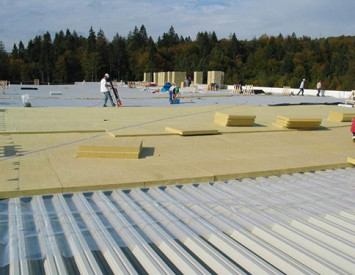
- Regardless of the type of base before laying the insulation, it is littered with a vaporizolation membrane. If you neglect this moment, over time, mineral wool slabs are soaked with condensate and stop holding heat, and the waterproofing laid on them decorates "blisters". Parosolation membranes are single and bilateral. In the first case, between the membrane and the base, it is necessary to leave free space literally at 3-4 cm so that condensate can freely evaporate. When using a double-sided membrane, the ventilation pocket is noted optional. As an alternative to membranes, it is possible to use conventional building polyethylene or consolidated materials (bitumen, polymer bitumen). As a result, vaporizolation should close all the horizontal and vertical planes, and the coating must be covered slightly above the level to which the insulation will reach.
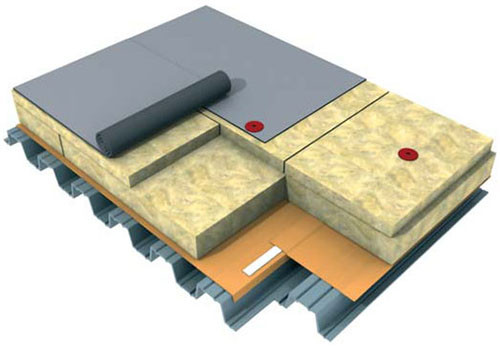
- Mineral wool plates should be laid in one or two layers. In the second case, it is necessary to calculate the thickness of the future roofing pie in advance and, if necessary, enhance the thermal insulation with a layer of thin and high-strength plates. Usually they do in the northern regions, where the level of humidity and temperature fluctuations are so great, which displays conventional insulation.
- To the base of the plate is attached by telescopic dowels or glued on bitumen - the method depends on the type of base. The dowel is better to use for the proflist, but also for concrete slabs they will suit, but the fasteners for concrete are more expensive than for metal. If you prefer the mechanical method of fastening, vaporizolation must be applied. Adhesive insulation on bitumen is quite troublesome and expensive, but it is this method that is recommended for the insulation of the roofs with concrete bases. A layer of bitumen is applied to the surface and stick the stoves. If you need to create a second layer of the insulation, the bitumen is missing the surface of the first layer and the additional plates "in the disintegration" are placed on it (so that the joints of the second layer did not coincide with the joints of the first).
- If the insulation was fixed by a mechanical manner, then the waterproofing on top of it should be fixed in the same way, that is, with the help of a dowel.

Video about warming flat roof mineral wool:
Extruded polystyrene foam
Extruded expanded polystyrene is distinguished by high strength and waterproof, and therefore is most often used for insulation of inversion roofs. On the stoves there are slotted locks that provide a very dense surface, but for a lot of reliability, all joints are recommended to sink a construction tape.

The beauty of expanded polystyrene is that it is easy to work with him and quickly:
- At first, the plates are placed on the base slab, sicking the slots of the compounds of construction scotch. If you need to put the second layer, the plates are mounted "in the disintegration".
- On top of the polystyrene foam insulation, geotextiles will be resigned to protect the lower layers of the cake from pollution and mechanical damage.
- 5-10 cm layer of gravel or crushed stone pour into geotextile. Sometimes for an additional drainage between geotextiles and powder, a profiled membrane is placed.
- Finally, crushed stone or gravel poured with a screed and put the finish coating. If it is planned to plant lawn grass or flowers on the operated roof, an additional layer of geotextiles should be added over the backfill, after which it is possible to pour 15-20 cm of fertile soil.

It is not so easy to insulate the flat roof, but this measure refers to the category necessary if you want to live in a warm house and not overpay for heating.