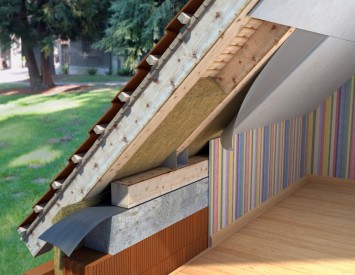
Heat roof foam – this is an important stage of the construction of a residential building, and therefore it is necessary to approach the performance of work gently and conscientiously.
Content
The temperature in the rooms, the level of humidity and the overall comfort of living, will depend on the heat insulation of the roof. Modern manufacturers offer a wide variety of insulation materials: polyurethane foam, ceramzite, mineral wool, eco-core, basalt plates, foamizol, etc. But the most practical and inexpensive expanded polystyrene foam.
Advantages of using foam
Many homeowners faced such a task as the heat insulation of the roof. Since the installation of insulating materials is often independently independently, it is necessary to clearly understand how to insulate the roof of the foam in the expediency of using this material. Consider the main advantages of expanded polystyrene:
- high resistance to temperature differences;
- environmental Safety;
- lack of a tendency to deformation;
- simplicity in processing tool and ease of installation;
- has a low thermal conductivity coefficient, which does not heat up in the summer;
- suppose to use under high humidity while maintaining functional parameters;
- the minimum weight of the material allows to insulate even the supporting structures;
- long service life;
- prevents the reproduction of bacteria;
- the material is hypoallergenic.

Disadvantages of polystyrene foam as insulation
Despite the impressive number of advantages of using expanded polystyrene as thermal insulation material, this type of raw material has some disadvantages. Depending on the degree of importance, it is necessary to make a decision whether it is possible to warm the roof of the foam. Consider the negative sides of thermal insulation by such material:
- polystyrene foam has sufficiently high sound insulation qualities, however, for the insulation of "noisy" metal roofs, it is suitable less than wadded sheets;
- promotes the formation of mold fungus;
- due to the fact that the rigid layers of foam not always docilely docked when the roof is insulated, there may remain emptiness in the space between the structures, in which the cold bridges are formed and condensate accumulates;
- when the material is ignited, poisonous gas is allocated.
Important! In order to eliminate the risk of mold and fungus, it is necessary to take care of high-quality waterproofing during the layout of the material.

Required tools and materials
Before starting work on the heat insulation of the roof of foam sheets, it is necessary to prepare the following:
- waterproofing film;
- construction stapler;
- wooden rails;
- vaporizolation membrane;
- acute knife;
- polystyrene foam;
- scissors;
- self-tapping screw;
- mounting foam.

Insulation of the roof of the foam: the phase of work
The thermal insulation of the roof will create a comfortable microclimate in residential space, protect the roof from heat loss and freezing during the cold season. Remember that the final result is entirely depends on the conscientiousness and quality of the execution of each stage of work. Consider them in more detail.
Preparation of the surface of the roof
The thermal insulation of the roof with polystyrene foam can be made by various methods, among which are distinguished by such as:
- attachment to the crate;
- laying material;
- gluing sheets (with the help of facade frost-resistant compositions, liquid nails or mastic);
- mechanical fixation of foam (by anchors, umbrella nails or wooden plates).

In this case, some rules for the preparation of the surface before starting work should be observed. Consider a sequence of actions:
- Initially, it is necessary to clean and carefully dry the surface on which the heat-insulating material will be laid.
- Since any roof consists of an inner and outer part, it is necessary to check the rafter frame and the roof itself for damage and repair work. Beams that could confine should be replaced by new and process the structures of fire chemical composition.
- To preempt the formation of a mold fungus, the inner surface of the roof should be treated with a special composition or antiseptic, which prevents the growth of microorganisms. In this case, all metal parts need to be coated with anti-corrosion fluid.
- The insulation of the roof of the foam from the inside requires a scrupulous selection of materials of the insulation, their thickness and quality. If the width of foam sheets will be less than the distance between the rafters, it will entail the formation of a slot and cavity, where condensate will accumulate.
- Be sure to consider vapor barrier and ventilation holes between rafters and insulating material to avoid rotting roof frame.
Polyfoam selection for isolation
Before you start working on the thermal insulation of the roof structure, it is necessary to know for sure whether the overlap can withstand the alleged load of the material. For this reason, choosing polystyrene raw materials, follow the parameters of its density. So, for thermal insulation, you can use the following types of material:
- polystyrene foam with a density of 15 kg / m3 - perfectly suitable for the insulation of ceilings, as well as scanty and attic surfaces;
- extruded foam - used for finishing attic rooms and gentle roofs, where mechanical loads are provided;
- polyfoam with a density of 25 kg / m3 - serves for insulation of walls.

The process of insulation of flat roofing
The correct design of the heat insulation of the roof includes:
- hydrobaric layer;
- directly insulation;
- vaporizolation layer;
- interior decoration.
Also in this design it is necessary to leave small cavities for airspace, which will be located between the roof and the waterproofing layer. This will avoid the unwanted concentration of condensate.

The sequence of action on the insulation of the roof is polystyrene is as follows:
- The primary task is to measure the distance between the rafters, as well as the thickness of the wooden plates themselves. You need to perform work with an accuracy of millimeters.
- Getting Started by cutting thermal insulation formations: the width of each fragment should be 1 cm more than the distance between the rapid sections.
- Next, laying foam plastic. The process must be produced so that there is no gaps between the insulation. Otherwise, the cavity will begin to accumulate the cold and condensate, which worsens the heat insulation of the roof.
- If you avoid the cracks when laying foamflast, it was not possible to carefully close the cavity by mounting foam.

- After installation of polystyrene foaming, you can start laying a vapor barrier membrane, which should be fixed using a construction stapler to wooden rafters.
- In the process of laying a vapor barrier film, it is necessary to follow the rule - laying the layers need to be a mustache, making a lining at 5-6 cm. At the same time, the edges of the film should be sampled with foil tape. This will ensure thermal insulation maximum protection against cold penetration.
Thermal insulation of the attic roof
Quite often, the attic space becomes a residential attic. In particular, such a reception is in demand if the house has a batch roof. As a result of the arrangement of this room, the owner of the housing receives a full-fledged area of \u200b\u200bthe structure. In this case, the process of insulation of the attic roof of the foam is the most optimal solution among all possible cases of thermal insulation.

To insulate the attic roof it is necessary to carry out work on laying polystyrene foam plates between the rapid fractions. In general, the process of thermal insulation is as follows:
- The measurement and cutting of foam plates on the sheets of the desired size occurs.
- The material is then located between the rafters so that they make the most tightly in the reserved space. Polyfoam must be fixed with special glue or use selflessness.
- In the following, it is necessary to pave the waterproofing film, fixing it by the adhesive composition or construction stapler.
- Also, on top of the foam at the request of the owner of the house, the rubberoid layer may be laid or a cement-sand tie with reinforcement.
- After that, you can start finishing the inside of the attic, mounting plasterboard or other finishing material.
- At the request of the owner, the surface is decorated by any selected way.
Important! In places where the insulation is docked with a rafter design or roof, it is necessary to produce additional sealing. To this end, the usual mounting foam is suitable.

Tips of professionals
Many homeowners prefer to perform work on the thermal insulation of the roof on their own. However, they often admit the mistakes that are reduced to "no" every effort. Consider a number of the most common mistakes:
- The use of low-quality materials, violation of the procedure and technology of work.
- Admission to the installation of foam material on which there are defects or mechanical damage to sheets during the installation process. Such a negligent relationship contributes to the formation in the heat-insulating layer of depressions and cavities where condensate is going, and subsequently nervous, mold and dampness.
- The cause of bad tightness can also be an incorrectly selected width of polystyrene reservoirs.
- Another error is the use of a polyethylene film instead of a vapor barrier membrane, which significantly impairs the parameters of thermal insulation.
A detailed instruction on the insulation of the roof of the foam on the video mounted in the fragment :