Sewerage is an integral element of almost every building and facilities. If you correctly care for the system of drainage, it will last you much longer. The main point when caring for sewer pipes is their insulation.
Content
Why do you need to warm pipes
Many owners of country houses, one way or another, are faced with the issue of insulation of sewer pipes. Many people think this is not necessary. Experts are considered different. The need for insulation tubes will depend on the climatic zone, as well as from the technology of construction and passage of communications.
If the building is built in the terrain, where the temperature is rarely reduced to a minus one degree, then you do not need to warm the sewer pipes. But if the building is built in the area with a harsh climate and frosty winters, then the insulation of sewage pipes is considered mandatory.

There is another option at which it is not necessary to further protect the pipes - when the communications are laid at a certain angle and are lower than a layer of freezing.
It is necessary to perform thermal insulation of pipes if:
- the pipeline passes not in a straight line, but with a turn;
- the depth of the sewer pipe is half meter ;
- when there is a slight bias of communication (less than half a million meter per meter);
- when the slope of the pipes, on the contrary, is significant and exceeds one and a half centimeters per meter of the pensile;
- when pipes are often clogged;
- so that the pipe does not burst into the frost (due to the temperature difference);
- in the cold time in the pipe did not freeze the wastewater, turning into an ice jam.
In any case, the insulation of the sewer tube will not be superfluous on the street and indoors.
Materials for insulation pipes
There are materials with which you can warm the sewer pipes in the ground and in the house.

For insulation of the sewer tube in the soil apply:
- fiberglass wool. This material is still ten years ago was considered the only insulation for pipes. Now the technical wool is extremely rare, because for its laying it is necessary to additional use of auxiliary materials - waterproofers. As a result, it turns out that the effectiveness of this material will be low;
- basalt insulation - easily mounted and has good thermal insulation properties. Among the disadvantages, the high value of the material was noted;
- polyopolmine - in demand thermal insulation material. It has good performance, easy mounted. Considered to be a budget option;
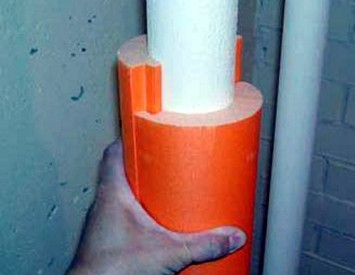
- polyurethane foam, like his predecessor, polystyolster, keeps warm well. It has the appearance of the "shell" in which the sewer pipe is "wrapped". You can find two types of pipes on sale - ordinary and insulated. The latter are released in a shell of polyurethane foam. In this case, the installation of pipes is significantly accelerated;
- penosole - has a double action: completely isolates the sewer pipeline, and also removes extra moisture out of the soil.
For insulation of sewer pipes in the room is used:
- polyethylene foamed. Common view of the insulation for pipes. It allows you to easily and quickly warm the sewer pipes in the apartment.

How to choose a heater?
When the sewer system is protected on the street, it is necessary to take into account that the insulation should not harm the environment and cope well with its task.
Consider more popular types of insulation: polystyolster, foam and mineral wool.
The foam plastic has the appearance of a pipe that connects with each other with special fasteners.
The first two insulation have several advantages:
- have a small weight, so they are convenient to transport and install them;
- easy to perform installation work;
- have a long service life;
- environmentally friendly material;
- have an affordable price.
Due to its uniqueness, the foam shell is withstanding any temperature and temperature fluctuations.

If we talk about durability, then the insulation of foam and polyne foam can serve fifty years in a row. It also happens that the sewage pipe fails earlier than the insulation itself.
The foam is allowed to install both indoors, because it is self-effect, and in the fire will burn one, a maximum of two seconds.
If you decide to insulate the pipes with an old proven method - mineral or glass, then you should be familiar with some nuances:
- This type of insulation cannot be called an environmentally friendly material, because in the Minvath there is a large amount of caustic materials that destroy the soil.
- Over time, the insulation gives shrinkage and cracks are formed on it. Because of its characteristics, absorb moisture arises the need to apply an additional insulator to attach the material.
Warming of the sewer pipe on the street
To protect the pipes from freezing during the cold season, you need to insulate them.
There are such heat insulation methods:
- engineering;
- using insulating material;
- active.
First method It is considered the simplest, because when laying sewer pipes, they must be located below the level of soil freezing. Based on the practice, the optimal depth of the pipes is two meters and more. It depends on what region you live in.
The insulation of pipes is performed according to such a scheme:
- A trench is prepared for a certain depth so that the pipes can be laid with a slot of one centimeter for each meter of length. The depth of the pipes can be found from the table. For each region there is its own table.
- Then at the bottom of the trench, you need to make a pillow of sand or gravel (grain size no more than twenty millimeters). The thickness of the layer should be at least ten centimeters.
- Works are performed on laying sewage pipes.
- Now you should pour pipes with sand or small gravel. The thickness of the layer should be at least twenty centimeters above the pipe. The layer needs to be well seal.
- In order not to arise where to take gravel, use the material that was taken out when the trench was prepared.

There are a number of moments, due to which such a method of insulation may be ineffective. For example, the structure of the soil or close locality to groundwater, the presence of insects and other harmful substances that can destroy the structure of the pipe.
With this method, it is also necessary to take into account the probability of impulse of sewer pipes. To restore the damaged area, you must roll up the pipe or remove it completely, to replace to a new one.
Second method - insulation of pipes with thermal insulating materials. Depending on the situation, a different type of insulation is used.
How to perform work on the insulation of sewer pipes with your own hands:
- Note the passage of the trench.
- Prepare a trench of sixty centimeters width and depth according to the project, plus the stock in five or ten centimeters.
- The trench needs to be equipped with a bias to provide a sideways of passing fluid on pipes.
- On the bottom of the trench, put the layer of sand or gravel (the thickness of ten centimeters). Seal it.
- Place the pipeline on the surface not far from the prepared trench.
- Perform a serial connection of pipes.
- Treat the edges of the pipe and the sealant itself.
- Now you can wear a heater to the pipe and fix the construction system.
- The pipe must be omitted into the trench, connect and fall asleep with a layer of gravel or sand.
- Fulfill the trench in the soil. It is important to ensure that there are no large stones and glass in it.

Third method Active insulation is considered the most efficient, but also more costly. It is the need for laying parallel to sewer pipes of electrocabels that will warm the drains. The heating system is controlled by the temperature sensor to which the entire automation is connected. If the water inside the pipes cools up to zero degrees, the sensor works, and the cable begins to heat the pipeline. As soon as the temperature rises - the sensor is automatically disconnected.
Such a method of insulation although it is considered effective, but refers to volatile and applies in exceptional cases when the two previous methods turned out to be ineffective. It is necessary to take into account the fact that if it is additionally not to insulate the pipes with heat-insulating material, it turns out that the cable will warm the land, and not your pipes.

How to carry out insulation of sewer pipes, look at this video: