Recently, the trend is more clearly traced - people in the desire to approach nature move from urban high-rise buildings in private wooden cottages. Downshifting is explained not only by the fashion and subconscious taiga to the natural and natural, but also a well-defined desire to live in a healthy atmosphere. It is known that wood is a natural heat insulator, but this does not mean that the house built from this material does not need insulation. Today we will talk about how to insulate a wooden private house with your own hands outside and from the inside.
Choosing materials
The practice of building houses from wood has millennium, and earlier people used for insulation only natural materials: pass, moss, straw, etc. Unlike the ancient solid solid logs of solid logs, modern wooden cottages are distinguished ease and need a solid warming. The optimal option according to all experts is outdoor insulation, but in some cases permissible and internal. In any case, it is necessary to conduct a study and identify which areas require special attention. So, if the house stands on piles, through the laptile semi will constantly walk through the drafts, if the basis of another type, it is necessary to insulate the foundation of the wooden house with their own hands, otherwise it will take up to 40-50% of heat through it.

The second zone requiring the most close attention is the roof - through it it can leave up to 50-60% of heated air. This will help you with an article. "Wheel insulation with their own hands". And finally, the walls of the house occupy the largest area, and besides susceptible to wind loads, and it is impossible to neglect their insulation. Thus, several stages of operation can be distinguished: floor insulation, roofs and walls. To save, you can use old proven "grandfathers" methods of cacopa with the use of sawdust mixed with earth or clay, moss, jute, hemps, pacles. Paul can be insulated with clay or eco-art.

In order to warm up a wooden house with their own hands, you can use any materials, but it is advisable to emphasize on their naturalness, otherwise the entire meaning of the ecological life of the home will be lost. Also in wooden houses a large risk of the appearance of rodents, so it is better if the insulation is solid or "tasteless" for mice. He also should not interfere with steam exchange, otherwise the wood will begin to work and rot. Also do not forget about fire safety. Taking into account all the above requirements, it turns out that the wooden house can be insulated with an eco-art or stone cotton, clay or shed. Polyfoam and its derivatives like polystyrene foam and polyurethane foam is better not to use, because they are non-environmental and do not miss water vapors.
Warming technology
Woodering of a wooden house is necessary not only to maintain a comfortable microclimate inside and saving fuel (electricity), but also to extend the operation of the internal coatings, furniture and structures that form the house itself. So, if inside the temperature and humidity differences will be constantly observed, the wooden elements will be dried and expanded, will begin to rot and rupture much before the deadline. To prevent this, first of all it is necessary to pay attention to places with the largest heat lines: the floor and roof.

Warming Outside
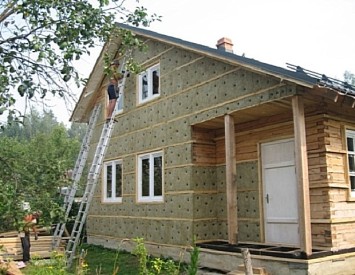
Before heating the wooden house outside, it is necessary to prepare all the tools and materials. If the house is two- or three-storey, one ladder-ladder will not be enough - you need to build scaffolding. As a heater, it is optimally used to use stone wool, because it copes perfectly with its task, is not affected by rodents, and does not prevent moisture microcirculation. The obvious advantage of the material is the incompleteness of fire and simple installation.

How to insulate a wooden house with your own hands (with video):
- Getting Started in warm and dry weather. Treat the outer surface of the wooden wall with an antiseptic antifungal agent. Agree, it will be a shame if the mold or insect parasites will be headed in just insulated walls. Special attention is paid to the ends of the logs and bars, because they are most inflicted against rotting. Cover the surface with an antiseptic in two layers and leave for drying for a couple of days.
- Before laying thermal insulation material, you need to attach vaporizolation. To do this, you can use a special membrane or pergamine. If you decide to purchase a vaporizolation membrane, you should mention that it is one-sided and bilateral. In the first case, one side will be a glossy, the second is a darous or porous. The glossy surface must be addressed to the insulation, porous - to the wall. For fixing, use a furniture stapler.
- To lay the heat insulation, you need to make a frame of wooden rails to which the first layer of insulation will be mounted. To do this, from the outer part of the walls build a laminate from wooden bars 40x40 mm, having them at a distance of 3-5 cm less than the width of the heat insulating plate. It is necessary in order to most closely squeeze the insulation, and that it keeps inside without any additional fixation.

- At one vaporizolation, attach mineral wool, with an effort plipping it between the bars of the crate. Additionally, you can fix the insulation with anchor nails.
- Then build another crate, but already in the perpendicular direction in relation to the first (if the bars of the first crate stood vertically, now they need to be consolidated horizontally, and vice versa). The second layer of the insulation, laid perpendicular to the first, reliably protect the house from drafts and the slightest bridges of cold.
- Next, it is necessary to protect the insulation from moisture, which can penetrate the facade. To do this, attach from above the polyethylene film with a thickness of 100-200 μm or rubberoid cuts. For fixing, use a wide tape, overlapping ceases to 15-20 cm.
- So that the moisture that fell under the wrap is able to quickly evaporate, it is best to equip the ventilated framework. To create it, you will need exactly the same bars as for the crate. It is so that there is a gap of 4-5 cm between the insulation and the decorative facade. Attach them with self-draws to the lower frame. If the walls of the house are a bit twisted, use perforated suspension for the profile - it will give the ability to adjust the distance to the frame. If you do a trim in a professional flooring or metal siding, instead of bars you can use a plasterboard profile.
- After carrying out the facade, make sure that there are no cracks, through which moisture could penetrate inside.

Will summarize the instructions of the video, how to insulate a wooden house outside with your own hands:
Useful advice: In most cases, mineral wool slabs with a thickness of 5 cm are used for the insulation of wooden houses. The bars, of which the lamp will be built, should be about the same thickness (better exactly the same).
Insulation from the inside
Before telling how to insulate the wooden house from the inside with their own hands, I would like to note that this method is undesirable and can only be used in cases where outer insulation for any reason is unacceptable. Internal insulation is inconvenient not only by the fact that it takes the useful area of \u200b\u200bthe walls, but also because it moves the dew point inside the trim. This means that it is not warmed outside the wall begins to freeze, the cold moves deeper into the inside, and when it comes to the back of the insulation, attached from the inside of the house, condensate appears due to the temperature difference.

It is much easier to insulate the ceiling in a wooden house with your own hands, gender or foundation. To do this, you will not need special equipment, and it is more convenient to work in more convenient than on the street (you can do it in any weather).
There are several thermal insulation techniques for the inner walls of the house depending on the insulation used:
- Warm seam - such sealing of seams and joints is used in cases where the inner surface of the wooden wall will be preserved in pristine form, that is, without finishing with decorative plaster and other materials. Warm seams significantly reduces the thermal conductivity of the masonry. As a heater, synthetic sealants on silicone, rubber, latex or acrylic base can be used, as well as traditional materials like flanks, pacles, linen harness. Such insulation can be easily carried out with their own hands without special skills, it does not violate the natural attractiveness of wooden masonry, does not disturb the microcirculation of air and moisture indoors. Also, it is impossible not to note the economic benefit at fairly high performance indicators.
- Mineral wool - This material is suitable for both outdoor and internal wall insulation, ceiling, cruel and overlap of a wooden house. At first, in the wall you need to smell all the cracks with a sealant and process the surface with an antiseptic, then build a crate, as described above, and act in the same way until the finish finish. In this case, there will be several other materials for it: wooden panels, lining, plasterboard, plaster, etc.
- Polyfoam - this material is very rarely used for the insulation of wooden houses, since it does not miss steam, which inevitably leads to the formation of condensate inside the wall. However, if you properly organize hydro and vaporizolation layers, this technology will completely protect the house from frosts and will save, since the foam itself is very inexpensive. Working with it is easy and simple, and low thermal conductivity with a small thickness of the material makes it possible not to sacrifice free space for the benefit of insulation, as in the case of mineral wool.
- Sprayed thermal insulation is a relatively new way of insulation of walls from the inside and outside. Unfortunately, it will not work this personally, because for applying (spraying) the heat-insulating material on the wall requires a special technique. As a result, an absolutely seamless coating is formed that does not pass moisture, nor cold, but at the same time not preventing steam exchange.

To insulate the floor in a wooden house with their own hands, you can use all the same mineral wool in the plates, polystyrene foam or bulk materials (ceramzite, vermiculitis). To do this, on the draft floor, lagows from a minimum of 50x50 mm are placed on top of them, the waterproofing material is placed on top of them (rubberoid or polyethylene), after which the insulation is placed. From above, we again lay the waterproofing and are sewn with boards or plywood, after which they get to the finish finish (they put parquet, laminate, a rack of linoleum, carpet, etc.).
Heat the wooden house - it means not to simply attach to its walls, the floor and roof the heat-insulating material, but to carry out a whole range of works associated with the arrangement of a comfortable microclimate inside. All this will eventually affect not only the well-being of residents, but will also affect the life of the structure itself. That is why it is necessary to carefully choose the materials and strictly adhere to the selected insulation technology.