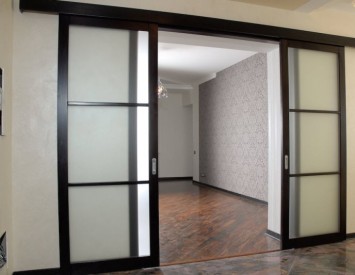
Sliding doors are the perfect solution for small rooms. Such structures do not twist the space, besides, they look very original and non-standard. In this article we will talk about the features and types of such doors, and also tell me how to install the sliding door with your own hands.
Content
Types of sliding doors
Such structures can be classified according to various features. For example, depending on the design features, sliding interior doors are divided into:
- cascade designs;
- radius doors;
- harmonic doors;
- single, duplex, three-rissed doors.
Doors can also be made of different materials, the most popular are wooden and glass designs. This factor is important if the system is supposed to be installed in your own hands. For example, for mounting the simplest wooden door, you will need a guide with one gutter, as well as two carriages with rollers. In the case of the installation of the glass door will have to be stocking with a large number of materials, namely, harvesting a lot of roller mechanisms, since heavy glass has a significant pressure on the entire design.
Glass canvases with poor fixation risk falling and crashing, so they are recommended to be mounted using two rails: top and bottom. This method of installation will provide good door stability. The sliding mechanisms themselves are fixed between two plates laid from the inside with special rubber lining.
Sliding doors systems are two types:
- The hidden intrauterine mechanism provides for such a functioning of the structure at which it hides in the wall. You can mount a similar door only at the wall structure of the wall, since it is thicker it is necessary to provide a gap in which the sash will be hidden. It should be borne in mind that the wall thickness will increase, and this will reduce the free space in the room. But the door itself will subsequently save much more space than the usual swing design.
- Open mechanism doors can be mounted not only at the construction stage, but at any convenient time. If there is a similar mechanism, the sash will move along the wall, but for this it is necessary to provide free space from the side to which the door will open.
The external sliding mechanism allows the use of a mass of door movement options, so you can choose the most convenient way. To close a very wide doorway, it is recommended to use systems with four sash, where the inner canvases will open towards external.
Before installing the sliding door, you should familiarize yourself with their classification by type of fixation. Depending on this characteristic, three types of structures differ:
- Doors that are fixed on the upper suspension.
- Constructions that are fixed on the lower suspension. With this method of fixing, the bottom is a small threshold, which is acceptable for cabinets and dressing rooms, but uncomfortable for interior doors. Railings can be dried in the floor, but it will require additional time and labor. But the installation of systems on the lower suspension is the fastest and easy process.
- Doors that are recorded by the two transmitted ways. This type of installation is considered the most reliable and durable.

Advantages and disadvantages of sliding doors
Before installing sliding interior doors, it will not hurt to get acquainted with the pros and cons of similar designs. To begin with, we will deal with the advantages:
- the plus of sliding doors is their originality and non-standard, attractive and unusual appearance;
- saving space is another advantage of such systems. You can not put furniture or other interior items to the ordinary swing door, whereas if there is a sliding design, the entire area of \u200b\u200bthe room can be used with a sense;
- the insistent advantage is also considered the safety of such doors, because it is simply impossible to hit hard angle in the dark;
- sliding doors do not break away from the draft.
Such structures are not devoid of disadvantages, among which the following can be distinguished:
- complex and labor installation method;
- if the door is not mounted independently, you will have to spend money on the work of the masters;
- low sound and heat insulating properties can also be found to be disadvantaged;
- if the system has a hidden intrauterine mechanism, it is quite problematic to care for it. If you need to clean the space in the thickness of the wall, it is enough just to spend it with a convenient nozzle, but for small repair, part of the wall will have to be dismantled;
- over time, some rollers can come into disrepair and demand replacement.

Installing sliding doors
Regardless of the mechanism of action and fastening, all sliding doors consist of the same type of elements. These include guides, roller mechanisms, as well as door canvases. In addition, various decorative parts are used, clamps, dough, as well as a variety of fittings in the form of locks and handles. Working on the installation of the sliding system can be described by step by step.
Step 1: Installation of guide profiles
The first stage on the wall is made of marking in those places where the design will later be installed. Focusing on this markup, guides for sliding doors are fixed on the surface. If the system will have lower suspensions, they can be embedded in the floor to get rid of the clad. In this case, the thickness of the floor cover will have to make a gap, but it is possible to foresee everything in advance and even before finishing the floor to fix the guides on the concrete screed.
Important: In the process of installing profiles, it is necessary to check their horizontality using the construction level.
The next step is to install the upper guide profile. This profile must be fixed strictly above the bottom, and it is possible to check its position using a control line. The installation height of the upper profile should be equal to the height of the door itself and take into account the slight increase of 1.5-2 cm. This increase is needed to provide gaps between the door web and the surfaces of the ceiling and floor. Note that the guides must be mounted strictly horizontally, so that the design stood smoothly and spontaneously displaced.
As for the length of the guide profile, this figure should be equal to the double width of the canvas and take into account the increase of 5 cm for the normal movement of the door. If the closer is provided in the system, you need to leave the stock for it.
When installing a conventional wooden structure, profiles can be fixed by brackets, but if we are talking about heavy doors made of glass or massive board, it is better to further strengthen the system using a wooden bar. At first, such a bar is mounted on the wall, and later the guide profile is fixed.
If the wall in the house is lined with brick or consists of a monolithic concrete, then the dowels should be used as fasteners. In the case of a plasterboard wall, it is necessary to equip an additional profile in its frame, and the installation of the guide is made directly to it. The work is recommended to use anchor for drywall.

Step 2: fixation of holders and fittings
The next stage in the installation of sliding doors is to strengthen the brackets on the canvas that will hold the door on the roller carriages. Such brackets are mounted according to the instructions and are located on the sides of the upper end. The optimal view of the holders for all types of sliding systems, with the exception of the harmonic design, are considered clamps that are attached on the sides of the door. In the case of a glass blade, metal fasteners with rubber gaskets are used, between which the glass is fixed. Such clamps are eliminated from the need to drill hole in the glass door for fasteners.
When installing door-harmonica for each section, they put special brackets with a rotary roller.
In the process of installing door holders, you can also equip handles and locks if there is a need. Then, when the sliding system takes its place and will be adjusted, you can install the castle's response mechanism. Note that when installing hidden systems, handles and other accessories should be deepened in the thickness of the door canvase.

Step 3: Door Holding
The next step in the installation of the sliding door is the direct installation of door flaps. Such work is better to perform together. One person will keep the door until the second carriage in the grooves of the guide profiles. If the door performs the role of interroom partition and the profiles are mounted on the wall to the wall, the rollers for the sliding door are introduced in advance in the groove through a specially provided window. After that, the holders on the end of the canvas are joined with an anchor descending from the carriage.

Step 4: Installation of closers and limiters
So that the carriages with the rollers did not fall out of the grooves of the guide profiles, you need to put the limiters. As such limiters, special plugs are used in the form of profile form, as well as studs that are installed in the guide in the marked locations.
Tip: So that the door when opening has not published loud sounds, choose the limiters with rubber stops. Such details will also not allow moving elements of the system to spoil too quickly.

Step 5: Installation of Sobor and Put
Tubes on the sliding door are mounted in order to protect the mechanism from dust and different contaminants. Another feature of such parts is decorative. The platbands are used to give a neat type of open-mechanis systems, they are not needed for intrauterine doors.
The platbands are mounted on the wall using brackets, but you can fix them in a guide profile with special latches.

Step 6: Adjusting the mounted design
The last stage of the installation of the sliding door is to check the result of the system and adjust the system. If at the initial stage of installation of the door, the guide profiles were fixed strictly horizontally, the canvas should be kept smoothly and not to shift themselves alone. In this case, the adjustment process will not take much time. It will be enough to check whether the door to the restrictive design is tightly adjacent, whether the canvas moves parallel to the floor, there are no unnecessary gaps in the places of contact of the door with the wall. At the very end of work, it is also necessary to check whether the shutters on the guides are easily and freely and freely, whether accessories are working, all the details are well fixed.
Sliding doors, photo: