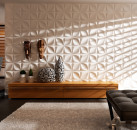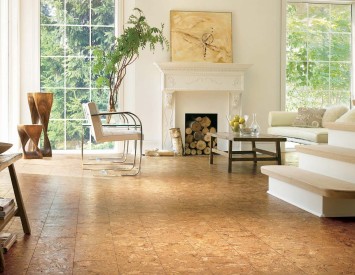
Cork material gradually becomes popular among the owners, and this is even despite the fact that there are even more practical solutions on the market. The thing is that cork covers have a lot of advantages that even parquet and laminate can boast.
Content
Good news is that on sale you can find a lot of different cork material options that are ideal for specific conditions and scales. In modern conditions, it is advisable to use cork coatings. And we are talking not only about the outdoor variants of the material. Now on sale there is a lot of various coatings. Some can be used as a wall finish, and some - to cover the ceiling.
Of course, do not forget about the lack of cork coatings. They really have considerable importance, especially given the fact that in the dwelling floor coverings are constantly operating, so it is very important that they have excellent characteristics. We will focus in detail about the negative sides of the cork floors.
We will also consider the process of laying the cork floor, analyzing each stage of work in detail. Rating a little should be noted that the cork floor is a truly good option for a large private house, and for a small apartment in a high-rise building.
Main features of cork material
Obviously, the cork floor is a fully natural product that has almost no analogues on the market. Of course, this is exactly what a traffic jam and captivates consumers. It is also interesting that there are quite a few options for this product. Each host has the opportunity to acquire the most practical option, which will show itself from the best side in specific conditions.
Next, consider the main varieties of cork flooring:
- Cork board. It must be borne in mind that this is the most expensive cork coating that can be found on the market. The material itself is a large plate, the dimensions of which can reach six square meters. The thickness of the cork board is limited to 6 mm. Often, this material is covered with wear-resistant varnish, since the cork board is very sensitive to a wide variety of impacts.
- Cork laminate. This material is almost similar to the most ordinary laminate, but its characteristics are similar to the parameters of the cork board. Unfortunately, this floor covering is rarely used.
- Pressed plug. This is a kind of budget version of the cork plate. Despite this, the quality of the material is quite high, therefore the material has no special negative sides. The extruded tube has a fine-grained texture, which may not come to the taste. It can also be noted and the positive side, which concerns arbitrary dimensions of the material. Manufacturers of themselves in this regard are not limited, so the tile of pressed cork can be both miniature and gigantic.
- Cork panels MDF. This variant of cork material has a low price. Externally, the material resembles a corkboard, but most of all he has in common with laminate. The material is based on MDF, after which there is a layer of cork crumb. Completes this composition another layer, which consists of a thin cork veneer. The advantage of this coverage is that it does not need much attention to its arrangement to pay a lot of attention to the quality of the underlying layer.

The main advantages and shortcomings of the cork
At the beginning of this material, we said that cork covers have a lot of advantages. Of course, they have and substantial flaws, some of which can significantly affect the choice of consumers. Of course, the positive sides are much more than negative, and it is worth remembering.
Advantages of cork floor:
- Natural material. Many people are skeptical about modern materials that are based on polymers and plastic. Obviously, in most cases, these construction resources are not the best option for a person, as they may have some disadvantages, primarily associated with the negative impact on human health. Sometimes this influence is almost minor, but in such situations, people are accustomed to give preference to natural products. And indeed, the plug is environmentally friendly for human health. In this regard, this material is much more attractive than the remaining floor coverings.
- Original coating. The bottom line is that the plug is quite elastic material. Accordingly, it is an excellent option for flooring in a nursery. This is a safer option than any other type of floor. Also, the covering of cork floors does not slide, unlike the laminate and parquet. However, it must be remembered that there are a wide variety of coatings that are suitable for a particular room. For example, we can talk about protective layers that protect the cork surface from water or any other substances.
- Sound and thermal insulation. Natural material for its properties resembles mineral wool or foam. Indeed, the cork floor can be used as thermal insulation, and with the right approach, the material also isolates the external noise. However, it is not worth overestimate the material in this regard, since it is still far from the properties of specialized products.
- Positive "perception" of the load. As we have already spoken, cork covers are elastic, and that is why they are well perceived even very high loads. Accordingly, if you place a heavy cabinet on the floor, the cork cover will see a bit. However, immediately after the cabinet is removed, the coating will return to the initial position. This is an excellent property that does not allow the material to be damaged even in the harshest conditions.
Disadvantages of cork coatings:
- High price. Those who wish to acquire a cork coating will have to pay a round sum. Of course, the whole thing is that the material is natural, therefore, in such conditions, the coating is always valued more. Of course, you can always buy cheaper sexual options, which are also made on the basis of traffic jams, but such solutions are deprived of the most important advantages of original cork coatings. Definitely, covering the floors in the whole house will be expensive, so sometimes it is advisable to limit one or a pair of rooms.
- Fragility. Despite the fact that the cork material withstands serious loads, it is very easy to damage. Just just stumble and hurt the surface. In this regard, cork covers significantly lose other solutions present in the market.
In addition, the plug has other negative sides. For example, the material has a high sensitivity to temperature differences. Also, natural products absorbs moisture too well.
If you analyze all the above items, then the cork floors are difficult to name durable. Literally in a year or two, after the start of operation, it will be possible to notice significant problems on the coating that cannot be restored. Accordingly, after a while you will have to replace the floor.
It is also necessary to focus on the fact that cork covers can only be used in separate rooms. It can be a children's bedroom, a living room, as well as a working office (hall). In some cases, cork floors can be applied in other rooms, but only if the material has special protective coatings.

Cork flooring
Required tools
In the process of laying cork coatings, you must have several tools:
- kiyanka;
- electrolovik;
- roller for a cursory (if the floor needs to be trimmed by glue).
Also, in the process you will need plinths for cork floor, as well as thresholds (since it is impossible to lay the cork covering in the doorways).
Preparatory work
Before starting laying the cork gender, you need to test a number of responsible preparatory activities.
First of all, we are talking about the alignment of the concrete floor. Often, for this, a concrete screed is created, however, the problem is that the concrete surface has a small roughness, which, in turn, creates serious problems for the cork layer.
In such cases, it is advisable to use a liquid equalizer.
In addition, it is possible to lay cork flooring over linoleum or laminate. In this case, it is also important to be sure that the base has a smooth surface.

Glue based cork floor
It is necessary to know that the quality of the adhesive cork is directly depends on the quality of glue. Unfortunately, there are very many poor-quality products on sale, so it is very easy to encounter problems. It is best to use non-toxic glue, dries which for 10 minutes. The best information associated with the choice of glue, clarify the coating manufacturer, as it is very easy to make mistakes in choosing a product. However, it is worth mentioning that often in such a process is not used PVA glue, as it has a water base.
- Laying the cork coating begins with the center of the room. The process itself occurs on the helix. At the very beginning, the glue is applied with a spatula on the base. In this case, it is necessary to ensure that the glue layer is the same.
- Each part of the coating should be coated with a roller, which we talked about earlier. It should not be pressed too much, but you need to be sure that the cork coating is reliably located on the surface.
- With the help of the most conventional construction level, you need to check the horizontal surface. Moreover, this procedure is carried out after laying almost every unit of material.
- In the event that the material begins to "go slightly" a bit, it is necessary to arm a rubber hammer and return the plug to its original position.
- In the process, it will definitely be situations in which glue will go out (between gaps). In such a situation, it is necessary to immediately remove the excess glue using the vehicle (it is desirable to moisten it with solvent).
- On the perimeter of the room, it is necessary to leave a small gap, which will serve as a space for the plinth.

Creating a floating floor
If it comes to creating a floating floor, then it can consist of whole pieces of veneer, or from cork laminate. It should be noted that the first option is quite complicated, so we will consider in detail the process of creating a floating floor based on cork laminate.
- At the very beginning, facilities occur. It should be borne in mind that the material is quite expensive, so it is better to acquire an exceptionally necessary amount of material. If there is a need, you can then buy a laminate. Immediately after buying, the material cannot be used. It is necessary to withstand the cork product indoors during the day (this is a kind of acclimatization process).
- The base surface is covered with film (braziness). It will also be necessary to enable the walls on the walls. After repair, it will be possible to cut off the excess part of the material. In places where joints are created, you can use the scotch.
- Now you need to take care of the laminate dimensions. The thing is that in the process, the situation will definitely happen at which the dimensions of the sheets will not coincide with the size of the room. In this case, it is necessary to cut the material, but only on the ridge side. In no case cannot cut the laminate from the groove.
- Laying material comes from a long corner. The crest of the next unit of material is placed in the groove of the previous plank. You also need to do everything so that there are small indents around the wall (up to 30 mm).
- At this stage, the extra part of the film layer is cut off with a construction knife.
- With the help of mounting glue around the perimeter of the room, the plinth is attached (preferably cork). By itself, the plinth must hang over the surface for a couple of millimeters.
- After the work carried out, the floor can be operated immediately.