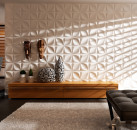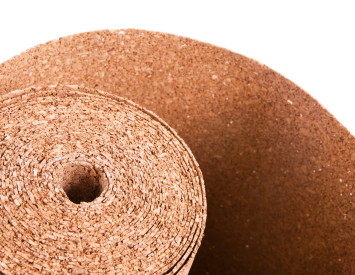
Over the course of dozen years in Europe, original materials are actively used as floor coverings. It is worth noting that new materials are not always expensive. Not so rarely in construction stores you can find far from the most common products, which looks attractive, and it is inexpensive.
Content
It makes sense to say that in a large number of countries, cork floors have become a real hit. Not only is it a comfortable coating, so also very inexpensive. Immediately you need to say that this is only a small part of the positive sides of the material. To date, manufacturers of such construction resources use all possible resources to ensure that the coating receives as many positive parties as possible. This applies not only to the strength and durability of the material, but also its appearance.

Features of using cork materials
Cork coatings are considered universal. However, on sale you can find the most different variations. Often, cork coatings are characterized by density. Many have become accustomed that this material is not particularly durable, but the construction of cork blanks of large thickness and the highest strength are used in construction. At home, this allows without any problems to use the material for decades.
As coatings, cork material can be found in the form of tiles, which, without any problems, are stacked on the surface. You can also meet a cork parquet having a lot in common with the original coating. Of course, the second option is significantly more expensive than the first, however, the use of one or another variant depends on the specific conditions.
Parquet is often stacked in the central dwellings, where it is necessary to create a rich and cozy atmosphere. Also, laying the cork parquet is limited to very simple actions, since often the material has already passed the necessary surface treatment. Cheaper options for cork parquet do not have the desired initial decoration.
Most often, experts recommend purchasing parquet without finishing. After the material is laid on the floor surface, it is possible to carry out full processing, while you can be sure that we get a positive result.
You can also be sure that the unprocessed surface of the parquet will not be damaged during transportation and long-term storage.
If we are talking about the factory processing of the material, it is necessary to focus on the price of products. Most often, the parquet surface will be cheaper, using the simplest tools.

Laying of cork floor
Most cork materials, which are currently available to buy in construction stores, is very simple. Companies producing similar products make it possible to simplify any manipulations with floor coatings.
If we are talking about the laying of conventional cork tiles, which are almost similar to ceramic material, then their installation occurs by using glue. Parts of the material are simply glued to the floor, which you first need to clean and wash.
For these events, contact glue is used, which is secure and on both sides sticks the material. First, the glue is applied to the opposite side of the cork material, and then on the surface of the floor. The binder layer must be relatively thin, and each laid tile is placed on the same level.
After applying glue to the tile, you need to wait 20-30 minutes before pressing it to the floor. Application of glue occurs with a brush or roller. Of course, it is impossible to prevent the presence of skips on the back of the material, everything must be carried out qualitatively.
It is also worth saying that there are often situations when there is a need to replace one or another piece of cork coverage. Of course, this is possible, but it is necessary to carry out this event qualitatively, without damaging the neighboring cork elements.
There is a advice that is capable of noticeably simplifying repair work. People who lay cork slabs pre-create a markup that allows you to immediately understand where the material will be located, as well as where it is necessary to cut part of the products purchased.

Features of laying cork parquet
Despite the fact that the cork parquet is almost similar to the classic parquet, the original material has some features that you need to know. A cork parquet of three layers is consisting: the first is a fibrous base, the second - cork, and the third layer is compensating, which perfectly copes with all the loads on the surface.
Unlike cork slabs, which are also very popular, parquet has a greater thickness (up to 11 mm). Accordingly, it creates some problems when repairing the surface.
The main advantage of cork parquet is the absence of the need to use additional insulating layers. Thus, precisely on the basis of the "floating" method is stacked by cork material.

The installation process is quite simple, and it consists in gradual stacking of rows of parquet. After the location of the first strip of material, it is necessary to attach the following cork element with a specific slope, which must be perfectly enter into the groove. If everything went well, then during this process you can hear a characteristic "click". Next, you need to beat the strip of the material along the mount with a small image.
Other features of cork material
It is worth understanding that the cork material is not universal. It is necessary to focus on the fact that it is desirable not to use indoors with high humidity. At the same time, cork coatings impregnated with moisture resistants can be found in construction stores, so that with moderate humidity and this material can be used in not the most favorable conditions.