Floors are styled from various materials. Regardless of the materials used, they must be smooth, without gaps between the boards and do not fade. Properly installed wooden lags are the basis for a well-plan floor. It follows in dry weather at a plus temperature in a plus temperature.
Content

Strict requirements are presented to wooden floors on lags. They are made once for a long time. The underground should be dry, and the base part of the building is provided for ventilation holes. The beams and lags are treated with antiseptic means and fit in a dry state with a moisture content of wood not exceeding 12%.
Calculation of beams and wood selection of wooden floor lag
Lags - in fact, wooden transverse beams on which the floor canvas is laid. Competently calculated and produced laying of wooden lag provides the correct distribution of loads, heat - and noise insulation. In the free space of the underground, communication systems of water supply and power supply are stacked. The main purpose of the lag are smooth and dry floors.
Calculation of the section and step lag for wood floor
The beams are selected from dense wood of conifer or hardwood. Pine, beech, fir, alder or elm are optimally suitable for the arrangement of lag. Lag beams have a rectangular section with a height ratio to 1: 1.5 -2 width.

- The step when laying a lag is 70 - 75 cm. Depending on the width of the span, these sections are selected:
- pour 2 m - section Lag 110x60 mm;
- span 3 m - Lag 150x80 mm section;
- pour 4 m - section Lag 180x100 mm;
- span 5 M - Lag 200x145 mm;
- span 6 m - Lag 220x180 mm section.
In the selection of the end section, the lag takes into account the distance between the bars of the lower strapping and the thickness of the insulating layer.
2. The step of lag directly depends on the thickness of the floorboard:
- board thickness - 35 mm step Lag - 60 cm;
- board thickness - 40 mm step Lag - 70 cm;
- board thickness - 45 mm Step Lag - 80 cm;
- the thickness of the board - 50 mm step Lag - 100 cm.
Selection of high-quality wood massif for flooring and lag
For laying wooden floors to lags, a board is selected at least 35 mm solid wood. Alder, aspen, beech or oak are quite suitable and popular wood breeds for floor covering. The difference in price depends on the hardness and durability of wood.

- For floor flooring under the varnishing, the board of the first grade without bitch and damage is selected. Wood for the floor under painting can be chosen as a variety below. Pay attention to the moisture content of the wood massif. It should be within 12%. Too wet floor after installation when dried may knock or twisted. The porched board has a tendency to cracking.
- For the protection of lag and floor boards from rotting, fungus and bug wood is treated with antiseptic solutions. The decrease in flammability is achieved by the impregnation of the tree with antipren. The lower crowns of the house and the place of attachment of the lag are subjected to similar processing.
Preparation of the underground space and the crowns of the house to the installation of Lag
Wooden lags are arranged for an earthen, concrete base or on beams. Before installing the lag, work is carried out on the waterproofing of the base and noise insulation of the floor.

- Earthy space between the lower wenzes of the house is thoroughly aligned and tamper. Pillow pillow from sand and rubble. Marking under the support columns and the waterproofing film is stacked.
- For a concrete base on a pillow of sand and concrete on top of the waterproofing film, an 8 mm lattice is cooked from the reinforcement. The cells of the reinforcing lattice are made approximately 15x15 cm. The base is poured with a layer of concrete with a thickness of 8 - 10 cm and a screed is made. After a day, the cluttered concrete "Reline". The surface of the concrete is moistened, sprinkled with a thin layer of cement and loaded with a wide spatula.
- Makes a concrete screed for at least 2 -3 days, and then treated with water-repellent primer. In marked places from brick or wooden bars, intermediate columns under lags are installed and the second layer of waterproofing is placed. Ruberoid or a rupture is glued to bitumen mastic.
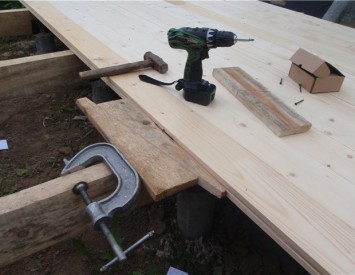
- Installation of wooden lags on the beams is performed using screws. The beams are processed by antiseptic impregnation and poured on the plane. The beams are not always installed perfectly horizontally. During attachment, wooden lining is used, and the mounting horizontal is checked by a long construction level. For screws in the lags, the holes are drilled.
Installation of wooden lag under floor covering
In the lower crown of the house, if during construction did not provide for the grooves for fastening the lag, it is necessary to label them. The insert is made by a turbo-shelf car with a disc on concrete. The groove is poured with a hammer and chisel.

- The horizontal plane of the lag is exhibited and adjusted with a long rail and construction level or rule. The check is carried out along the coordinate axes and diagonally. For correction and fittings are used hard wooden or plywood lining.
- The end parts of the lag installed in the lower crown of the house are laid by rubble and are embarrassed by cement mortar. Sculptures are attached to the wooden intermediate columns of lagows. To prevent cracking, the mounting place is pre-drilled.
- Brick intermediate columns are laid out in such a way that the last brick is perpendicular to the lag. Waterproofing from the frontieroid is placed on bricks and glued with bitumen mastic.
- The first are two lighthouse lags from opposite walls. They are aligned and the remaining intermediate lags are aligned. The protruding surfaces are constrained by the plane, and in the places of deflection places are installed. Lags for metal corners are attached and fixed by self-draws.
Warming of underground space and wall floor mounting
For a warm floor and a comfortable microclimate in the room, insulation of the underground space and the arrangement of ventilation channels is insulated if they were not laid during the construction of the house.

- In the free space between lags, basalt wool or polystyrene foam is stacked. In areas with a mild climate, sometimes cells between lags fall asleep with clay. In the lower crown of the house, ventilation holes with a diameter of up to 10 cm are cut into, in which metal sleeves and protective pads with a shallow metal grid are inserted.
- Wood flooring on the lags begins with a long-round room. Having retreated 10 mm from the wall, the first floor board is displayed to the wall. The clearance will later hide the plinth, and it is necessary for compensation in case of wood expansion. In the angle of the opening, the nails are driven or screwed up the screws in such a way that the caps are cut on 2 - 3 mm.
- The following rows are tightly pressed and bubble in the grooves with a wooden Cyan. It is important to take into account that when laying wooden floor boards, annual rings on a longitudinal cut of the boards had the opposite direction. A short edged floorboard is installed with a displacement. The last board is fastened with nails or screws at an angle of 65 ° - 75 ° in the direction from the wall so that the hats hid the plinth.