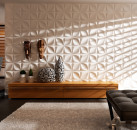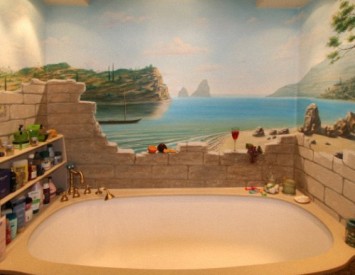
Three-dimensional wall painting Gypsum is a way to create three-dimensional compositions on the walls using plaster, wood, paints and other infrid materials. With this method of finishing walls, the interior is completely transformed, the irregularities of surfaces are equalized, the living space is visually increasing.
Content
- Choosing an idea for three-dimensional painting
- Selection of lighting for three-dimensional painting plaster
- Used to create three-dimensional painting materials
- Performing three-dimensional painting by plaster
- Addition of three-dimensional painting - bas-reliefs
- Care for three-dimensional painting from plaster and bas-relief
Choosing an idea for three-dimensional painting
This method of finishing use world-famous designers, for example, the world-famous artist of Interior Tom Berg creates compositions that transfer the owner of housing and its guests to the real forest. In the creations of Tom Berg, trees grow out of the walls, and three-dimensional landscapes inhale freshness and life into the room. Are works by such masters a lot of money, but use a little patience, desire and the necessary materials are easily created from plaster walls with their hands with minimal effort.

An exemplary procedure:
- Creating a three-dimensional painting from plaster starts with the choice of idea. The place of placement of painting, its lighting, size, materials and concept is selected. The idea is selected, based on its own preferences - a marine landscape, painting in the eastern tones, scenes from the life of wild animals, the quarters of the beloved city and much more. Next, the selected ideas are selected for the interior so that the painting emphasized him, hesitated harmoniously and did not fall out of the general accent.
- After creating an idea, its layout is created - a drawing or sketch of the future masterpiece. The size is carefully thought out so that the drawing is not lost against the background of a large plane of an empty wall, but also did not presue its size in a small room. With the help of programs like Photoshop, excellent layouts are created, which will clearly demonstrate the appearance of the future painting.
- As the easiest ideas that do not require mounted designs from wire or hypostertone and do not need a careful selection of lighting, painting in oriental style. Intry patterns and drawings are not difficult, it is not necessary for artistic and engineering skills for this, and the room will be supplemented with sophisticated beauty and style.

- Easy to perform landscapes without protruding elements - trees branches, waterfall cascades, animal figures, and other things. In such a design, much attention should be paid to the further design of paint. It will revive the painting, make it bright and intricate. Natural leaves and flowers are used to create complicated natural landscape shapes. They are arid and covered with plaster. It eliminates the need for a complex modeling of such elements from a solid piece of gypsum.

- The size of the composition is selected individually, based on the size of the room and its own aesthetic preferences. It can be a small painting around the switch, doors, or free from furniture corner or a whole picture that makes up all the walls of the room.
Selection of lighting for three-dimensional painting plaster
One of the most important points in the creation of painting is lighting. The direction and intensity of the light flow completely changes the perception of painting. The light hides all the shortcomings of the painting and highlights its advantages. In the absence of lighting or incorrect selection, some areas are shaded, this leads to visual deformation of the convex parts.
As a result, even the most even lines on an absolutely perfect painting will seem spoiled. It is necessary to select the backlight at the very end of the work when the painting is fully ready. It is at this stage, by samples and errors or a method of clear calculations, a backlight is established or ordinary stationary lamps, the light of which falls on the painting in the dark. If it is planned to create an internal illumination of the picture, then its equipment is thought out at the very beginning, since it is then impossible to pave all communications in the wall without prejudice to the mural.
Installation and backlight testing is carried out during the creation of the composition. When creating a composition with internal illumination, we think over the paths of easy repair of its elements. When breakdown in one of the lamps or diodes, they can be easily replaced inside the composition, without disturbing the integrity of the picture. To do this, leave small opening windows in the composition. Use wood, plasterboard, metal wire or decorative elements. For example, in the composition in the style of a night city, where the windows of houses are highlighted by small light bulbs, windows make opening.
Used to create three-dimensional painting materials
- When creating painting from plaster on the wall, a variety of materials are used. The basis of the whole composition is gypsum. It is used not only in its pure form, but also in the composition of gypsum plasters and putty, it does not affect the quality of the composition. If laying of large layers of material is planned, it is advisable to use plaster. For small parts, tinting and smoothing the compositions use putty. Plasterboard are used to create hidden cavities and layers.

- If you need to create an additional volume and strengthen the design, use wood materials. For example, with their help frames, lines, sides are created, to distinguish between the space of the composition and the creation of straight lines apply rails and bars. Compositions with speakers of wood trunks are created from real branches. They are well dried, fasten on the composition and then deceived by a gypsum solution so that the wood is organically fitted into the landscape. Also, the tree is used as a frame.
- Metal structures strengthen the gypsum elements. Metal wire is an excellent material for creating elements of a complex shape. With it, it creates the designs of various complexity, hollow elements, animal figures, protruding from the wall, details and much more.
- In the formation of landscapes of nature use natural stone. The grots, waterfalls, rocks or beaches are formed from it. To reduce the weight of the structure, it is advisable to choose a sewer or sandstone. The base of the stone smears with a layer of plaster, if the composition requires or simply polished and processed by varnish.

- To create a bulk painting, use specialized thick paint with filler. Such material is sold in art stores and helps to make volumetric strokes. This paste is easily prepared and at home - a color is added to the primer or putty and stirred to homogeneity. Moreover, this kind of mixture on gypsum surfaces creates a real monolith and is better enclosed with the basis. PVA glue is added to the wooden surfaces in the paste.
The limit of fantasy in the creation of the composition of the gypsum is not. In the picture, dried and declared leaves of trees, which give the image greater realistic. Dried flowers, inserts from genuine leather or fabric, feathers, jewelry and much more.
Performing three-dimensional painting by plaster
After the idea is selected and thought out and all materials are selected, the wall painting of the walls are started:
- Apply a pattern on the selected plane. If a color image is planned, the drawing is applied with multi-colored pencils so that it is once again to estimate the correctness of the layout selection. At this stage, some adjustment of forms and size are performed if they did not meet expectations.
- In the absence of a sufficient number of artistic skills, stencils are used. The workpiece for it is drawn on the computer, and then printed. There are two embodiments of the stencil - the hollow, in which the necessary parts of the drawings are cut, and then the composition on the wall is transferred along the inner lines. The second option is the usual drawing on the sheet, which is then transferred to the surface with copy paper.
- After transferring the picture, all the strengthening elements are mounted. Take into account the decoration of attachment points on all surrounding surfaces. All supporting structures from wood, metal or drywall are assembled. When fixing and choosing stiffness, weight increases after work.

- Next, spend all communications and check their work.
- Now the creative process begins - the modeling. The first layer is applied to the starting putty, it is placed on it a construction reinforcing grid, it will help to combine all the elements of the composition and will save from the formation of cracks and detachments. To speed up the process of creating a composition, it is divided into zones - a solution dries in one section, the process of modeling is running in the other. In some cases, additional reinforcement with wire or grid is required. The most important thing in the process of creating painting is not to be afraid of errors and irregularities in the picture. The individuality made by their own compositions is determined by such small inaccuracies and errors.
- In the simple version, the stencil is again applied on the putty layer again and the drawing of the gypsum is cut on the lines.
- After the end of all the work on the modeling, when the draft painting is ready, it decorate and create a volumetric pattern with structural formations. At this stage, all decorative elements and volumetric lines are ready.
- The composition is decorated and painted until its creator wishes. Only creating a masterpiece artist decides when a three-dimensional painting is completed. At the last stage, any deviations from the initial project are possible, since the decor of the walls by three-dimensional painting is a creative process that does not accept the mathematical accuracy of any repair work.
Addition of three-dimensional painting - bas-reliefs
Support the bulk composition from the gypsum and harmoniously enter it into the interior will help bas-reliefs. The technique of creating a bas-relief is similar to a three-dimensional painting. This is an ordinary three-dimensional pattern, which is created inpatient on the wall or with the possibility of transferring to the shrink. If a three-dimensional composition of the gypsum was created in the room, it will be perfectly complemented by the bas-relief of the same subject placed on the other wall of the room or in the next room. This will create a common image for the entire apartment. The following materials will be required to create a bas-relief:
- sculpture clay;
- stacks;
- capacity;
- knife;
- water;
- pVA glue;
- rolling;
- brush.

The process of creating a bas-relief looks like this:
- At the first stage, they prepare the wall, the surface is communicated to perfect evenness, painted. If you plan to create a portable bas-relief on the slip, then it is prepared from the same glove mixture, only more liquid. Also bas-reliefs create on plastic, cardboard or fiberboard.
- The future image is selected and transferred to the wall with the same method that was described in the method of creating a three-dimensional painting.
- The modeling starts with the central elements, from which the creation of the figure is moving on the periphery of the composition. The selected layout site is lit, and then placed on the sketch of the pattern. The form attached with stacks - it creates angles, lines, gives the shape of the figure. Thus, the element behind the element is laid out the entire picture. Before noting the upper layers of the bas-relief to the bottom, you should give them to dry, otherwise they may be damaged. If clay loses its softness and elasticity, it adds some water and PVA.
- When the composition is fully created, it is left for a week for complete drying.
- Next, irregularities are removed using fine sandpaper. Dust from the picture neatly blown away.
- Apply a mixture of PVA and water glue in a 1: 1 ratio. Leave the bas-relief to dry for another two days.
- After drying the protective layer on the bas-relief, varnish and paints are applied.
Care for three-dimensional painting from plaster and bas-relief
The rules for the care of compositions from plaster are simple. The first few weeks it is necessary to protect the gypsum design from moisture, dust and tobacco smoke.
Otherwise, it will lose brightness, and the colors will change their tone. Protective layer of varnish, which covers the painting, must be updated. The frequency of this action is determined individually and depends on the intensity of light and the amount of dust indoors. Wipe the composition dry or slightly damp cloth, also use a soft pan.