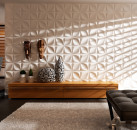
Textile wallpapers today are quite popular finishing material. They are produced on the basis of fabric or fliesline. Moreover, the fabric can be both genuine and synthetic. They can be used almost in any interior, but still the best of all they will look indoors with upholstered furniture and carpets. We will tell you about the nuances of choosing this material and work with it further.
Content
Textile Product Characteristics

The technology of production of such wallpapers is quite complicated. First of all, the preparation of the textile canvas is carried out, after which the base is glued on it. Then everything is pretty dry in special chambers. In addition, there is a technology that implies the mounting on the basis of not a whole web, and the threads. In any case, the glued wallpapers create the effect of upholstery walls with a cloth.
Textile wallpapers have a number of advantages:
- First of all, it is worth saying that they are quite aesthetic. This quality is achieved due to the fact that there are almost no joints between the canvas, which cannot be said about other types of wallpaper.
- Thanks to some qualitative characteristics of the tissue base, the coverage of these wallpaper has functions of heat and sound insulation, which is very useful for urban apartments.
- In addition, it should be noted that these wallpapers are made of natural material. Therefore, it is reduced to a minimum risk of an allergic reaction and accumulation in the premises of harmful substances.
- Due to the fact that the canvases are made of fabric, they "breathe", because of which moisture will not accumulate and you can avoid the appearance of mold.
- In addition, some types of these wallpapers have additional beneficial properties. For example, linen fabric cans have bactericidal effects.
- It is also worth noting that today there is a large range of textile wallpapers of different shades and patterns.
Textile wallpapers for walls have some "weaknesses":
- The main minus is the price. Some wallpaper models (premium) are much more expensive than other finishing materials.
- In addition, this type of coating requires special care, since the surface of most of these wallpapers is strongly attracting dust. The exception is only those types of material that were treated with antistatic impregnation.
- If we talk about ordinary wallpaper, you do not need care for them, but the textile canvas will need to be periodically vacuuming. You can purchase antistatic materials that do not attract dust particles, but the price of textile wallpaper of this class is usually very high.
- In addition, it is worth noting that the larger in the material of natural filaments, the more uniform color. Wet cleaning they do not tolerate. Therefore, you have to spend only dry cleaning, and do it carefully.
- In addition, when sticking should be very careful that even a drop of glue does not hit the surface of the wallpaper. If the adhesive composition falls on the fabric, it will remain there forever in the form of stains. This is not avoided, even if you use glue, which is recommended by the manufacturer. So be careful and careful.
It can be concluded that the minuses in textile canvases are still more than the advantages. Therefore, many try not to use them for finishing. In some cases, it is solved only to make a small decorative insert from textiles. In general, this kind of wallpaper prefers respectable and wealthy people. After all, they are only interested in the chic appearance of textiles, and hired workers will be performed.
It is worth saying that many elegant interiors have their luxurious species in many ways due to the fact that the walls were saved with textile wallpaper. After all, no invoice can be equal to beauty with textiles, which literally enjoys the room and makes it more comfortable. This method of wall decoration even today is considered one of the most expensive types of finishes, which can not afford not to each owner. To use such wallpapers, you need to prepare for work, read the instructions, talk to people who were engaged in such a sticking.
Types of textile canvases

Wallpapers on a textile basis have their own classification, depending on which the fabric was the basis for their production. Consider only some of them:
- The budget option is considered linen walls. They are manufactured using modern technology lamination surfaces. The result is the basis on which some threads differ slightly with a tint, "playing color." This gives the material a natural look. In addition, the wall, placed by such products, looks like a cloth. This type of wallpaper has a high degree of sound and thermal insulation. In addition, they are racks for fading. At the same time, they are less than others attract dust. These wallpapers are suitable for children, cabinets and other premises, where the level of moisture is held within the normal range.
- Pretty popular jute wallpaper. Jute itself is an Indian plant used as the starting material for fabric and rope. Wallpaper from it have a pronounced texture. With the help of them you can hide small defects on the walls. In addition, there are varieties of such crafts that can be painted in the desired color. Jute wallpapers can not be called demanding. They are not the most difficult in care. Therefore, they should not deliver a lot of problems. In addition, they do not burn out and rather wear-resistant.
- In bedrooms and cabinets are widely used silk wallpaper. If you see the composition of these canvases, you can see that they actually consist only of silk. What makes these wallpaper makes much cheaper. The rest of the material is viscose. The properties of silk wallpapers are the same as most other textile canvases.
- The most popular view of textile wallpapers are considered felt products. The external texture, they strongly resemble such material as velor. These wallpapers almost under the influence of the Sun are not fused. In addition, they have good sound and thermal insulation. They are made by applying felt. Instead, the material sometimes use propylene or other analogs. The smaller in the wallpaper of synthetic components, they are less environmentally friendly. On the other hand, such canvases are somewhat cheaper, and care is an easy task. After all, they can be washed even with the help of a washing vacuum cleaner. Externally, the walls look like a delayed whole piece of fabric. But not for all rooms, this material is suitable. The fact is that these wallpapers strongly absorb odors. Therefore, it is desirable to use them in rooms where there are no smells. For example, it is a living room and a bedroom.
- Vellar wallpaper Produced according to one of the most modern techniques. Their base is paper that is covered by a polyvinyl chloride mixture. Next, an adhesive paint ornament is applied to the surface of the material. After that, the blade is processed in a special machine, as a result of which the tissue particles are sprayed on the adhesive base. They, due to static electricity, cover the entire surface of the material. After that, the obtained canvas carefully succumb. It turns out the material that externally looks like expensive fabrics, for example, velvet or tapestry. Despite the wonderful appearance of such wallpapers, their operational properties leave much to be desired. The fact is that this kind of cloths is very bad to carry mechanical impacts. In addition, problems can cause care. For this reason, it is better to beat them in the bedroom, where there is no large cluster of people. Anyway, the canvas will require special care. Otherwise, they will lose their main advantage - an excellent appearance.
- One of the most unusual wallpapers can be called frames "Japanese grass". The process of their manufacture is as follows: Fiberglass threads are placed on the basis of paper. In some cases, other materials are used instead of fiberglass. In any case, production is quite expensive. In this case, the demand for these wallpaper is relatively small. If we talk about their sticking, then immediately it should be noted that it is quite difficult. Therefore, it is recommended to trust this business professionals. With such thin canvases it is difficult to work. Because of their thickness, through the material without problems you can see all the defects of the working surface. Therefore, the wall before sticking should be carefully treated so that it becomes perfectly smooth.
Textile wallpapers: photo


As for the basis of textile wallpaper, most often use:
- flislinic materials,
- synthetics
- paper.
Textile flieslinic wallpapers are easily pasted onto a working surface, but if you compare them with other webs of the same class, it should be said that they need impregnation with glue. Without it, it is very difficult to stick the material.
The basis of synthetic textile wallpapers is a thin foam. Therefore, the thickness of the material can be about 4 mm. As a result, the surface of the walls, placed by such wallpaper, becomes soft to the touch. In addition, it serves as additional heat and sound insulation. The thickness of the materials strongly complicates the docking, so the web has to be connected manually to each other. Therefore, if there is no experience, then it makes no sense to think about sticking these wallpaper.
As for paper-based wallpapers, it is one of the most eco-friendly materials. Especially if only natural fibers are used in the canvases. It is worth noting that, unlike wallpaper on a flash basis, they glue a little more difficult.
Apart from various colors and textured decisions, we looked at all the variety of modern textile products, which today can be found on sale.
Textile wallpapers: how to glue

To reduce the number of cropping, it should be calculated how the wallpaper and doors will be fitted. It is worth reading the text that is available on the roll. Be sure to take each web for compliance with the articula and color. When cutting out the material it is worth leaving 100 mm so that you can already close the cloth under the ceiling.
Before you begin to stick, you should know what basis it is done. If it is fliseline, the glue is allowed to be applied to the wall, and the wallpaper does not pre-process. If the basis is paper, the glue must be gently applied onto the canvas, then wait a bit while the paper elevates moisture, and then glue. You can do it differently. For example, apply glue to the wall, but at the same time prepare a web in advance by treatment with a sponge, slightly moistened in water. In this case, the moisture should be so much so that it does not pass through the canvas and the seams are not wicked.
Important moments:
- The fabric is a rather hygroscopic material. Therefore, even a small drop can turn into a cloth into a large spot. This stain after driving, can leave unpleasant view of the divorce. Defects may appear, even if the drops of pure water droplets. The fact is that the threads are painted water-based paints.
- One way or another, when weeping these wallpapers, it is necessary to carefully monitor the amount of glue applied. It should be so much enough for uniform gluing. The glue should not soak the canvas through either go through the seams. In the event of an adhesive composition on the front side of the canvas, it will have to be replaced with a new one. Therefore, be extremely neat.
- After sticking two cloths, they should look at them: they should not be notable defects. In order to estimate the quality of work as a whole, you need to give the material to dry. In addition, some defects (for example, spots, divorces and discrepancies of the seams), we manage to see only after the glue dries. If there are no defects, then you can continue pastizing the walls of the rest of the room.
- When gluing textile wallpapers, it is categorically impossible to use a plastic spatula. The fact is that it squeezes the glue through the seam, which is why stains are formed on the canvases. Wallpaper from textiles is recommended to smooth out the roller, and it should be done from top to bottom.
Punning textile canvases with reverses

Such wallpapers are noted by a special icon with parallel arrows directed in different directions. If you see this symbol, it means that these textile canvases need to be glued to each other. Pre-prepare wallpaper for sticking. For this, they are cut into parts of the desired length. Each of them should make a mark so that on it then focus, how to stick the canvas correctly.
The first canvas should be glued so that this arrow drawn on the icon was directed upward, the second one corresponduously pastes the down arrow. The next canvas again up arrow up, etc. As a result, it turns out that the right and left edges will be combined correctly.
Reverse wallpaper color that has the right edge, in some cases a little lighter or, on the contrary, is darker than the left. This differential is almost impaired until the wallpapers are pissed. This nuance will be visually visited if reverse textile products are punished as ordinary, i.e. All canvas in one direction. A sharp transition of a light edge to the dark will be noticeable. Typically, these wallpapers do not have a picture, so they are not required to strictly combine. The technique of sticking some other canvases with reverse may not be as described above. Therefore, carefully read the instructions attached to the roll of wallpaper.
Punching textile wallpaper with a hubborn pattern
Some manufacturers of textile wallpapers produce products on the edges of the webs of which there are repeated drawings. Thanks to this, the seam after sticking will be neat. The groove drawing avoids damage to the edges during the transportation of rolls.
If you break such wallpapers in the usual way, i.e. Job, it will be seen that the seam has a drawing of the pattern. In this case, the canvas should stick the bracket, which combines the applied pattern. After that, take a ruler, and with a sharp knife to cut off the edges with a sharp knife. In order to avoid the appearance of stains, it is impossible to allow the adhesive solution to hit the front surface of the wallpaper.
Nuances of textile leaf care

After repair, there are usually excess material. These trimming is recommended to save. They can experience cleaning products before using them on the already pasted canvases. Textiles - material is quite demanding and fragile. Usually for care for such wallpaper use "dry" cleaning. If you do not test the remedy on trimming, you can spoil the work done earlier.
It is also worth saying that textile wallpapers are slightly different from others by the method of drying. Textiles dries longer. Therefore, it is impossible to allow a draft of at least two days after sticking to the premises. Recommended term - three days. The drying process should pass, while the room holds an acceptable temperature. During this time, the canvas will be able to get used to the conditions in which they will be constantly being.
How to glue textile wallpapers: video
m.