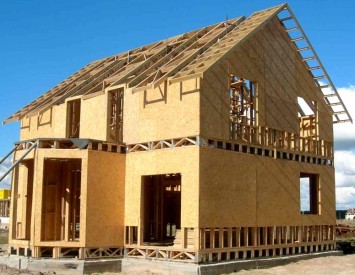
The frame houses first appeared in the United States, but over the past few years, such a construction practice has gained popularity and in domestic expanses. Despite several advantages of such buildings, inexpensive and ergonomic houses have one significant drawback - a low thermal insulation. It is for this reason that the insulation of the walls of a frame house becomes a priority when building a building.
Content
Choosing an optimal insulation
Technology domazavisit insulating walls of the frame on the type of insulating material selected for cladding walls. Since the normal room humidity and heat retention inside - important criteria for a comfortable stay, the choice of material should be approached with responsibility and scrupulousness.
In general, all insulation materials can be divided into two groups:
- organic;
- synthetic.
In the first category, raw materials of natural origin, for example, tyrsh, peat, chips, etc. Such materials are environmentally friendly and do not harm human health during operation, but they are impractical: high degree of flammability, moisture intensity and low thermal insulation - not the best option for insulation of modern buildings.
The second group can be attributed to more technological insulation, which provide reliable insulation of the room. These include:
- balzat mineral wool;
- equata;
- wool from fiberglass;
- foam and foam;
- stone wool.

Consider the features of the operation of each material in more detail:
- Basalt Minvata. - One of the highest quality absorbing materials, which has significant advantages: resistance to biological corrosion, low flammability, good sound insulation, resistance to moisture and sunshine.
- Glasswater - Material with high vapor permeability. Also, this insulation is easy to install and does not fall apart with time. However, with thermal insulation of the walls of glass, it is necessary to additionally fix a special film that helps to hold heat inside the house.
- Ekwata. - relatively new seal, which is cellulose fibers. It has a natural origin, does not require installation of films and has good thermal insulation properties. The insulation of the walls of the frame house is an equally relevant for those who seek to make the house are environmentally friendly.
- Penoplast and Penosop - The most popular materials for insulation of the room. The advantage of such a raw material consists in high moisture resistance, due to which the pair-protecting membrane will not be necessary. As well as the insulation of the walls of the frame house, the foam is much cheaper than the analogues, while the quality of the result achieved does not change.
- Stone Vata. - New finishing material, which is rapidly gaining popularity. This type of insulation has good water repellent properties and flexibility. It is distinguished by durability during operation and easy to install.

Warming of the walls of a frame house outside
The loss of thermal insulation properties in the houses of a frame type occurs through the walls of the structure. This indicator often exceeds 40% of the overall heat loss of the building. Therefore, the process of cladding walls can be carried out as an outdoor method, and choose the inner finish of surfaces. The most appropriate and practical decision will be the outer thermal insulation of the house, since it is much easier to lay material from the street.
Since the foam is the most popular and affordable insulation, consider the process of insulating wall cladding on the example of this material.
Step 1: Waterproofing Surface
- Prepare waterproofing material. For these purposes, Pergamine is best suited, the water absorption of which is 20% per day.
- Remove the roll in accordance with the sizes of frame sections.
- With the help of a building stapler, lock the parchment to the trim and standing stands. Strengthen on the joints at the intervals of 10-13 cm.
Important! Fragments of the interlayer must be laid the bracket, making a 10 cm overlay.

Step 2: Playing a vaporizolation membrane
This stage in the insulation of the walls of the frame building is necessary, even if you are placing the highest quality insulating materials that moisture are not afraid. The reason is the feature that, in addition to the insulation, other elements are also in the wall cake of the house. They also need to protect against steam penetrating the walls.
Consider the step-by-step guide to laying a vaporizolation membrane:
- This material is fixed to the construction of the frame by the construction stapler so that the film is closely adjacent to the seal.
- As in the case of waterproofing, the junctions of the membrane should be made by the brass, leaving the lining at least 10 cm.
- For a better result, all the places of the adjoint must be strengthened with aluminum scotch.
Important! Sometimes builders resort to such a vapor barrier method as a simple winding of insulating membrane sheets. However, this technique will not be able to protect all framework elements.

Step 3: Staying insulation
- Prepare foam plates, cutting them into the required dimensions, depending on the size of the frame sections. This uses an electrolovka or hacksaw with small teeth.
- Place the insulation between the racks so that the sheets fall uniformly, and in the places of adjoining to the wooden bars, 2-3 cm remained on ventilation.
- Each plate of foam plastic is attached to the base of the walls by means of special compositions: two-component - adhesive and aligning, or one universal.
- For strength, glued blocks must be fixed with umbrellas or fungi.

Step 4: Wall Facing
After the process of insulation of the walls of the frame building is completed, it is necessary to firm the surfaces. This is suitable for plasterboard sheets or OSB plates.
- plasterboard is recommended for perfectly smooth walls;
- OSB can be attached to any surface, since the stiffness of the material will allow you to hide and align flaws on the wall.
On top of these facing materials, a decorative finish of surfaces can be performed.

Wall insulation from within a frame house
This technique of thermal insulation is carried out according to a similar principle with the insulation of the outer surface of the house. However, minor differences in the techniques are still present. Consider their more details:
- The wall surface must be prepared: clean and align flawed.
- Then the walls are carefully processed by primer.
- After that, you can proceed to laying foam sheets. The method of fastening is similar to the previous one - first plates are glued, then fixed with fasteners.
- The drywall sheets are stacked on top, which are also fixed using mounting glue, and for reliability are fixed with umbrella dowels.
- After that, finishing finish and decorative wall lining.
Important! It should be known that the insulation of walls from the inside is less efficient than the outer insulation, while the thermal insulation material significantly reduces the size of the room. This technique is extremely rare, in case it is impossible to conduct outdoor work.
The instruction regarding the process of insulation of the walls of the frame building is presented on video fragments: