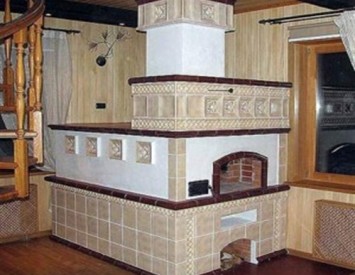
Recently, to give an attractive and aesthetic look to a non-stove, facing with ceramic tiles stoves have increasingly be used. At the same time, the correctness of the choice of suitable materials and the literacy of the installation have a significant impact on the final result of the facing, therefore, at the preparatory stage, it is necessary to take this event very seriously.
Content
Criteria selection tiles for facing oven
When choosing a facing material, it is worth considering not only the style of the interior, but also the compliance of the materials to the conditions of future operation. Therefore, choosing a refractory tile, it is necessary to pay attention to the following parameters:
- maximum level of moisture absorption up to 3%;
- the thickness of the tile varies in the range of 6-8 mm;
- the linear extension coefficient is 7-8% relative to the density of the selected tile;
- availability of information on the absence of deformation with a sharp decrease / temperature increase;
- the absence of the tiles of harmful elements released when the temperature is heated to 1000 ° C;
- high thermal conductivity coefficient, heat capacity;
- resistance to aggressive media;
- manufacturer's warranty for the operating period, which is up to 50 years.

The inconsistency of the tile at least one parameter will soon serve as a reason for peeling the tile from the base, the formation of cracks, the heat transfer disorders and, as a result, the reduction in the efficiency of heating.
Types of refractory ceramic tiles
Recently, extensive distribution has been facing with ceramic tiles, the price of which is formed under the influence of the cost of components included in its composition. However, despite the variety of varieties of ceramic tiles, only the following types are suitable for facing furnaces:
1. The terracotta tile is formed as a result of pressing kaolin clay followed by a firing at a temperature greater than 1000 ° C. At the same time, shame, an increase in the heat resistance of the finished product, and various additives in the form of cobalt, manganese, iron, to create a sample spectrum are added to the clay. The terracotta tile has a homogeneous high-resistant structure, a embossed spacious surface with unobtrusive shades.

Advantages:
- lack of temporary deformation under the influence of large temperature fluctuations;
- resistance to fading;
- when heated, there is no extraction of toxic substances;
- high strength with a slight weight that does not require increased construction during cladding;
- the speed of heating the structure of the tile with a slow heat transfer allows for a long time to maintain heat indoors;
- high countertility preventing the racing tile racing racing;
- easy laying;
- durability.
The disadvantage of terracotta tiles is quite high cost, although a wide selection of the color spectrum, along with the duration of operation, the price factor is insignificant.
2. MAJOLIKA - is made similarly to terracotta tiles, possessing the same set of advantages.

At the same time, the distinctive features of Myolics are:
- glazed surface;
- expressive relief;
- availability of pattern.
Due to the coating of the tile surface with a small layer of glaze, the majolica can be used for cladding of furnaces, without fearing the probability of cracking in the glazed coating.
3. Clinker tiles - manufactured by extrusion from a variety of clay varieties in combination with shamot, flux, mineral inclusions with subsequent firing. The clinker tile is inherent glazed, or a splading surface with a small relief.

Advantages:
- a low-spirited high-strength structure contributes to good heat transfer;
- low coefficient of moisture absorption;
- excellent heat exchangers;
- high frost, heat resistance;
- does not react to significant temperature differences;
- environmentally friendly material that prevents emission of harmful compounds when heated;
- ease of care, installation;
- long operation.

Against the background of all the advantages, with the cladding of the furnaces with ceramic tiles, the cost, and quite high, does not represent much interest.
When facing the furnaces should be used to use a tight clinker tile, since when heated, the finishing material is possible, due to the various thermal expansion of the stove walls and glazed clinker tiles.
4. Porcelain stoneware is made from a composition comprising inhomogeneous clay, marble or granite crumb, quartz sand, oxides of a variety of metals, by pressing under greater pressure. In the process of firing, the temperature reaches 1200-1300 ° C, contributing to sintering the mass into the monolithic structure. The ceramic granite is characterized by an unhappy surface, although glazed tiles are also available in small quantities. However, the smooth surface of the porcelain is achieved not only by applying the glaze, but also by polishing, somewhat reducing the strength of the product. 
Advantages:
- the possibility of imitation for granite, clinker, terracotta;
- resistance to fading;
- high strength of the product prevents temporal deformation;
- resistance to surface cracking within a large range of temperature fluctuations;
- minimal moisture absorption that promotes use in conditions of high humidity;
- frost resistance;
- durability.
Of all the types of ceramic tiles, porcelain stoneware has a long utilization period, along with the predominance of quality characteristics and, accordingly, cost.
5. Tiles - piece material produced from special grades of clay by calcination at high temperatures. Glazed tiles have a glossy surface with a printed pattern, although monochrome surface is no exception. Thus tiles surface is perfectly flat or comprising some or significant relief of convexity and concavity.
A distinctive feature of the tiles, from all kinds of tile material is the presence of voids on the reverse side of the element resembling an open box, through which are provided with a unique heat-saving properties. 
Advantages:
- ecological purity of the product;
- high resistance to sudden temperature changes;
- moisture, frost;
- nonsusceptibility a mechanical deformation under the influence of UV;
- high heat transfer coefficient;
- ease of maintenance;
- long operational period.
Prohibitively high cost did not attach cladding tiles special popularity. Moreover, installation of tiles only in brickwork of the furnace, i.e. oblitsevat them already folded oven is simply impossible.
Technology cladding with ceramic tiles furnaces
All cladding process is divided into several stages, consistency and completeness of performance which will ensure the success of the final result.
Substrate preparation
Preliminary work associated with performing the dirtiest work, which determines the reliability of the tile engagement with the furnace surface. In preparation is necessary:
- thoroughly clean the surface from plaster, paint down to the bricks;

- make frequent sipe depth about 2 cm, if the oven has been painted and the paint removal causes severe difficulty;
- clear the joints between the masonry at a depth of 1 cm, using a wire brush or grinder;
- wipe with a damp cloth to remove dust and debris remaining particles;
- every 0.5 m mezhkirpichnye seams to drive nails or screw anchors, leaving the distance from the surface of about 5 mm to secure a mesh or wire;
- set ready mesh with 50x50 mm or erect it from the wire, by fixing nails, anchors;

- mix a solution of sand, clay and cement in a ratio of 0.2: 3: 1, although can use the prepared adhesive compositions (e.g., Skanfixsuper);
- plaster made solution of the entire surface of the furnace;

- check the verticality of the angles, walls using a plumb;
- if necessary, apply an additional layer of solution to reach direct surfaces, angles;
- wait for a complete drying of the plaster layer and protruding the oven;
- after cooling the furnace, you can start mounting tiles.
Selection of adhesive composition
Glue used to lay tile, not necessarily choose the most expensive. The most important thing is that it is heat-resistant and withstand the temperature differences without any changes in the initial species. Currently, such brands of heat-resistant glue, as Hercules, Hevesil Termix, Ceresit, a somewhat different composition, cost, are widespread.

The ideal option will be the purchase of facing tiles and adhesive composition in one store, where glue will immediately select relative to the selected version of the ceramic tile.
Laying tile
Before the direct process of cladding, around the perimeter of the furnace, first it is necessary horizontally using the level, fasten the rail so that the height from the top edge of the rail to the floor is equal to the height of the tile, taking into account the interpatch seam.
The implementation of this procedure is possible, even if there are insignificant, the irregularities of the floor, due to which the seams of the above-mentioned rows will be eliminated by disturbing the aesthetic attraction of a lined oven.

Facing tile is performed in the following order, ranging from fixed rail:
- on the tile, apply a thickness of 2-5 mm thick and dissolve with a toothed spatter over the entire surface;

- attach to the wall and, turning a little tile from the side to the side, finally press the hands in the desired position;
- the next tile is stacked in the same way;
- between the tiles, install suture crossbars providing the same width of the seam;

- at the end of the highest row, remove the horizontal rail;
- touch the tile in height, if necessary, trim, then apply glue and glue the furnace;
- give glue to dry for 3 days.
Shutdown of seams
To fill the interpatine seams, you can pick up a special grout into a tone of a facing material, or a tile contrasting with the main color, and you can use the composition by which laying was carried out. Field process:
- remove crosses;
- clean the seams from the remaining glue;
- wipe the surface with a damp rag in order to avoid dust entering the grouting composition;
- dilute the grout according to the instructions and mix thoroughly;
- to maximize the filling of the suture space, it is necessary to ram the grout of the hand by pressing hand movements using a rubber spatula;

- the rounded end of the spatula to spend on the filled seam, giving the final form;
- after 2-3 hours, wipe the surface with a moistened rag, removing traces of the remaining branch;
- after a day, the surface of the tile can be washed with a soap solution, after which it is possible to finally dry.

As a result, what result it turns out when cladding the furnaces with ceramic tiles, the video will tell once again:
Useful advice
- For exterior angles, it is necessary to use solid tiles, and cutting parts are fully cut in the places of dusting.
- When cutting, the rairy tape passed on the surface of the tile will prevent the formation of the chip during the dipping of the desired item.
- Rezanny fragments are stacked only after the end of the facing with whole tiles.
- Each 2 rows it is necessary to check the evenness of the lined tiles by means of a level, since it is possible to correct the glued tiles for 15 minutes until the glue grabbed.
- Excess adhesive composition, which turned out in the seams, need to be removed immediately with a narrow spatula.
- Adding a conventional salt to the glue composition (1 bucket of + 1 kg of salt) ensures an obstacle to rapid evaporation of moisture, increasing the time to adjust the position of the laid tile.
- It is better to start the stove better gradually, after 1-2 weeks so that the finishing materials are gradually accustomed to raising the temperature. Otherwise, the sharp drop of high temperatures may result in peeling the tile from the furnace surface.

Upon completion of the facing of the furnaces with ceramic tiles, the photos of which are presented in the article, the oldest furnace acquires the appearance of a new design that pleads its owner with the result.