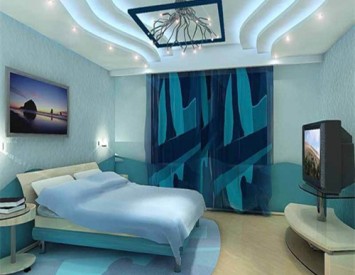
Currently, a multi-level device of suspended and stretch ceilings significantly transforms the interior of the room. In this case, an important role is played by the properly designed and competently installed lighting. Great opportunities in the design of the ceiling today opens LED products, through which it is possible to achieve not only high-quality lighting, but also the original LED. In addition, a beginner specialist will be able to fulfill the LED lighting of the ceiling with their own hands.
Content
Types of LED products
High demand for LED products pushes manufacturers to constant improvement of old and release new models. To date, LED products are made in the form:

- linear type lamps;

- point luminaires;

- various types of ribbons;

- radiators of the searchlight type.

The lamps of the point and linear plan are used to create the main light, while the LED ribbons are ideal for decorative purposes (for example, to illuminate the ceiling, curtains).

Despite the fact that LED ribbons are a relatively new fashion trend, they still managed to win a large audience of designers who actively use them when interior design.
Varieties of LED tapes
The LED tape is a flexible fee on which resistors and LEDs are located at certain intervals. The LED tape of 5 m long is supplied to the realization in the coils, in order to avoid damaging during the transport period, since the tape width varies in the range of 8-10 mm, and the maximum thickness does not exceed 3 mm.

Food ribbons are made from voltage 12 V, so a transformer is required to connect to their connection to 12V 12 to voltage.

The power of the LED tape, along with the brightness of the glow, largely depends on the number of LEDs located on 1 m, the density of which can be 30, 60, 120 and less often 240.

Based on the shade of the glow, the LED ribbons are divided into:
- LEDs are characterized by monophonism of the glow. To the transformer, such tapes are connected in parallel. In addition, monochrome tapes do not require the use of the controller;

- rGB LED tapes - equipped with diodes that radiate the light of various shades. In this case, the ribbon installation is carried out only if there is a controller, by means of which not only the color of the strip and the brightness of the glow is changed, but also the synchronous switching on / disable LEDs. In addition, for every 5 m RGB ribbons, it is necessary to install the signal amplifier, especially if the power of the tape exceeds the power of the controller. Connecting several RGB ribbons is carried out in parallel to one another.

Despite the fact that the creation of a backlight using RGB ribbons is made only with the use of the controller, the cost of them will be at no higher prices for ordinary LED ribbons, especially considering the purchase of several monochrome tapes needed to obtain an effect similar to the use of one RGB ribbon.
Advantages / Disadvantages of LED Tapes
Relatively recently the ceilings equipped with point lamps were considered relatively recently. Currently, the ceiling LED lighting is based on both the use of lamps and LED tapes with unique operational and decorative characteristics.

Advantages:
- the possibility of accommodating the ceiling plinth, in the area of \u200b\u200bthe eaves or in a small niche due to compact sizes;
- the lack of mercury does not require special disposal of exhaust products;
- high efficiency is due to low power consumption;
- the ease of the perception of illumination due to the lack of flickering and the effect of blinding;
- the presence of the controller allows you to make an instantaneous switching on / off;
- high resistance to voltage and temperature drops;
- low degree of ultraviolet and infrared radiation;
- uniform distribution of the light flux inside the room;
- high level of reference;
- easy installation associated with the presence of a self-adhesive basis;
- duration of operation.

Along with a lot of advantages, LED tapes have one substantial minus - quite high cost. However, the durability and aesthetic attractiveness of any backlight made using various types of LED tapes are worth such investments.
Views of the ceiling backlight
Modern ceiling lighting is divided into the following types:

- general purpose - is realized with the help of point lights or suspended devices;

- target - applies to zoning the space of the room to certain segments by directed illumination using point lighting devices;

- designer - carried out by LED ribbons and ensures the comfort of staying in the room due to the diffusing light output of diodes.

For decorative ceiling design, a directional or contour illumination is applied. At the same time, the complexity of mounting work on the ceiling lighting LED ribbon depends on the type of backlight and the design of suspended or stretch ceilings.

Mounting backlight
Preparatory work
Before proceeding to fixing the tape, it is necessary:

- Check the compliance of the power of the transformer length of the tape. For this, the length of the tape required to illuminate a certain section of the ceiling is multiplied by the power consumption of 1 m, which is indicated on the package. The resulting value is increasing by 20%, creating a power reserve. If a significantly lower power is indicated on the power supply than the calculated one, then it must be replaced immediately to a more powerful one. When installing a tape with a length of 15-20 m, it is advisable instead of one power supply unit of high power and, accordingly, significant dimensions use 2 small for each tape.

- Select the controller. If the controller power is less than the power of the LED tape, then you will have to purchase a signal amplifier at the rate of 1 amplifier by 5 m tapes.

- Prepare a tape. If the base is contained for sticking the base greater than 5, 10, 15 m, etc., then you need to cut off the missing piece in a place specifically indicated by the manufacturer. To solder individual pieces of ribbons to one whole better on the floor, because at the top there is not very convenient to do. Pour soldering places with a shrink tape. To improve contact between the transformer and wires, the ends of the wires are needed to close with special contact tips.

Basic principles of installation of LED tape
The tape mount is carried out by means of adhesive base on an aluminum or plastic profile, pre-fixed with the help of self-tapping screws. As a rule, the width of such a profile is about 3 cm. However, the profile is used mainly when the backlight mounting is hidden. At the same time, the installation of tension ceilings lighting with the LED tape is quite a lot.

Ribbon can be fixed:
- to the rough ceiling. Manipulations are made after the placement of all guides and profiles intended for the tension of PVC canvas. At the same time, the distance from the base to the stretch ceiling should be about 10 cm;

- to the wall between the draft and stretch ceiling;

- to the profile, fixed between levels, if a two-level system is planned. Fixation of the tape in this case is made until the guide and tension of PVC canvas.

However, with LED lighting of the stretch ceiling, it is worth considering the direction of light radiation, in order to the draft ceiling and other ceiling structures did not spoil the aesthetics of the completed type.

LED tape can be mounted and when finished tensioning ceiling. To do this, polyurethane eaves or ceiling plinth is attached to the wall so that the distance from the ceiling to the eaves is 2-3 cm. The width of the plinth must match the transformer and controller dimensions.

Similarly, the LED ribbon can be placed behind the plinth.

In addition, when laying the tape on the plinth or cornice, it is worth considering that the ceiling and other lighting elements are not reflected on the glossy surface of PVC.

The considered ribbon installation options are applied to the stretch ceiling and for mounting the lighting ceiling lighting from drywall. The exception is only over the option that implies the fastening of the ribbon to the rough ceiling, as plasterboard is not able to skip light.

After the ribbon is fully pasted, it is necessary to connect it to the power supply and controller, while observing the correct connection of the wires.
Thus, all complexity and labor-intensity of work in the design of LED lighting are related to the technical, as well as the optical characteristics of diodes, among which are important meaning as the power of the light flux, the angle of light radiation, the degree of reflection, and the color gamut ceiling, walls. At the same time, the direct installation of the tape does not take much time and is easily ease and simplicity. However, the final result, depending on the quality of the execution of all stages, will exceed all expectations.