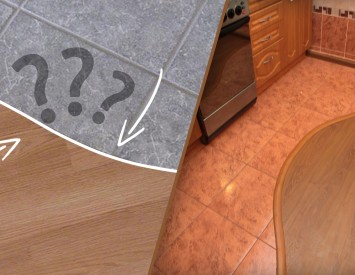
Over the past years, the method of combining two finishing materials in one coating has gained considerable popularity. Such a designer solution allows you to create original design of the room and divide it into zones. One of the options for execution is a laminate boards with tiles. This will make it easy to zonate various space segments. In this article, we will look at the features of such a dock and the ways to perform it.
Content
Features of registration
The docking of coatings is often performed both in the living room and in the kitchen. However, this scope of the application is not limited. A fairly common option is the design of space near the fireplace or balcony. This technique is used for the arrangement of hallways. And near the entrance door, as a rule, a tile is stacked, which is more resistant to moisture, and then the laminate coating is located.
Tile is recommended to highlight the space near the washing, plates, kitchen headset, washing machine. This material has a high degree of strength, resistant to mechanical effects, moisture and high temperature. The tile is easily cleaned by contaminants, including fat. But it is not recommended to cover it all the surface of the floor, since it is uncomfortable to walk on such a coating. This is pretty slippery and cold material. Laminate is more convenient for this. According to tactile sensations, he resembles natural wood, but it is noticeable cheaper. The appearance of the laminate board is preserved for a long period.
The following reasons for combining two types of coatings can be distinguished:
- zoning space;
- visual increase in the room;
- efficiency. Tile costs more than laminate, so the use of two materials will help reduce repair costs;
- practicality. The use of tile coating will give the ability to protect places subject to mechanical loads.
Laminate and tile jack. Photo:


Method of registration with the help of thresholds
When combining coatings, the question will inevitably arise how to make a junction between tiles and laminate. One of the options for design is the use of ironing. They are divided into several types of material from which are made. These products are divided into:
- steel;
- aluminum;
- wooden;
- plastic parts.
More advantageous performance characteristics have aluminum and steel-based beams. They exceed products from other materials for strength and wear resistance. But it is advisable to apply only when working with a metallized tile.
For tiles and ceramics, wooden and plastic parts will be more suitable. Wooden boards are distinguished by high aesthetic indicators. Plastic products can mimic various types of wood, but they are inferior in terms of the strength of the natural wood. For this reason, they should not be used in premises with a large load. In order to maximize the aesthetically arrange the joints of the tile and laminate, the flames should be chosen under the color of the coating.
The threshings are also divided into species depending on the purpose. According to this criterion, allocate:
- aligning;
- straight;
- finishing elements.
Direct type products are used to protect and decorate the gap between coatings that are on the same level. The task of leveling parts is adjusting the difference between coatings. With the help of the final elements, edges of podiums are drawn up.
Docking is performed as follows:
- There must be a minimum clearance between finishing materials.
- The edges in processing do not need, they will be closed with a spawning.
- Over the gap through a perforator or electric drill holes.
- Next, with the help of plastic dowels, the threshings are mounted.
- Moldings may have a hidden fastening. In this case, the bottom plank is installed primarily, after which the threshings are fixed.

Disguise with cork
The junction of the tile and laminate without a neck can be issued using the cork compensator. This product is very easy to use, because It you just need to insert into the gap. The advantage of such a plug is the lack of need to leave the technological seam, since the compensator has an increase in and decrease in size by 5 mm.
But when using this product, the tile and laminate must be cut as soon as possible. The cork only fills the space, but does not hide the edges of the floor covering. Therefore, if the cutting is made poorly, all defects will be visible.

Features of the use of sealing agents
A silicone sealant or mounting foam is also used to mask the gap. Today, there are sealants of various shades on sale, which will allow you to choose a remedy for the color of the coating. The sealing composition should have high elasticity to compensate for the difference in the physical properties of the laminate board and tiles.
The advantage of this method for placing joints is high strength and reliability. But the use of such agents has the opposite direction - the impossibility of carrying out repair work in the field of compound. In case of such a need, you will have to dismantle the entire joint.

Unnoticed association
Almost invisible laminate and tile connections are used for direct junctions. The edges of the tile and boards must be perfectly cut. There is a 03 mm gap between the materials. It is impossible to perform the docking, because It will provoke the destruction of the coating. Moreover, the finish may be damaged not only at the place of connection of materials, but also at a distance of several meters. Fill the mounted gap of the fugue for ceramics. The disadvantage of this fund is bad adhesion with a laminated board, in the future the smelter will have to be periodically updated.

Use mosaic
The jack of tiles and laminate can be masked using a mosaic. To do this, perform actions in such a sequence:
- First, the space is filled with the cement mixture, PVA or the composition by which the laying of tiles was carried out.
- Next, without waiting for the drying of the solution, you need to cover the surface with a mosaic.
- After that the area of \u200b\u200bthe gap should be lost.
The use of mosaic will allow supplement the interior of the room and make a note of originality. If you choose the material at the color of the room, the mosaic strap will become a continuation of the total color composition.

Registration of arcuate junctions
The flexible junction between tiles and laminate is made up with a soft plastic or aluminum. Plastic is a T-shaped product consisting of two elements: a retainer attached to the floor of the floor and a decorative flexive overhead material that is placed in this retainer. This product is well bended. T-shaped lining is also used with insufficiently smooth trimming.
Installation of the flexible profile is performed in the following order:
- There should be space between tiles and laminate, which will allow to fix molding and leave a gap of 5 mm.
- Next, in the seam, the perforator need to drill holes for the dowels. If the seam passes along the warm floor, it is better to use liquid nails.
- Then it is necessary to cut off the desired length of molding and attach it with a dowel to the base.
- When using a flexible decorative profile, it is initially softened. To do this, molding is placed in water to 70 ° C for 20 minutes.
Aluminum is a mortgage detail that is mounted simultaneously with the tile. Unlike soft plastic, it cannot be used to hide uneven trimming. Aluminum is capable of overlapping the material only by 2 mm. This detail is sold in direct form, when using it, you need to bend and give the required position. Work with aluminum requires careful approach and attentiveness. To install aluminum thresholds, you need to cut the desired material length and fix it in the seam area.

Tips for cutting laminate and tiles
Before making a joke of tiles and laminate, you should familiarize yourself with the rules of cutting material:
- For sawing, the laminate board will not need a lot of effort. This procedure is performed using an electric bison or a circular saw with small teeth. In the absence of data tools, a metal or manual saw is suitable.
- The material must be put on a solid surface by the outside. It is necessary to cut the board carefully, otherwise it is formed by chips.
- Cut the tile will help the tool called "Plattekorez". But it is not all of everyone, so you can apply a common glass cutter.
- It is necessary to conduct them on the tile using an even object, such as a ruler. The material is cut only 1 time. If a glass cutter can be carried out by glass cutter, the edges are obtained by curves.
- Then the tile must be broken down. To do this, a nail is put under it and a sharp press is performed.

Rules of docking
The junction between tiles and laminate is recommended to be carried out on the same plane. Theoretically, the laminate coating can be combined with a step, but in practice it will be inconvenient and can cause injury. To achieve the necessary plane, you need to carefully prepare the base, and the screed of the floor must be smooth. The thickness of the laminate and tile is almost identical, the difference can be 1-2 mm. This difference is adjusted by the substrate for a laminate coating.
In order for the area of \u200b\u200bthe connection to have an aesthetic look, you need to perform accurate trimming of the material. The width of the decorative linings is small, so with poorly cutting with their help will not be able to completely hide the joint. The space between the two types of coating should not exceed 10 mm. It is impossible to perform docking without clearance. Laminate changes its dimensions under the influence of temperature differences. If you do not leave the required distance, the coating will swear, and there will be a violation of the seams. Special attention is paid to arcuate compounds.
Work must be performed in the correct sequence. The tile is placed using an adhesive mixture or cement mortar, and for laminate, contact with moisture is undesirable. Therefore, it is necessary to initially lay the tile, wait for a complete drying of the composition and only after that begin to lay the laminate coating. Such a sequence is due to another nuance - the laminate is easier to cut, so it is easier to correct it than the tile.

Recommendations for care
- Laminate care does not require much effort. To maintain a coating in a purest state, it is enough to perform a weekly wet cleaning.
- In rooms with a large crossway, such as an entrance hall or corridor, a solution of 4 l warm water and 2 tablespoons of shampoo can be used for purification.
- If the laminate swelling the situation can be corrected using the following tool. In the container you need to connect 2 glasses of water, 1 cup of lemon juice and 2 glasses of vinegar. The resulting composition is needed to wipe the coating.
- As a result of the movement of heavy items on a laminate board, scratches may remain. You can get rid of them with the help of an ordinary elasty, which must be lost in a damaged place.
- Due to the regular use of cleaning products on the surface of the laminate, a wax flare may form. Eliminate it will help the composition of 1 cup of vinegar and 4 liters of water.
- Pollution on the tile is removed using a warm water and detergent solution. But for cleansing it is impossible to use hard and metal brushes, wipe the tile coating should only with a soft rag.

Conclusion
The union of finishing materials will allow to divide the room on the functional parts, to diversify the interior and give it the originality. But before close the junction of laminate and the tiles need to carry out appropriate training. The edges of the finishing material must be smooth, to do this, cut it in compliance with certain rules.
How to make a jack of tiles and laminate. Video: