Stone's countertop gives the interior of the cuisine of solidity. She is beautiful and practical. At the same time, natural stone is very expensive. A good alternative is an artificial stone. Consider in this article how to make a countertop from artificial stone with your own hands.
Content
Fake diamond? What it is?
What is an artificial stone? This is such a composite material, which includes:
- fillers;
- mineral pigments;
- polymer resin, which all connected it.
The resin type is determined by the type of artificial stone. Resins are most often used:
- Acrylic. This is a leaf artificial stone. It does not withstand very high temperatures - only 180 degrees with, so, using it in the kitchen, you need to follow the precautionary measures and do not put very hot dishes on the worktop. Good place for him - bathroom.
- Polyester. Artificial stone with polyester base. It is able to withstand temperatures up to 600 degrees C. This material is produced in the form of individual components, of which the liquid suspension is prepared. It is either applied to the future countertop, more precisely on the basis of the chipboard, or the liquid stone is poured into the form.

Advantages of artificial stone
Artificial stone takes not the last place among the finishing materials. Of the advantages can be called:
- relatively low price;
- large mechanical strength;
- moisture resistance. Due to what, no stains from tea and coffee on the surface are not fixed;
- absence;
- ease of care;
- resistance to high temperatures;
- a variety of design solutions;
- ecologicaly clean;
- the ability to take any form;
- there is no radiation background;
- in acrylic artificial stone, the color gamma includes up to 100 shades. In liquid - up to 120.
Manufacture of artificial stone countertops
If you are familiar with the carpentry business, you can make a worktop from an artificial stone yourself. To get to work, you need to equip a small workshop, and besides, get acquainted:
- sheet of artificial stone. Sheets that offer you in the store usually have dimensions of 3.66x0.76 m and a thickness of 12.0 mm. There are also very thin sheets - from 3 to 6 mm;
- the substrate in the form of moisture-resistant plywood is 30 mm thick. Sometimes used fiberboard or chipboard, but this is not a very good solution - swelling due to moisture ingress, they are able to destroy leaf artificial stone;
- glue two-component. On average, for one sheet of artificial stone, glue is required to 150 ml and better in the tube;
- pencil and ruler.
Set of necessary tools
The manufacture of the tabletop involves the presence of a large list of tools and devices, which includes:
- grinding machine;
- lobzik;
- disk and end saw;
- orbital grinding;
- drill;
- vacuum cleaner;
- milling, but do not care, not any, but only excellent quality;
- the glue pistol;
- mill;
- cutters equipped with carbide blades;
- tire guide;
- devices for measuring measurements.

Technological process
When using artificial stone, the technology of manufacturing tabletops, consists of a number of operations:
- We start with careful measurements of the place where the tabletop will be installed.
- Having thought over to the subtleties, make a card cutting or drawing.
- Cut the artificial stone on the necessary items:
- actually a worktop. Standard sizes: Length - 0.76 m, width - 0.605 m;
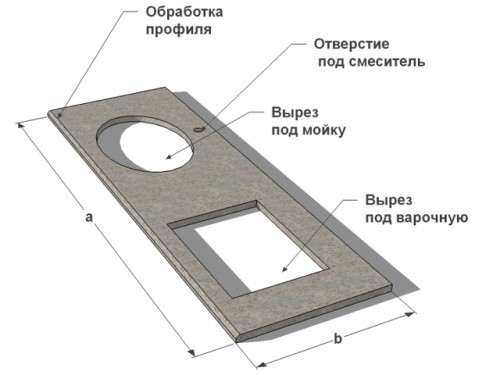

- strips for processing ends with a height of 3.5 to 3.7 cm; - Priest plinth or side, whose height is 3-6 cm. These sizes are only recommended, and you can choose others.
- With the help of a milling milling of the edges of the workpiece and the contours of cutouts under the sink and the cooking panel.
- Processing the profile, for which the worktop blank turn over the wrong side up and using the milling mill, perform the groove under the edge. Its depth is 0.2 cm.
- Cut from plywood strips with a width of approximately centimeters 7 to form a frame, and if the thickness of the leaf of the artificial stone is minimal, i.e. 3 mm, then the frame is cut into solid, otherwise sufficient rigidity will not be ensured.
It is important not to forget: The edge is installed on a clean surface, so do degreasing using alcohol or acetone.
Final design countertop
Further work on the table top is to sample edges and plywood frames:
- take a tube with two-component glue, equip it with a mixer, squeeze into a cellophane package, mix, after which we cut off the tip of the package and squeeze the adhesive to the edge or on 2 mm grooves;
- tabletop with edge squeeze clamp. Since glue dries very quickly, we do everything quickly;
- after the frozen, we consider the gloves that made the glue;
- around the perimeter of the workpiece with glue silicone glue strips, cut out of plywood, forming a frame lagging behind the edge by 0.2 cm;
- if the countertop has a M-shaped form, then in the place where the 2 elements are joined, the plywood strip is pasted as the rigidity rib;
- clear the design in the clamp and leave the clock to 7;
- silicone residues remove the chisel;
- on the plot where the plywood frame lags behind the edge of 2 mm, we still apply silicone and far until the level of the frame and silicone coincide. For alignment, the cutter is used with the lower bearing;
- spin the Faneru, using the grinding;
- placing a tabletop face up, rounded the edge using a mill;
- places where there are cutouts under the cooking panel and washing, reverse the side by sticking the second layer of artificial stone;
- we glifting the surface of an artificial stone to half-one;
- it remains to take up the rounding of the cluster side and the countertop can be installed.
A variant of the manufacture of a simple rectangular countertop is described. When performing L-shaped countertops from the artificial stone, the ends processing technology is slightly different: the ends are milling mirrored.
Mirror milling of ends
The L-shaped table top has two elements and they are joined in a straight line. To perform such docking, both elements need to be milling simultaneously. This is called mirror milling. It is performed to make the most imperceptible joint of adjacent parts. 
The whole process of manufacture of artificial leaf stones is shown in this video material:
Tabletop of liquid stone with their own hands
Liquid stone in the interior looks very elegant. If you can not select enough tools for buying a finished shape and liquid stone, then try it all to make it yourself. 
Liquid stone make it yourself
To do this, we make a stock of components for liquid stone:
- plasticine;
- fiberglass;
- pastes of different colors;
- chemical resin;
- filler;
- hardener;
- acetone;
- calcinitis;
- epoxy transparent gelkuty;
- thermoclause;
- there will be more sheets of wood and fiber-based.
Mixing all the necessary components, we obtain a liquid stone. Now we have to decide: what of the 2 options we will make a worktop.
Option number 1 - direct method
This method is fast and not very time-consuming:
- after all the necessary measurements, cut out the workpiece from the fiberboard or chipboard;
- we prepare the mixture, which we will be sprayed, for which 60% of the gelcoat, 40% of the filler, 1% hardener;
- with the use of a gun, a liquid stone is sprayed on the workpiece. Layer thickness of approximately 0.2 cm;
- dry the product, and then grind.
Option number 2 - Inverse way
For this method of time you need more, but we win from a smaller consumption of materials:
- billets make 2 pcs. from the fiberboard, at the same time, compared with the finished tabletop, they are 5 mm more along the entire contour;
- glue the blanks, draw and cut the hole under the sink and put them on the table;
- cut the strips from chipboard or plywood and with the help of a thermoclaus, fastened along the contour of the workpiece, which in this case serves as a template for obtaining a matrix by installing them on the edge;
- the workpiece is removed and cut off 5-mm allowance;
- we celebrate the place where the sink will be;
- we take plasticine and smear the gap between the sink and the table;
- the place where the edge of the countertops is planned is also failed with plasticine, and then give the necessary shape by using a special template;
- we process the matrix inside by a dividing wax or other separation composition and wait for 15 minutes until it is absorbed;
- in all the surfaces of the matrix spray liquid stone;
- after 0.5 hours, the composition will clarify and we place fiberglass, the purpose of which is to increase strength;
- the turn of the soil fill, which includes a resin with an accelerator (6% of its mass), 1.5% of the quantity of the resin of the coloring pigment, 80% calcite and 1% hardener from the total weight of the solution;
- tabletop blanks put in the matrix and apply evenly apparently, removing excess soil and air;
- withstand 1.5 hours. During this time, the ground will freeze and the cargo is removed;
- we apply another layer of soil on the table top;
- milling edges;
- we process the surface.
Note: by 1 square. M table tops require 8 kg of soil, of which about 5 kg is consumed at the 1st stage and about 3 - on the second. Mixtures of liquid stone on this area will take approximately 3.5-5.5 kg.
But another way of making tabletops from an artificial stone, and the liquid stone itself is obtained from the available materials.
We make form
The outline of the future tabletop depends on the form, therefore, approach the question responsibly:
- we measure the installation location of the table top, covering the holes for the sink and the stove, if they are there;
- making strong racks for the base. Everything should be durable, because the liquid stone - the material is heavy;
- as a base, take the Kronospan - a sheet of chipboard, covered with a polymer film. To a simple chipboard, the countertop sticks and it will not be possible to remove;
- screw to the base of the plank such as longitudinal and transversely in size to the sizes of the future countertops;
- inserting the form for the details that will be mounted in the worktop: washing, cooking panel;
- in places where the crane, a mixer or other plumbing, the countertop should be thinner, so kpripim there are small wooden cubes;
- we scroll the corners of the form, sprawling them slightly.
Cooking the mixture
For cheap liquid stone, we take:
- cement is not lower than M400 - 1 part;
- 3 pieces of sand;
- 1 part of water;
- color.
All mix in a suitable container.
Start the manufacture of table top
For a tabletop of a liquid stone was durable, we observe the following technology:
- on the base form we place the reinforcement grid;
- we introduce the mixture into the form, trying to distribute it evenly. At the same time, the air from the mixture is removed by means of a vibrationree or at least a perforator, in extreme case. This is the first layer;
- reinforcing metal wire over the first layer around the perimeter of the form;
- we lay out the rest of the solution, equally let the product dries. Time to complete drying for different mixtures is different and sometimes it can last a week 3;
- we take out the finished product from the form;
- grind the front side, stepping sharp edges;
- spanking well, rub the plane plane, giving it a glossy shine.
Installing countertops
Installation of table tops from an artificial stone on a kitchen database - it's not a simple matter, because it has a lot of weight, which means one cannot cope. 
Inviting assistants:
- we remove the worktop from the desktop, place it in the right place and fix it;
- we perform holes under the plumber;
- install the washing and cooking panel;
- we wipe the finished design.
Manufacturers of artificial stone
Having gathered to make a countertop from an artificial stone, you will definitely ask yourself: - What composite material to buy better? Consider the advantages and disadvantages of the material produced by different manufacturers.
Montelli and Corian.
Manufacturer from America DuPont (DuPont). Materials under this title have the following qualities:
- durable;
- racks to bacteria, contamination;
- homogeneous;
- color palette - wide;
- bonding seamless;
- price is relatively low.
Acrylic stone Tristone
Produces company from South Korea Lion Chemtech. Several collections are available:
- "Classic" - tones of monotonous;
- "Romantic" - only natural colors;
- "Baroque" - the material includes natural and transparent particles;
- "Byzantium" is an artificial stone premium class, has a 3D effect.
Hi-Macs.
Releases LG Corporation. The stone has in its composition:
- 70% of natural materials;
- the basis of acrylic resin;
The quality of the composite is high, the price is democratic. Sheet thickness from 6 to 12 mm.
COLGRAN Liquid Stone (Collegi)
Links a liquid polyester stone of excellent quality and has:
- the color spectrum includes 150 colors;
- resistant to the formation of spots and scratches;
- easy to care. It is cleaned by ordinary household means.
Repair countertops from artificial stone
Despite excellent characteristics, sometimes there is a need to repair worktops from artificial stone.
Types of possible damage
On the worktop of artificial stone, in the case of its improper operation, the following damage may occur:
- scratches;
- cracks;
- bloating;
- white spots from hot dishes;
- skoli.
Cracks, scratches and their elimination

If you seduced low price and bought an artificial stone from Chinese producers, then the crack may appear due to non-compliance with manufacturing technology. Eliminate the crack like this:
- cleaning and degreased crack, slightly expanding it;
- we enter the glue consisting of two components into the resulting channel - the same as used for gluing edges;
- we grind, and then polish the surface.
Visually, the surface of the table top will not differ from the new, but still the strength characteristics will deteriorate, so:
- buy only high-quality material;
- clearly observe the technology in the manufacture of table tops.
Not deep scratches, as well as some spots are removed by grinding, using sandpaper of different grain, starting with the largest and ending with shallow. Subsequently, these places are polished with the help of a felt nozzle, dressed on the drill. This repair is possible if a sufficiently thick sheet was used for the table top.
Elimination of bloats and spots
If such defects on a thin sheet appeared, then:
- cut the damaged place applying for this mill;
- from the remnants of the leaf artificial stone cut the patch, picking up the color;
- lubricate glue and insert a patch to a damaged place;
- i rub and grind the joints.

To learn how to eliminate chuck on a tabletop from an artificial stone Look this video: