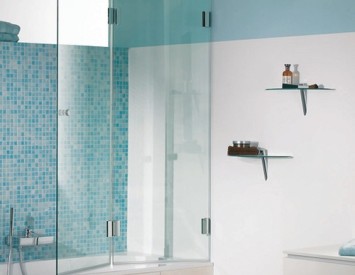
Thanks to the tireless work of the interior designers today, you can observe an amazing variety of bathroom design options. It also contributes to the fact that the approach to the use of finishing materials is radically changing. A visual example of this is the use of glass - if only shelves and decorative elements were made from it, today the bath with a glass partition becomes commonplace. Practical and stylish innovation accounted for many, so today we will devote to the creation of a glass partition in the bathroom with your own hands.
Content
Appointment of a glass partition
In the interior of a modern bathroom, it is often possible to meet elements that were previously considered unacceptable in such a room. In such a specific room, it was always possible to give preference to solid and functional materials - cafél, porcelain, stainless steel. But the glass is also not afraid of any moisture, nor wear, but with due tagging technology becomes durable as a stone.
The glass partition in the bathroom is an original and stylish solution that will allow not only to transform the interior visually, but also take on a number of functional loads. Why put the glass partition, can only say the customer himself, but we will look at what role this item can play in the interior of the bathroom.

Appointment of a glass partition in the bathroom:
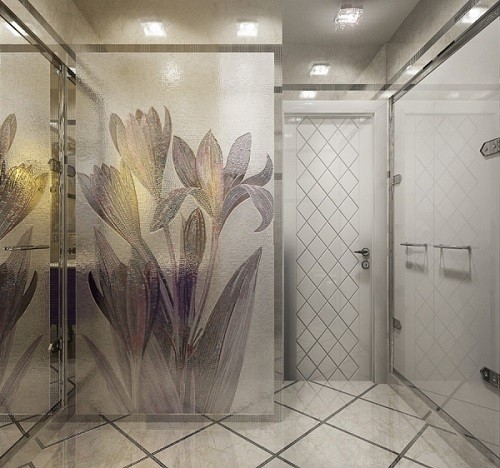
- The decorative function - by itself, glass as a separating element looks unusual and beautiful, especially if the drawing is applied, stained glass window, or the surface has relief. If you decide to equip an apartment, say, in oriental style, then in the room you put a bamboo partition. In a constantly wet bath, such an obstacle will not last long, therefore, as an alternative, you can install a light glass partition with stylistic painting - hieroglyphs, caravel, sun or the same bamboo.
- The separation of functional zones is a glass partition, unlike brick or drywall, does not overload space, leaving it light and air. At the same time, it is a real obstacle separating the zone, for example, shower from the restroom, if it is an adjacent bathroom. If the bathroom is a washing machine, drying and ironing board, this "lounge" zone can be delicately extinguished from the rest of the room, rationally using space.
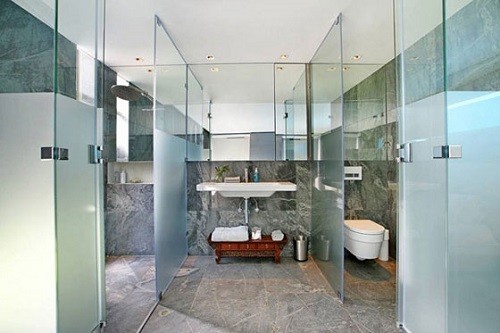
- A camouflage function - the glass bathroom partitions will serve as an effective disguise, if, for example, a riser's pipes stick out of the wall and cannot be hidden. Then you can hang a beautiful lamp on the partition or attach several glass shelves to it, turning the usual screen to the functional wall. In the combined bathroom and not to do without such a partition, especially if several people live in the apartment. In order not to deliver to each other discomfort and increase the aesthetic look of the bathroom, put an opaque barrier between the toilet and shower.

Classification of partitions
The idea of \u200b\u200binstalling glass partitions in the bathroom has appeared long ago, so the designers had a lot of time to come up with various types of designs.
Today there are several types of bathroom partitions:
- Depending on the material used - it would seem, the glass it is in the bathroom glass, but no. There are thin-sheet partitions from monolithic elements and glass block - made of thick double-gray glass "bricks". Throughly partitions are frame and frameless. The latter are completely transparent and for visual separation of space are not suitable. They are more often used as the doors for the bathroom or shower.
- The light-effect capacity is the light-permeability of glass partitions depends on their decor. They are completely transparent, translucent matte and completely opaque. It should be noted here that transparent or translucent partitions are suitable for small premises, since the dark will "push" and visually reduce the space.
- Mobility - In terms of mobility, stationary barriers and transformer partitions can be distinguished. The latter can be quickly assembled or disassembled to transfer to another place or removed at all. One of the most common mobile partitions is a glass cloth on the rollers, which can be moved by the type of wardrobe, overlapping the right or left part of the room.
- Depending on the method of opening - there are partitions without doors with stationary opening and, accordingly, with doors (swing, departures). Opening partitions in most cases are used in shower cabins and spacious combined bathrooms.
- Purpose - zoning room, disguise or arrangement of the shower cabin.
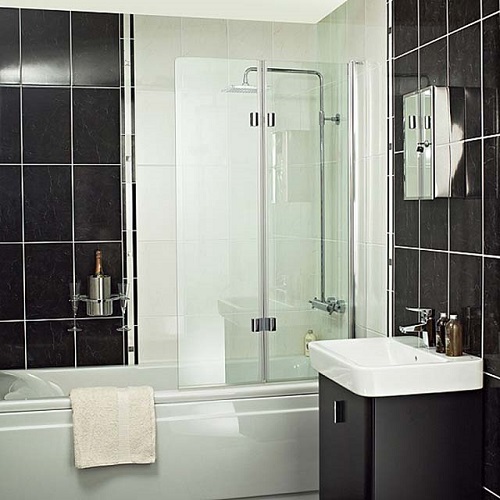


The only one, with the permission, the lack of such partitions is that they are recommended to be used only in pretty spacious bathrooms, because if you try to install even a light transparent barrier in the toilet of the usual Khrushchev, it will be at least uncomfortable.
Manufacturing technology
As mentioned above, glass partitions are monolithic from solid thin-filled glass and from glass "bricks". The thincase partition, despite the seeming fragility, is made of durable kanenic glass, which is still necessary to try. Glass blocks are almost indestructible at all (in any case, at home, such a barrier will not work).

Partition from glass blocklocks
The glass bottle is an element created from two glass plates compressable under high pressure, between which a hermetically closed cavity is left. Thanks to such a design that resembles a thermos, glass blocks are one of the most efficient energy-saving materials in the world. In the Soviet Union, windows from glass blocks were often made in the entrances of residential buildings, so inside there was always warm even in the coldest winter and cool - in the summer. Today from the glass blocks make walls, original flooring, countertops, bar racks, etc. We will tell you how from this material make a partition for the bathroom with your own hands.

Before you begin to work and go to the construction store, make a drawing of the future partition, count how much glasslocks need, select the color (or more colors).
Tools and materials necessary for work:
- glass blocks;
- adhesive
- grout for seams (pick up to the glass blocks);
- reinforcing tape (wire);
- PVC tape;
- stainless steel spatula;
- rubber spatula;
- crosses for glass blocks of the desired size (from 1 to 16 cm or more);
- knife-jamb;
- sponge for washing dishes;
- dowels;
- plumb and construction level.

Properly installed glass blocks for partitions in the bathroom will serve at least 10 years, so follow the instructions for sure.
Make such a wall of "transparent brick" is completely difficult:
- Draw marking on the floor and the wall to which the partition will be adjusted. It is not necessarily that it reaches the ceiling. You can make it with a height of 1.5 m, and up to put pots with falling curly flowers. Or make a slightly lowering and growing on the orchid partition (if there is a large window and enough natural light in the bathroom) - they just love constant humidity and warmth. Marking should consist of 2 parallel lines, the distance between which is equal to the width of the glass block.
- Check out the evenness of horizontal lines on the floor using a construction level, on the wall - with a plumb. If the instruments have shown that the wall or floor is uneven, they will have to be aligned, otherwise the glass blocks will be crooked, and the partition will not last long.
- Any house over time gives a shrinkage, and that your partition does not suffer (after all, it has to sleep at least 10 years), it is necessary to ensure protection. For this, between the lines of markup, glue the PVC tape, freed from the protective layer and dissolving over the surface.
- Lock the glass blocks are necessary from the angle, where the floor is fitted with the wall. Apply the adhesive composition on the wall and bottom of the block with a layer of 2.5-3 cm and slightly press the "brick". Adjust the position relative to the markup, knocking on it with a spatula handle. Protective film from glass blocks Do not remove until the end of the installation!
- After installing each block, check its smoothness with a level.
- Place the entire bottom row in a similar way, missing the bottom and side of each block and not forgetting to install spacer cross between them so that then it turned out even and beautiful seams.
- Every two segments (vertical and horizontal) "crowd" reinforcing wire or tape.
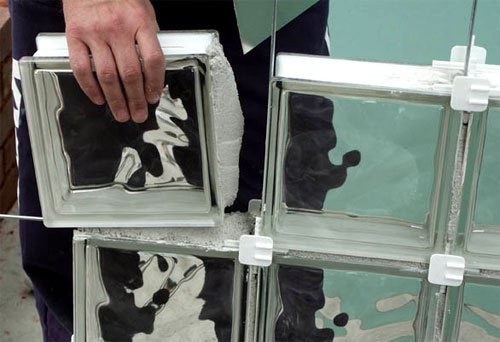
- Setting 3-4 rows, interrupted for a day so that the solution as it should have gripped. Consider that the glass blocks weigh quite a lot, so the solution on the lower rows can "move", if the top will be too large.
- When part of the wall is ready, remove the excess solution between the blocks using a knife-shock or a spatula corner. It is necessary to do it right away until the solution is frozen. Simultaneously, to clean the crosses, slightly uplooking them with a knife.
- After a day, you can start laying the next wall segment, and so to the very end.
- When the wall is ready, you can proceed to the grout of the seams. If you are afraid to make a mistake with the color, choose a white grout - it always gives a spectacular contrast. Instruct the rapid solution to the consistency of thick sour cream and apply it in the voids between the glass blocks with unlucky pressing movements. For this work you will need a rubber spatula.
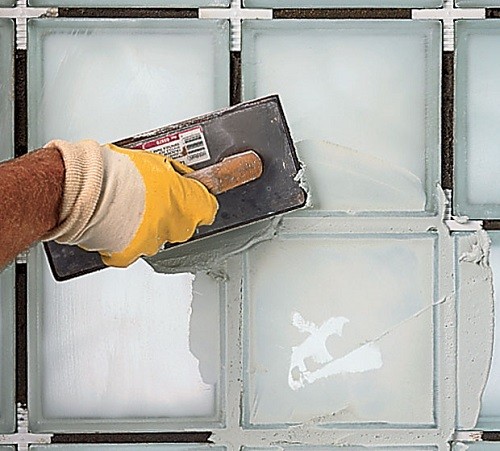
- With unusual, you can hardly get perfectly even seams, but it is not enough. After drying, the lubricated areas can be easily "denying" emery paper No. 2 or No. 1.
- Surplus grouts Rock with a wet sponge for washing dishes.
- Only now you can remove the protective film from the glass blocks and enjoy the work done.


To better understand the process of making glass partitions from blocks, we suggest watching a video on this topic:
Sheet glass partition
With the laying of "bricks", it is more and more understandable, but how to make a glass septum from a solid sheet? This process is somewhat more complicated, but the effect is created completely different. To independently make such a screen, it is necessary to produce a lot of calculations - the weight of the glass, markup, profiles, fasteners, etc. As a rule, a novice, not knowledgeable in engineering works, such a task seems to be unbearable, so many prefer to buy ready-made systems. In essence, it makes it much easier for work, and you will save on the installation - anyone can cope with the finished system.

How to make a glass partition in a solid leaf bath:
- Make marking on the walls, ceiling and floor. In this case, the partition will reach the ceiling.
- Check out the smooth markup with a plumb that lines on the ceiling and on the floor were in the same plane, otherwise the septum simply will not rise in fasteners.
- Install the profile by screwing the tires on the lines of markings of the dowels.
- Under the tires, put rubber gaskets to reduce the pressure on the surface, create a noise insulating barrier and prevent the destruction of the partition from the shrinkage of the house.
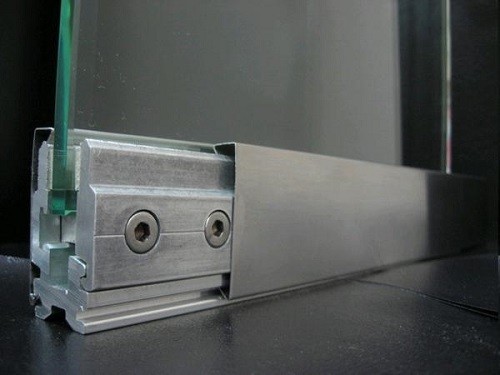
- Dowels fix the carbon tires by setting 2 pcs. through each meter. It is necessary so that the partition is as stable and not falling as much as possible.
- Screw to the Cuttings of the Foots, without spinning to the end.
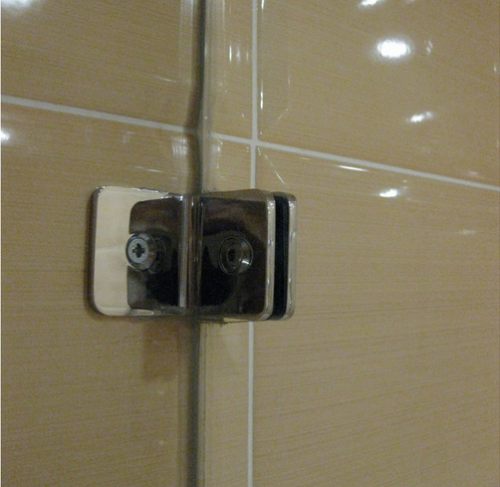
- Secure the glass in the connectors using a hex key. At first, install the cloth into the lower connectors, then to the upper and last time - in the side. It is better to do this work together, and even better - threesome (two hold the glass on each side, and the third sends).
- Adjust the partition height by adjustable supports or linings and tighten the fit pictures.
- For partitions from several glass sections, set 1-3 cm from each other, then pour the gap sealant.
- Install the decorative lining by clicking on the one hand to the squares, on the other - on the fit pictures. If necessary, attach an end cover to the profile.


Detailed video on the installation of sheet glass partitions will help you better understand the procedure:
Glass partitions for bath: photo
By tradition at the end of the article, we suggest you see how glass partitions can transform the interior of the most ordinary bathrooms.


A visual example when the glass partition serves as a disguise for a washing machine: