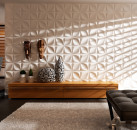
When choosing a bathroom design, it is worth paying special attention to both stylish and beauty in the finished variant and the practical side of the finishing material used. The glass mosaic has all the necessary properties for use in the interior of the bathroom, and through its varieties it is easy to divide a small room into several active zones.
Content
Types of mosaic, their advantages and disadvantages
Mosaic for the first time appearing a few centuries ago in the form of various sizes and color of pebbles, had a fairly narrow scope. With the development of the society and the development of previously unknown raw materials, new types of mosaic began to be created, expanding the scope of their use. Currently there are 4 types of mosaic:
1. Ceramic mosaic - in structure does not differ from conventional ceramic tiles and is manufactured by firing clay. The only difference is the size. Ceramic mosaic produced 2 types:
- glazed - has a smooth surface and increased moisture resistance;
- the stlaced - characterized by a relief surface, divorces, the presence of specially created cracks or injecting outsiders, low moisture resistance.
Ceramics mosaic is represented by rectangular, square modules that facilitate the facing of the surfaces indoors, facades of buildings.

Advantages of ceramic mosaic:
- high fire resistance;
- wide sample spectrum;
- good strength to point exposure;
- resistance to most chemical compositions;
- abrasive abrasion resistance;
- low water absorption.
Disadvantages:
- porosity;
- the average cost relative to other types of mosaic.
2. Stone mosaic - is made by sawing large size stones into smaller elements, as suitable as possible to create a specific type of matrices. If necessary, stones are subject to grinding, polishing or artificial "edition". The mosaic of this species is represented by chips round or incorrect shape. The main purpose is the facing of steps, walls indoors, facades of buildings. For the manufacture of mosaics used:
- natural stones, including marble, travertine, jasper, lapis, onyx;
- artificial stones - production is based on the combination of elements of a broken mirror with granite, marble.

Advantages of stone mosaic:
- high fire resistance;
- environmentally friendly material;
- aesthetics;
- durability;
- lack of temporary deformation;
- moisture resistance;
- a large variety of color shades;
- resistance to chemical exposure, temperature drops.
Disadvantages:
- exposure to artificially produced by stones abrasive effects;
- pretty high cost.
3. Metal mosaic is obtained as a result of gluing stainless steel plates on the front side of the ceramic mosaic, rubber or plastic base. To give a shade, the metal is applied with a relatively small layer of bronze, brass. In this case, the surface may be matte, brilliant or relief. Chips for creating a metal mosaic are distinguished by a wide selection of geometrically correct and incorrect forms.

Pluses of metal mosaic:
- high resistance to wear;
- resistance to mechanical damage;
- moisture resistance;
- high strength.
Minuses:
- oxidized during chemical effects;
- limited color palette;
- the ability to change the color shade over time;
- low cost.
4. Glass mosaic - produced by melt venetian glass or siliceous sand with the addition of cadmium, avanturine, boron and other elements based on the need to obtain a color shade. The module shape is represented in the form of oval, square, rectangle, but sometimes it is possible to meet the elements of the wrong shape.

Advantages of glass mosaic:
- variety of various shades;
- resistance to chemicals;
- immunity to sharp temperature fluctuations;
- high impact resistance;
- resistance to the appearance of mold, fungus, stains;
- waterproof;
- heat resistance;
- resistance to ultravioleti;
- high wear resistance;
- durability;
- ease of care;
- democratic value.
Disadvantages:
- mounting complexity;
- instability to abrasive wear;
- relative resistance to sharp point shocks;
- the damaged area is difficult to replace.
Thus, any kind of mosaic is suitable for the bathroom interior. However, special preference, in view of the mass of quality characteristics and relatively low cost, it is worth paying glass mosaic and its subspecies, with which truly unique masterpieces are created.
Glass mosaic
Features mosaic of various manufacturers
The main manufacturers of glass mosaic are Italy (Trend, Bisazza), Spain (Ezarri), China (Zaijian, Rose Jnj), Germany (Folia,). Of course, the Chinese mosaic is somewhat inferior to the quality of Italian manufacturers, as evidenced by the cost of 1 m². Another distinctive feature of the mosaic from China is the width of the seam, which makes up 2 mm. While the Italian and German mosaic is 1 mm.
However, Mosaic Glass China is in great demand, rather than Italian, due to minor differences and an acceptable price.

Molds and dimensions of mosaic
Mosaic made of glass is made of various sizes. Moreover, the smaller the size of the module, the more expensive the cost of the finished matrix is \u200b\u200bobtained. However, small fragments are very convenient to build oval, curvilinear surfaces or shallow niches in the wall.
The shapes of a glass mosaic are represented by the most different figures - ovals, rectangles, squares, circles, crushing forms with uneven edges, opening up before designers, all perspectives for creating unique interior solutions.

Types of mosaic matrices
Mosaic enters the sale of both separate modules and ready-made matrices. In this case, the front side of the module has a smooth surface, and the reverse - with small grooves for the best adhesion of the material to the base in the process of laying.
Matrices stand out 2 types:
1. Glass mosaic on paper is a more common option. In this case, the laying is produced by the back surface, since the paper is fixed on the front. After mounting, the paper is cleaned, and the seams are wiping.

Pros:
- the impossibility of deformation of the seam width between the modules;
- high adhesion between the material and the base;
- ease of installation, especially when cladding uneven surfaces;
- low cost.
Minuses:
- in the process of purchase, there is no possibility to check the facial surface for the presence of defects.
2. The glass mosaic on the grid is performed, mainly expensive collections represented by the inclusion of the Avanturin, Pearl, since in the production of this type of mosaic there is a large percentage of rejection.

Pros:
- the ability to check for the defectivity of the face of the matrix.
Minuses:
- relative adhesion mosaic with the base;
- mounting complexity for an unprepared person;
- the ability to change the interputric seam;
- high price.
Based on the destination of the mosaic, the selection of one or another type of matrix depends on the surface.
Glass mosaic varieties
The popularity of glass mosaic entailed the development of new ideas regarding the combination of glass with other elements. Today, the following types of glass mosaics are produced:
- Smalt mosaic - characterized by the opacity of the tiles with the effect of inner glow and a wide range of saturated colors that do not have any white inclusions. In this case, the module with the same tint on one sheet is quite difficult to find. It is widely used in places of intensive passability, for example, for floor cladding, corridors. The only difference of the smalt from glass is immunity to abrasive damage.

- A monophonic mosaic is represented by the manifold of shades and uniformity of the structure without any divorces, inclusions of foreign shades. The greatest demand is used to create mosaic mixtures or stretch marks, as well as in the manufacture of paintings from glass mosaic as the main background.

- Stretch marks - produced by a smooth flow of dark shades to brighter or vice versa. In the creation of stretch marks, all varieties of glass mosaic are used.

- Mosaic mixtures are achieved by a combination of monochrome mosaic modules using a different percentage of shades included in this mixture.

- With the addition of Aventurine, it is allocated by flickering point engines obtained by interfering in the glass mass of the pre-prepared adventuric powder. It looks very original with well-set light. It is suitable not only for the bathroom, but also for the kitchen, bedroom, living room.

- With the addition of iridium (pearl effect) - with competently arranged lighting, the bathroom will be blocked by all the shades of the rainbow. Moreover, if you look at the mosaic laid out from different angles of the room, the colors will differ. However, more than two shades in one color spectrum for design, let's not use the baths.

- Under gold - is achieved by additives of metal oxides in any shade of the existing color scheme.

- Sparkling mosaic - luxurious shades at a low price can only be compared with a mosaic under gold.

- Golden mosaic - represents a slice of gold sprout to foil, which is placed on a small layer of glass, followed by filling a thicker layer.

- Mirror mosaic is made by dividing on modules of a conventional mirror (silver or gold), followed by combination of glass mass and mirror. It looks very advantageous when finishing a segment of the wall, columns.

Quite often, when placing a bathroom, a combination of various types of glass mosaics is used.
Glass mosaic application options in the bathroom interior
A large variety of species, sizes, shapes and scene palette of a glass mosaic emphasize designers with stunning capabilities that allow you to transform the room beyond recognition.

Often, full lining of the bathroom using mosaic is very expensive.

However, a harmonious combination of glass mosaic with any decorative materials allows you to revive the interior with a bathroom even partial facing of individual elements.

Ceramic tile combination with mosaic
- Frame for the mirror. A wide frame is quite impressive around the mirror, made of a contrasting mosaic color relative to the wall tile. However, the color scheme should be harmonized with shades available in the decor.

- Shelves, niches in the bathroom. Miniature modules mosaic with ease allows you to bind small, hard-to-reach places. It will cost it inexpensively, but the bathroom will shine, as after repair.

- Screen for the bathroom. Feeling the tile of the mosaic glass into the tone of the laid out tile and a variety of it with other textured combinations, one can achieve a visual increase in space, although minor. As a supplement, you can bind walls around the perimeter of the room to the height of the screen.

- Apron over the sink. It is laid out or to the base of the mirror, or to the entire wall, focusing initial attention on this section of the decor.

- Window frame, doorway. It is drawn up similarly to a mirror frame, visually increasing the window or input space.

- Box, columns. The contrasting mosaic significantly revives the design of the bathroom, while the plumbing pipes hidden in the box will not be so annoying with their moon and inappropriate location.

Creating special effects
By means of mosaic techniques, it is easy to achieve special effects when:
- room premises merge together;

- the impression of the seabed is created;

- the space of the bathroom is visually increasing;

- the bathroom shines with all the colors of the rainbow.

Additional decoration of mosaic ornamental panel
Pretty original, stylishly and modernly looks like a bathroom, decorated with a variety of glass mosaic in combination with a wall panel made by a set of smalt modules.

Qualitatively performed panels become the main element of the decor, invariably attracting their effect.

In addition to the design of the bathroom, the glass mosaic for the kitchen acquires an important meaning.

Quite often, mosaic finish is used to decorate tabletops, walls above the table, adding freshness of the sample spectrum and charming with desktop or wall patterns from glass mosaic to the interior.

Thus, a huge shade assortment of various types of glass mosaic photos of which are presented in the article, allows you to create unique masterpieces of art, depending in many ways from the designer's fantasies and their own designs.