Plastic bags are becoming increasingly popular in homes. They serve quite reliable protection against wind and cold, penetration of pollution and noise from the street.
Content
A separate variety is sunscreen that allow you to significantly reduce the percentage of ultraviolet rays into the room. To protect your home from the excess of the Sun in the summer - you need to know how sunscreen provides a similar effect.
The principle of operation of sunscreen
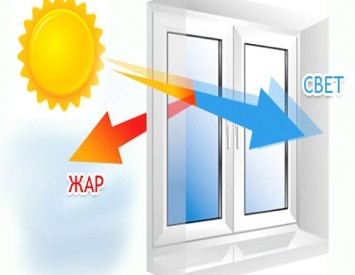
The main goal for which sunscreen glasses is used is to reduce the flow of sunlight, which reduces the effect of excessive ultraviolet and the temperature indoors. As a rule, such glasses features another color shade: grayish or greenish.
First of all, the absorption of solar radiation occurs due to the tinting layer. As a rule, it is added either during the introduction of metal oxides into a viscous mass, or later, by applying a film or spraying to the finished surface. Thanks to the tinting light, a tangible temperature decrease occurs: even with a single-layer glass glass with sunscreen glass, a decrease in temperature occurs on average by 3-5 ° C.
Such double-glazed windows are made of reflector glass with reflective effect, or from heat treatment tempered by heat treatment.

Even with the direct impact of sunlight on the glass, it is not necessary to fear its overheating. Such a danger threatens those glasses that have an overlooking dark tinting film.
According to the principle of work, glass is divided into two groups:
- reflecting
- absorbing
The reflecting layer is applied in the process of production by spraying, or at the time of installation or after, by catching a film that will ensure good protection of glasses from the Sun.
The production technology of absorbing glasses is more complicated. Finding on the surface, light is repeatedly dissipated and divided into spectra. Ultraviolet remains inside the glass package, and the remaining light streams pass to the room.
Sunscreen production technology
Two glass production methods are used:
- furio,
- float.
The Technology OP method of Furio involves rolling the glass mixture through the rollers, after which the sheets obtained move to the cooling chamber. A similar method managed to obstruct morally, because, unlike float technology, a significant percentage of glass surface defects implies.

According to the technological process, the FLAT method is more preferable because it has the following advantages:
- no need to refine the glass surface,
- small percentage of marriage finished products,
- high performance,
- optical defects on the surface of the glass are practically absent.
According to the float method of the production of sunscreen glass, the molten mixture having a ribbon form enters the tank with tin. Due to the fact that the tin has a higher density, the glass is not mixed with it, but is located on the surface, cooled and smoothes to an ideally smooth surface. Next, cooling to 600 ° C, the glass enters the furnace, in which the metal dioxide layer is sprayed. After that, the glass is gradually cooled and is checked for defects. If they are detected, when cutting, such areas are cut and used again, in the next batch - due to which the production of glass is a waste-free process.

Species and characteristics of sunscreen glass
Relatively recently, exceptionally varieties with toning were presented as sunscreen glasses. They are inexpensive, but have a significant drawback: the higher the stopping ability, the darker glass, and, accordingly, it skips less light. As a result, on a cloudy day or in the evening, the room lighting leave much to be desired. Exceptions are those kinds of glasses which have a greenish tint.

Of the benefits of performance necessary to allocate bandwidth, which make up 70% of sunlight and only 30% for the infrared and ultraviolet flux.
But there are also disadvantages: tinted glass heats up and are afraid to uneven cooling.
Another effective solution to the problem solar transmission would use in the pane sunscreen colorless glass, which allows the coating to reflect ultraviolet light. This method is based on the presence of particulate contaminants titanium and chromium oxide. A mixture of glass covers the thin film, and the metal is a good reflection of the sunlight, and the most important thing, "kicking" the excess ultraviolet radiation, while they themselves continue to miss the glass sunlight and do not heat up. The downside would be the cost method.
It is gaining popularity kind of combination, which is becoming a hallmark of the appearance of silver mirror surface. The technological process of producing such a coating has no significant differences: the workpiece placed in a furnace at a temperature of 650 ° C, is applied four layer coating of metal oxides, then subjected to quenching. In the end, silver-plated glass cover and allow to cool.
This type, in addition to the high indicators of reflection and absorption of ultraviolet, is also characterized by an excellent degree of thermal insulation, which is very relevant in winter. A pleasant addition will be a beautiful aesthetic appearance and the lack of the need to purchase a curtain or blinds - because the combined reflex glass looks like a mirror and does not allow to consider what is behind it. It is important from his minuses to note the complexity of the manufacturing process, as a result of which the final price for the glass package is determined. More often, such glasses are used in buildings where invisibility is ensured by visitors and working people. A good example is the banks and buildings of the office type, as well as bars and restaurants. Another advantage of the choice of such a glass grade will be its resistance and strength to mechanical effects.

It is less likely to meet a special type of sunshine - these are photochromic glass that received the nickname "chameleon". They demonstrate an interesting ability to change the percentage of light and heat gain into the room under the influence of sunlight. With an excess of ultraviolet, such glasses are darker, with cloudy weather, on the contrary, the suspension of the surface comes back to normal. Such a grade is obtained by adding silver and cesium to sodium-spur-alcoholic glass. Of course, the total price of such double-glazed glazed can be upset by an ordinary consumer, but for household needs there is an alternative - a photochromic sunscreen film that manually applies to any glass and found an application for both buildings and windows of cars. Moreover, the price of the route meter of such a film is quite modest - only $ 4, which made it possible to get widespread from car enthusiasts.
Application of sunscreen glass
First of all, glass is used precisely to protect against the sun. Any type of glass used is capable of significantly reduced the impact of the ultraviolet on the decor in the glass. For example, furniture and curtains are able to easily fade, while under the "Sight" of the Sun. The glass is suitable for any application: its species are installed in winter gardens and greenhouses to protect plants from excess sunlight, in high-altitude high-rise buildings, in double beds of private houses and apartments. Moreover, anyone at least once in his life wore sunglasses whose glasses are covered with a tinting film, or have shadowing impurities in their composition - therefore, a favorable effect of using such glasses is noticeable to everyone.
Modern glasses are able to shade natural lighting, but at the same time to ensure comfort in the following directions:
- Thermal insulation of the room. There are many types of ready-made double glazed windows and toning films, in whose task is the protection of glasses from the Sun, while the inner heat in the room is reflected from the glasses and is preserved longer.
- Due to sunscreen properties, overall energy efficiency increases. Properly selected sunscreen glass in the double-blade can reduce the cost of air conditioning and heating of the indoor space. The difference is essential compared to simple glasses and glass packages.
- The solid coating is distinguished by durability and high mechanical strength.

Sunscreen with your own hands
The sunscreen glass is especially true if the windows come out on the south. Tightenfully close with curtains or blinds is not the only way out when it is completely able to produce an independent blowing of the sunscreen film on the glass. There are several varieties of films that are optimally suitable for this task:
- Standard tinted. Designed for easy protection from the sun. The room, in the presence of such a film on the window, it does not heat so much and in addition, there are no glares from the sun on the TV or computer screens.
- Mirror film. It is an excellent solution for the case, if the neighboring house is located in close proximity, and there are no desire to keep the curtains to the curtains. Such a film on the glass from the Sun will provide one-sided visibility, when the outside it is impossible to view the room. It is important to remember that a similar effect works in the daytime or when the degree of illumination is brighter than inside. When the light is turned on, the mirror effect disappears.
- Matte film. Used for those cases when it is necessary to limit the transparency of the glass. As a rule, for internal glass partitions in order to reduce direct visibility. At home, the film has found its use in door stages and glass shower partitions in the bathrooms.
- Protective film. It has a high resistance to mechanical damage. Its use is important in the nursery, since some varieties allow you to make a glass that is unboring, which is important if the child causes careless actions, will strike on the glass. Even in the case of destruction, glass covered with a protective film will not split into fragments.

Since there is a large range of film selection on the market, and their price is available to any consumer, the conclusion is obvious: the sunscreen film on the glass represents a tangible competition to finished glass packages, since there will be no special skills for her adhesive. In the event that it is finally used to use it, it is necessary to prepare auxiliary tools in advance:
- stationery knife,
- spatula for alignment. The spatula must be used rubber, since the metal is quite easy to inflict damage to the film,
- a sprinkler with a cooked soap solution for finishing film position adjustment. Simple water in this case will not be divided because it does not adversely affect the adhesive composition.
The blending process must be divided into several stages for greater convenience:
1. Preparation for work:
- a roll rolls on the smooth surface and the required amount of film is measured;
- with the help of a stationery knife, the area required in size is cut, while it is important to leave the step of 1-2 centimeters around the perimeter, which will be cut later;
- the glass surface is sulfted from contamination and dust using cleaning agents on an alcohol-containing base, then dryly wipes the newspaper. Newspaper paper is better suitable for this work, rather than a rag, because it does not leave divorces on the glass.
2. When preparatory work was finished - it is necessary to move to the main:
- the surface of the glass is abundantly wetted by soap solution;
- a protective layer is removed from the film. It is recommended to perform this work with the assistant in order to avoid difficulties in sticking;
- using the soap solution, the adhesive layer of the film is wetted so that it does not start randomly stick to the glass when sticking;
- further, the film section is applied to the glass and carefully spacing with hands and a rubber spatula. Also often use a small dense roller. Rope is always necessary from the center to the edges to remove the moisture spoked from the edges;
- the final stage of the work becomes a neat removal of excess film with a stationery knife.

It often happens that the film as a result of damage or replace will require removal, and in this case the difficulties will occur. Some films are based on lavsan, which belongs to chemical-resistant materials, therefore, according to many specialists, traces of the adhesive composition with great difficulty and are not always completely removed, even with solvents and means for cleaning glass. In this case, you should not despair, but it is better to pay attention to simple means. For example, it is enough to apply a fluorine-containing toothpaste on a sponge and wipe the traces left after the film. Then the opposite side of the sponge having a rigid base, the glass is stopped for the second time and the traces does not remain. In addition, the most common wet wipes are also suitable for this task.