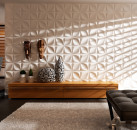
When it comes to building a house or perform major repairs in the room, we are faced with the fact that you have to align the walls, and then independently perform their finish. It should be immediately prepared for the fact that the plaster of concrete walls is a long and time-consuming process that requires certain skills. In addition, the plaster of concrete walls has a decent price, so you can learn these works yourself.
Content
The plaster of the walls is a very important stage in the finishing of the premises, regardless of whether the walls will be in the future with wallpaper or the surface will be prepared under painting.
In this case there are many nuances. So, some experts advise first to prepare the surface and fully clean it from flaws. Some advise not to spend a lot of strength and do not prepare the concrete wall to the plaster, but immediately sew its plasterboard. But, as it turns out, an artificial continuity in the future is problematic. It is impossible to attach kitchen cabinets, plasma TV, shelves, air conditioning, water heater and other heavy household appliances. That is why it is better to choose an old proven way to finish the wall and perform the plaster of concrete walls with their own hands.
Classification of material
Currently, there are many different mixtures for wall decoration. For each surface, separate species are intended.
Common types of plaster:
- Gypsum (ordinary) or a mixture of sand with cement. Such plaster is designed to align the walls, as well as to protect the surface from moisture and dampness, as well as temperature effects.
- Special. A mixture that has a narrow orientation. Its main task is to protect the room from emissions, save heat and suppress noise.
- Decorative. The name itself says that such a mixture is used for the final stage of repair work, when it is necessary to give the surface a beautiful view.
About technology
Before you begin to perform a surface plastering, a device of plastering concrete walls is necessary. First remove the dirt, dust from the concrete wall. It is necessary in order to provide a stronger clutch of the material with the surface. After the preparation of the wall proceeds to the preparation of the solution.
How to make a solution correctly
When it comes to the implementation of plastering, it should be guided by such rules:
- for a concrete and stone wall, which will be subject to constant precipitation, it is necessary to use solutions consisting of portland cement or slag-cement;
- stone and concrete surfaces, as well as facades that will not be subjected to precipitation (rain, snow) can be shuffled with solutions consisting of a mixture of cement and lime;
- internal plastering of premises, with air humidity not exceeding sixty percent (placing the bath, laundry, bathroom) The first layer applied cement with lime, and the subsequent cuts will already consist of cement mortar.
Prepare a solution for plastering walls from well-sieved material (through a large metal sieve) and stirred carefully so that there are no lumps and grains. In one solution, one or more binding elements may contain. The fat content of the solution is checked by a special tool - "Celma".

If the solution is very fat, it will pester to the surface and fall badly. To reduce fat, it is diluted. "Skinny" solution, on the contrary, will not have a clutch and it must be complemented with one astringent element.
If you prepared a dense, fatty solution and started work, then after drying the wall can go cracks. Yes, and work with such a thick solution will be uncomfortable.
You can prepare a mixture for plastering on your own, most importantly, adhere to the basic rules. Thus, the container for kneading the solution should be deep, metal or plastic. Cement is mixed in certain proportions with sand, and then introduced into the "dough" that is divorced by water and mixes. To work with a solution, you need to know what kind of layer, first, second or third. Each solution for each subsequent layer is prepared according to its recipe.
- To prepare a "limestone dough", you need to take part of the lime (not hawken) and three parts of the water. Mix, wait until the chemical reaction begins, add water and mix again. Capacity close and leave alone for 24 hours.
- The solution is lime. "Dough" is one part, one fifth part of the sand mix, add water gradually. Dilute to the necessary density.
- Clay lime. The dough (clay) is one piece, a limestone dough (0.4 parts), three or six parts of sand (the more sand, the stronger will be the solution), water. All components are stirred, and water is gradually added.
- Cement mortar. Consists of part of cement and two or three parts of sand. It is prepared as: in the tank, the cement and sand layers are mixed, stirred and diluted with water to the desired consistency.
If you decide to prepare a solution for plastering from the finished mixture, carefully read the instructions on the package.

How to work with mortar
Plastering concrete walls, if you resort to the services of specialists, has an average cost. It is calculated based on the surface area and the cost of materials.
A feature of the work on plastering concrete walls is that the surface often has a smooth and smooth structure. Because of this feature, the layer of the solution can fall off. So that this does not happen, small notches are made on the wall.
Next, the wall is treated with primer, which will strengthen the surface and improve the clutch. In addition, primer mixtures prevent moisture penetration and fungus.
After the primer layer is completely dry (usually allocated on one or two days), you can begin to shock the wall.
If there are large differences on the surface, then the metal grid is used. The application of the mixture is performed in several stages.

The first layer - "spray" can be applied using a pump. If there is no special device, the plaster is superimposed by a special spatula. The thickness of the solution layer should not exceed five millimeters.

Before applying the first layer, the wall is preferably a little moistened with water so that the mixture is better adhered to the surface. After the layer applied, the wall is aligned with the construction spatula and leave until complete drying.
The next stage - the layer of plaster is applied over the first layer. The second layer will go smoothly, as the mixture is preparing more thick.
Actions to apply plaster are the same as the previous time. The only difference is to leave the surface to dry at least a week.
After the wall is finally driving, performing clutter work. During the week, while it is dried, it should be periodically moistened with water.
After that, you can proceed to the next stage - the final one. The layer of the mixture is prepared very scrupulously and is thoroughly stirled to exclude gravinoks and avoid the inhomogeneity of the mixture. The wall surface should be smooth and smooth, and also not to have cracks and tubercles.
After the wall is driving, it will have a beautiful white color and will become smooth.
Features of working with concrete walls
Do not forget that when working with a concrete wall, you need to rub each layer. This is necessary so that the layer of plaster holds firmly.
So, the thickness of the second layer is also the main one, should not exceed five millimeters, if the wall is relatively smooth.
Feathers your walls have different differences, when applying plaster, you need to consider this nuance and leave more time to dry each layer.
Plastering concrete walls can be viewed in the photo:


Plastering of concrete walls is presented on this video: