Spaklyka is a popular building material used for wall decoration, ceilings and floors. The main task of putty is to eliminate small defects and align the surface. You can find the finishing building material in the form of powder and paste. Depending on which binders prevail in the composition of putty, several types of material are distinguished.
Content
Types of putty for the floor
To put in order wooden floors, improve the appearance of the floor covering and extend the service life, it is necessary to process the surface with a special putty for the wooden floor.
Types of putty for finishing floors of wood:
- Acrylic.
- Oil.
- Polymer.
- Based on solvent.
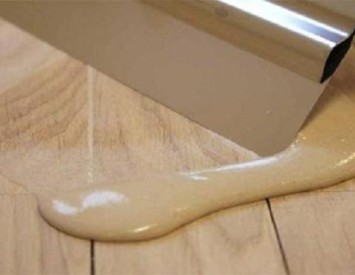
Acrylic putty copes well with the elimination of small defects, and also fills the seams. The peculiarity of this type of putty is that it is considered harmless and resistant to moisture. In addition, the acrylic putty plastic, it is easy to work with it. The main requirement to be performed when working with this material is to carefully prepare the surface. Wooden floor should be clean and dry. After complete drying of the putty, the surface will be smooth and shiny.
Quality acrylic putty:
- removes different wooden coating defects;
- lulls joints;
- regardless of temperature - does not highlight toxins and does not evaporate;
- harmless;
- elastic, soft material;
- high resistance to fire.
Oil putty consists of chalk, oil and water. The mixture has one significant disadvantage - a long period is required to wait for the complete solidification of the mixture. If you do not pay attention to this nuance, then overall oil-based putty is a practical and durable material that lasts for many years.

To process wooden floor, you can use a polymer putty on a tree. It consists of water and polymeric materials. The main purpose of the polymer putty is to fill the gaps, align the irregularities, eliminate defects in wooden floors. The polymer putty has one essential plus - prevents the accumulation of dust and does not allow the treated edges of the tree to be clogged. Save the putty very quickly, and filled with putty slit, even after several years of operation, will not be seized and fall.
Advantages of polymer putty:
- fills the gaps;
- quickly freezes;
- environmentally friendly material.
When working with a polymer putty, it is necessary to adhere to such restrictions: do not process the floors from the cork tree, do not apply the mixture directly to the floorboard.
The composition of the solvent-based putty includes wood dust. Parquet floors and wooden surfaces are treated. Such a putty can be used to process wooden surfaces equipped with a "warm floor" system. The main advantage of this finishing material is the ability to process different breeds of wood, even exotic. The putty is unpretentious in work, it is easy to apply it, and it dries very quickly.
When you need to use a floor putty
Putty wood for the floor will be needed if there is a new floor laying, including the parquet. There is also a need to process the wooden floor surface during cosmetic repair when it is necessary to update the coating.

If it is decided to lay a wooden coating on the floor, then without putty do not do. It will fill all the seams and irregularities - the floor will be smooth and smooth. Also use putty in the cosmetic repair of wooden floors. Before painting, all the cracks must be filled with putty and smooth out irregularities. As a result, when processing wooden floors with putty, the life of the natural coating is significantly increased.
How to make putty yourself
In a construction store you can buy any putty, but when it is not possible to purchase it, you can independently make a mixture for the restoration of the wooden floor.
The basis of putty - Olife. On 500 g of Olifa, it is necessary to prepare such components:
- animal glue (10%) - 100 g;
- skipidar or kerosene based on varnish - 125 g;
- liquid Sikkativ - 25
Also for the preparation of putty need a dry sophisticated chalk - 0.5 kg and liquid soap 100 g.
The technology of preparing the spacious mixture should be strictly observed:
- First you need to heat the animal fat on fire, constantly stirring inserting liquid soap into the mixture.
- In the mixture are introduced in small portions of the components in such a sequentially: olifa, turpentine and seaccative. The mixture is stirred.
- You can remove the hot mixture from the fire, add chalk and mix. According to the consistency, the putty should resemble a shop sour cream.
Using self-cooked putty, it is necessary to remember that the mixture should always remain warm. If you need to fill out a few cracks and smooth irregularities, then you should not prepare a large amount of putty. During work, even if there is a large area processing, the material must be maintained in a warm state, so prepare a pelvic or a bucket with hot water in advance and place a bucket with a spike.
You can prepare putty to process wooden floors using the minimum amount of materials. The budget recipe for the preparation of the composition for sealing cracks consists of a mixture of PVA and sifted chalk. The putty should remind a thick sour cream on the consistency. If it is necessary to eliminate the significant defects of the wooden floor, then chopped dry wooden sawdust are added to the mixture. Such a putty dry about 2 days.
Important: When using wooden sawdust, they must be pre-soaked for 24 hours in warm water or in a liquid that will be used to prepare putty.
Another simple recipe for making putty at home: Take the chalk or cheap finish plaster, dilute the dry mixture with water-soluble or acrylic varnish. Mix the mixture to the pasty state.

If you need to process wooden floors in a wet room, then it is better to use a carp on an oil basis. It consists of 1 kg of olifa, 100 SICKATIVE of the NF-1 brand and 2 kg of chalk.
Putty from construction waste: Take a clean linoleum on an oil basis (without insulation), break it into pieces and pour acetone. Wait for the putty to acquire the desired consistency.
Important: When working with chemical liquids, it is necessary to use protection tools. Prepare a mixture is better in a well-ventilated room or outdoors.
Concrete
For coating concrete floors, a self-leveling cement polyester putty is used.
The shops presents such types of finished putty:
- acrylic;
- polyester;
- water based.
Self-leveling putty is used for solid putty of floors. This material is characterized by high elasticity. Good reviews received the putty "Thomsit DD", it stacked with a thickness of no more than 5 mm, quickly hardens, suitable for processing a large area, durable and durable.
Polyester putty for concrete floors is popular. It has high strength, elastic. The main advantage of a polyester putty is that it does not shrink after drying, but when working with this material it is impossible to put a putty layer. It is better to first apply 1 thin layer, wait for a complete drying, and then put another 1 layer of putty.

20 years ago, a concrete mixture was used in alignment of the floors. It is preparing from 1 part of cement and 3 parts of sifted river sand. Both components are stirred, the water in the mixture is gradually poured (0.5 liters of water takes on 1 kg of cement). The solution should not be very liquid and not spread. The floor screed solution is used.

To get a good result, it is necessary to highlight 1 day and after applying the solution to wait for a complete drying. According to the rules, drying the tie must water every day with water, and then cover with polyethylene. The strength of the concrete screed will drop in 28 days, and after aligning the surface to the concrete floor, any coating can be stacked.
When choosing a floor putty, it is important to take into account such requirements as the time allotted on the drying of the composition and humidity of the room. There are types of putty, which are used only at a certain temperature with low moisture levels. These nuances need to be considered. It is also necessary to wait for a complete drying of the putty (about 24 hours) and minimize the load on the treated surface.