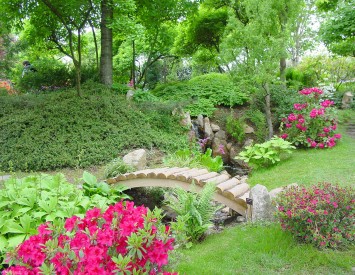
Fruit trees and flowers in the modern garden are no longer so popular because the landscape design of the territory has acquired high importance. For the original design of the house, decorative vegetation is increasingly used, the variety of varieties of which is affected by imagination. Among the existing types of trees and shrubs, you can choose exactly those that optimally fit into the concept of the garden, regardless of the size and type of terrain.
Content
Choice of trees in the garden style
Determine the variety of vegetation that can decorate the garden plot much easier if you know what style is planned to land in green spaces. Today there are two main concepts of territory design:
- regular garden;
- landscape garden.
Plants for regular garden
This embodiment of the house section involves planting vegetation on clear geometric lines, where a thorough care of plantings must be required: shrubs and trees for the garden are carefully trimmed to get the right form. For such a garden, a live elevation of any type is characterized, so often the varieties of plants that carry the haircut are used.
For the formation of a low green fencing is suitable:
- currant golden;
- linden mellitis;
- sugit evergreen;
- lapper shrub;
- tess berry;
- spruce ordinary.
If the goal is to create a high molded hedge, then you should pay attention to such plants as:
- elm mellite;
- turn;
- virgin Juniper;
- barberry;
- western Thuja.

Vegetation for landscape garden
This type of household plot is an untouched corner of nature, where trees and shrubs for the garden grow in an original form, without strict order and forms. The selection of green vegetation is quite wide, since the only criterion is the susceptibility of the tree to the conditions of a particular territory. Otherwise, it remains for the fantasy of a landscape designer.
For landscape garden, both deciduous and coniferous plants are suitable. Among the favorites you can select such species as:
- spirei;
- snowberry;
- lilac;
- maple;
- kissel;
- birch;
- cUBUBUS;
- bubbler.
Many of them beautifully bloom, and some grades even bring edible fruit in autumn.

Exotic trees and shrubs in the garden
Modern gardeners strive to move the rust of the greenery and the multi-fission of the original plants to their territory, since traditional trees and shrubs are somewhat losing in aesthetic. In addition, many varieties of plantations are quickly leaving in domestic expanses, pleaseing the eyes with originality and beauty. Consider the most popular types of trees used in landscape design.

Apple tree Nedzvetsky
Fruit trees in the prejuves are valued above the rest. But this grade is famous not only to fruitful qualities, but also decorative. Apple tree of the Uzvetsky is a low plant growing up to 8 m long with purple leaves. The color of the tree flowering is the most valuable, since the entire crown is covered with bright pink and lilac flowers. This variety of apple conquered popularity thanks to such qualities as:
- frost resistance;
- resistance to disease and pests;
- unpretentious;
- high aesthetic value;
- universality of planting in group, allery and single compositions;
- fertility.

Sakura
Decorative trees for the garden are difficult to imagine without Sakura, about the flowering of which is known all over the world. This variety of wood includes a cherry short-profile and smallcopilic. Her unusual purple color gives a plant high decorative qualities. However, it is quite susceptible and needs to be care:
- it is recommended to bind the placement of the vaccinations and crowns to the reed layer, to ensure the conditions of frost resistance;
- prevention is required from bone diseases;
- it is advisable to plant in moderately warm climatic conditions.

Bignonyevoid Catalpa
Catalpa brought from America today became a popular plant that decorates domestic gardens. In the late spring, the tree is covered with a cloud of snow-white flowering, which even looks exotic in their form. The plant won wide popularity due to such features:
- white flowers exude saturated flavor;
- the tree is light-cuply, due to which it can grow in any part of the garden;
- unpretentious in care;
- well tolerates dry weather, does not require frequent irrigation.

Konsky chestnut
Solving what exactly buy trees for the garden, attention is attracted by Kashtan Baumanii, which is distinguished by lush terry inflorescences of white or red shade. This type of wood is distributed among the gardeners through such characteristics as:
- growth intensity;
- unpretentious care;
- resistance to disease and insect;
- decorativeness of inflorescences.

Principles of the location of trees in the garden
For registration of a neat garden area, it is necessary to be guided by the principles of the correct placement of vegetation, since the form of the composition, the growth rate of plantations and their combination depends on this. Consider the main requirements for the placement of trees on the plot:
- For a small-sized plot, you need to pick up low or dwarf trees - cherry, dwarf apple tree, etc.
- High vegetation with a lush crown looks good in lowlands or on the lawns.
- Lookage trees need as far as possible from the power line.
- When planting trees, try to prevent the massive branches to subsequently be over the roof of the building. Since this is how the risk of damage to the roof in case of their clogging.
- When choosing a variety and type of wood, take into account the conditions for its growth. Do not land plants with a powerful root system near the house. It is also recommended to design a garden depending on the photosensitivity of each tree.

Traditional trees in the garden
The beauty of exotic trees is not questionable. However, in many climatic zones, these plants will not be able to take care of, whatever careful care. In addition, among the traditional types of plantations, there are no less decorative representatives that are discussed in detail below.
Maple Dlanoid
Many trees in the garden in the photo of designer publications are precisely a variety of maple. This plant has a high decorative value, since an unusual color and the form of leaves creates an original tree view. In addition, such a variety of vegetation is famous for the beauty of inflorescences, the texture of the cortex of the base and painting of shoots. Such a maple has gained popularity due to the following features:
- the presence of honey characteristics;
- the growth intensity of seedlings;
- the possibility of using both group and single compositions;
- combination with coniferous trees.

Gimalayan cedar
This plant is a durable and fast-growing tree with decorative forms of crown, trunk and needle finishes. This is a fairly common grade of coniferous plant, which is used for a single landing and protects well from the penetration of foreign explosion, noise and dust. For cedar such characteristics are characteristic:
- attractive crown contours;
- good endurance haircuts;
- used to create a living hedge;
- frost resistance of the breed;
- unpretentious care.

Breeding beelandist
This dense shrub has a thick rounded crown, which is scattered up to 1 meter high. It grows intensively, and also paints his foliage into a saturated red shade with the onset of autumn. In addition, the bearer is beautifully blooming in May and decorates the garden with an umbrella inflorescences of yellow-green. The plant has such features as:
- winter hardiness;
- the possibility of creating a form;
- resistance to high temperatures;
- universality of disembarkation: it grows well any soil.

Hibiscus
An unusual plant having a shape of a small tree or shrub. Reaches not more than 3 meters in height. Hibiscus received a special popularity in horticulture thanks to funnel-shaped blossoms with elegant trump, as well as petals of various shades. In addition, this tree has such characteristics as:
- abundant bloom;
- unpretentious to habitat;
- duration of flowering period;
- aesthetic appeal.

Hydrangea
Hydrangea is an unusual decorative shrub, characterized by thick hats of bright flowering. Due to this feature, it has become quite popular among landscape designers and gardeners. Her crown has variable shades and wide large leaves, and the plant height reaches up to 3 meters. The beauty of the shrub is manifested in the summer months, when hydrangea dismisses fully.

Maple Ostroland
GloboMum or Ostroland Maple is a decorative tree with a rounded crown. Its dimensions reach 6 meters in diameter and differ in a saturated yellow-orange tint. This tree has gained its popularity thanks to such features as:
- aesthetic attractiveness of glossy, fined leaves collected into a dense crown;
- combinability with other types of vegetation on the site;
- the possibility of forming a single landscape composition, as well as disembarking in the alleys;
- frost resistance;
- low irrigation need.

Magnolia
This tree shrub is distinguished by the beauty of flowering, appearing on branches before foliage breaks. Dense petals of inflorescences possess the color color variability - from purple to yellow, due to which the plant can be planted in any composition. In addition to other advantages, Magnolia has a rich fragrance and unpretentious to growing conditions.

Garden layout
Many owners of the local area seek to create a cozy garden corner where you can spend your leisure. In order for the site to be as comfortable as possible, neat and complied with the requirements of landscape stylistics, you should adhere to several rules in its design:
- The priority is the design of the garden. Apply a schematic representation on paper where we designate the desired zones for fruit trees, deciduous and coniferous vegetation. At the same time, consider the characteristics of the growth of each variety, since for some types of plants it will take a sunny side, and for others - shaded.
- Calculate the garden square. To do this, you need to know the criteria for each planned plant of plantations, namely, its dimensions in a mature state. If the trees are closely, they will begin to deplete the soil, because each root system will need enough nutrition.
- Single trees It is advisable to land at a distance of 4-5 meters in one row, and if several landing lines are planned, then between them you need to make an indent of at least 8 meters.
- For group plantings, hold a step in 6-7 meters.
Trees landing guide can be viewed on video: