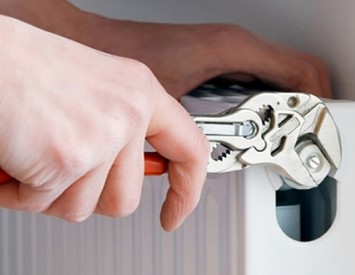
The technology and sequence of repair of heating radiators depends on the type and design of the battery itself. In addition, the reason for the breakdown is important. For example, the repair of bimetallic heating radiators is not much different from the repair of any other, it all depends on the specific situation. We will then consider in detail how to find, localize and eliminate malfunctions in heating radiators.
Content
Types and design of heating radiators
In this article we will analyze the sequence of repair of such types of radiators as:
- steel heating radiators,
- aluminum heating radiators,
- cast iron heating radiators
- bimetallic heating radiators.

During repair, it should also be taken into account the design of the radiator. The main types of structures are four:
- Sectional radiators - assembled from individual single-type sections, securely bonded among themselves.
- Monolithic radiators - are one large section-case.
- Tubular radiators - has no unifying case, because The coolant circulates through the pipes, which constitute the radiator body. Frequently performed in non-standard forms and sizes.
- Panel radiators. Consist of two metal plates that are welded with each other.
In order to start repairing heating radiator, you need to know which basic and additional items, parts and components are included in its design.
General Device of radiator batteries
Consider the components and details that are equipped with heating radiators. Depending on their type and design, components and additional devices will be different, but in general, the list of possible components, the following:
- sections and tubes - Channels inside which circulates the thermal fluid,
- pipes - connect with pipes for supplying and removing the coolant,
- detachable rings - close the place of exit pipe from the wall panel,
- plastic rod - fixes the detachable rings,
- corks - plugs on the sides of the radiator,
- ball valve with valve - for overlapping coolant circulation,
- maevsky's crane - for manual discharge of pressure in the heating system, as an option, install automatic pressure reset valve,
- the thermostat head, with the help of which sets the room temperature,
- steel bushings, intercreational nipples, silicone gaskets - placed in sections in places
- couplings, lock nuts and brackets for fastening heating radiators.

An aluminum heating radiator is sometimes a circulation pump that provides uniform heating of rooms. It is also used for other radiators when the lower connection of the heating system is installed, i.e. Pipes are suitable for the radiator below. In this case, the use of the circulation pump is necessary, otherwise the heat loss level will increase significantly.
Signs and reasons for heating radiators
Possible causes of damage and breakage of heating radiators:
- Initially incorrectly selected radiator. Depending on the diameter of pipes, pressure and water temperature in the heating system, various types of radiators are installed.
- Incorrect connection of the radiator to the pipes of the heating system.
- Strict operating conditions of the centralized heating system. The increased acidity of the coolant and sharp pressure drops lead to electrostatic and electrochemical corrosion of the metal.
- The heat carrier of poor quality in the heating circulation system forms a raid at the joints of the sections and in the fields of fastening pipes.
- The poor-quality coolant clogs the radiator sections and the radiator as a whole. This causes the need to wash them periodically.
- Degradation of intersection gaskets and the destruction of threaded nipples. It is necessary with a certain periodical to replace the gaskets between the radiator sections.

The main signs of breakage and deterioration of heating radiators are as follows:
- during the heating season in the premises it became colder than usual,
- at the joints of the sections and in places of fasteners, a flight was formed,
- there was a flow.
If the heating radiator is very old, it is best to replace it. Modern models are more effective, possess high thermal conductivity - in the house will become warmer, and heating costs will decrease. In addition, new batteries are compact and distinguished by a beautiful design.
In the case when it is not possible to change the radiator, you need to fix the breakdown as soon as possible. The best solution is to contact specialized services or resort to help professional masters. But you can also try to repair heating radiators with their own hands.
Repair of sectional radiators of heating do it yourself
Sectional radiators include an overwhelming majority. First of all, it is cast-iron and bimetallic, less often metallic.
Of course, the preventive repair of heating radiators is best made before the start of the heating season or after its completion. However, often we begin to do something only when the problem becomes critical. The main reason why the need for repair occurs is a leakage of hot water. Therefore, the following is the instruction, how to quickly repair the radiator with your own hands and get rid of the leaks:
1. Diagnose the flow. Often the place where the water flowed from, can be seen with the naked eye. But it happens that it is difficult to identify it. In this case, the radiator needs to be dismantled and immersed in the bathroom with water. From the place where the hole was formed, bubbles with air will begin to rise. However, it is most often necessary to remove the battery, and the repair is carried out locally.

2. Prepare the tool. When the location is defined, you need to proceed to repair the radiator. To do this, prepare the following tools and materials:
- thin steel cable,
- mask. You can use to choose from: a mixture of epoxy resin and metallic (bronze or aluminum) powder; dense zinc bleel; polymer or powder sealant; "Cold welding" (note that it is moisture resistant and withstand temperatures up to 100 ° C),
- canvas, bandage or other fabric for applying putty,
- metal clamp. If it is not - isolate (or rubber) and wire.
3. Equip the repair location. Battery Put the oilcloth, waterflaw or a piece of film. From above - a big rag that absorbs water well. If necessary, set a number of pelvis or bucket for water collection.
4. We make sweeping space. Most often, the location of the leaks is the joint between the radiator sections. In this case, you need to remove the old winding, remove pieces of destroyed gaskets and paint layers. Take advantage of the string (thin cable with nodules at the ends) and clean the damaged joint to the metal. Rinse the purified gasoline or acetone plot so that the new winding is firmly fixed on the radiator.
5. Mind a damaged area of \u200b\u200bthe radiator. Mix epoxy resin and metal powder, make the composition to a narrow tape from the fabric. Make a tape with a tight as a tight with a mixture of two or three layers. If zinc bleel used as a shuttering agent, then in four or five layers. When using "cold welding", you need to cut a small piece from it and stretch it with hands to a homogeneous consistency. Apply welding around the joint, the tape is not necessary to use the tape.
6. Fix the mashed plot with a metal clamp. Take the clamp on top of the smelting. Turn it and securely secure with bolts and nuts. The compound of the clamp must be aside opposite to the place of flow. If there is no clamp - use an insulating tape or a piece of rubber. Rubber is better cut from an elastic medical harness or cycling chamber. Wash the isolent or rubber in several layers, the edges firmly twist with a metal wire.

When the heating season is over, it is recommended to replace the defective heating radiator or at least damaged sections. In the absence of such an opportunity, it is necessary to remove the old winding and process the place of course on the same scheme. It is necessary to do this before the next heating season, so that the new winding can get good enough. The repair of cast iron heating radiators is performed in the same way.
Repair of aluminum radiator heating by soldering
In some cases, the damaged areas of the aluminum radiator must be sought. In the presence of skills to work with a soldering iron, it is easy to implement such a repair. However, note that aluminum and its alloys are poorly soldered, so it is necessary to carry out such work extremely gently. So:
- prepare a surface for soldering and apply iron-rosel flux on it;
- wipe the damaged zone with a heated soldering iron;
- when the rosin spread over the surface, enter the tin-lead solder with an admixture of iron sawdust.

The walled aluminum radiator is recommended to re-paint. For this:
- Will erase the old paint layer with a special wash.
- Carefully process the radiator with sandpaper.
- Heat-resistant paint or enamel apply a smooth layer from top to bottom. If the section is a sectional, start painting from sections between sections. Note that when painting the radiator should be cold.
Some tips and recommendations to increase heat in the house
Finally, several tips to improve the work of heating radiators and the heating system as a whole:
- Painting of the radiator (in particular, the cast-iron) in the dark color increases the proportion of heat reducible by radiation.
- The recommended distance from the radiator to the windowsill is 100 mm, and from the wall to the battery - 20 mm. Otherwise the heat flux is disturbed, and the effectiveness of the heating system is reduced;
- In order to increase the thermal radiation pointing in the room, attach the heat insulating film with a foil surface to the wall behind the radiator.

- The optimal distance from the floor surface to the battery is 120-150 mm. If you do not follow this rule, sharp temperature differences will cause drafts in the house;
- When connecting (when hot water is fed to the radiator below), the total system power decreases by about seven percent.
- The efficiency of the heating system also significantly affects the installation site of the radiator. The maximum effect gives accommodation under the windowsill - 96-97%. If the battery is in an open niche, then efficiency decreases to 93%; If the radiator is closed in part - up to 88-93%, if completely up to 75-80%.