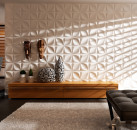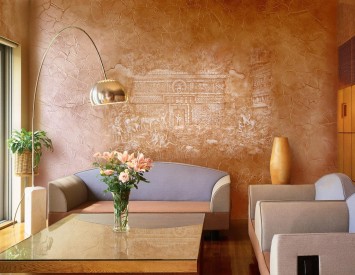
Construction technologies in recent years have gained active development, and today the mass of manufacturers offer an extensive range of materials for every taste. In particular, a wide variety of materials for wall decoration appeared. Each homeowner may choose bulk products, paint, as well as decorative plaster, creating a relief effect. It is about the latest version of the walls of the walls will be in this article.
Content
Varieties of embossed plaster
Such facing material contains in its composition granules of mineral origin, which create the effect of relief. The size of such components may be varied, so that they determine the structure of the wall surface after the material is applied. Also, in the production of this coating, a dye of a certain type can be used. It allows you to make tinting deeper and intense, and contributes to creating visual effects.

Types of material for chemical composition
This material is customary to be divided into views of several criteria. In terms of fillers and chemical composition, this coating is divided into the following types:
- Mineral plaster is a facing coating that is made on the basis of cement and lime. It has the form of a dry mixture, which you need to stir in water before applying the required consistency. The composition of the plaster of this type may include marble crumb. The size of these inclusions will depend on the volume of relief. Mineral material has universal properties and is suitable for both interior decoration, and for the scenery of the exterior of the facade.
- Silicone coating is characterized by the properties of elasticity and sufficient vapor permeability. The main advantage of such a coating is ease of care. If the facade of the room is lined with silicone coating, then enough rain is enough to clean it so that the surface returned to its original state. Despite the high cost of production, this condition was the reason that the silicone type of plaster is chosen mainly for the exterior decoration of buildings.
- Polymer or acrylic coating is a water-dispersion mixture, which is fully ready for the application process. As part of such a coating there is a certain filler: it may be a crumb of glass, ash waste, marble. The polymer plaster is distinguished by resistance to different atmospheric phenomena, however, has a low paronger coefficient. Therefore, it is not recommended to decorate the facades of the premises.
- Silicate plaster - represents a mineral substance, as part of which liquid potassium glass is used. It serves as the astringent component of the solution. This type of finishing material is distinguished by high vapor permeability, therefore it is optimally suitable for finishing any type of room.

Types of plaster structures
According to the structure of the formable image, such varieties of decorative coating can be distinguished:
- furridge plaster (RILLEN structure);
- uniform and rough (EDEL structure);
- modeling arbitrary coating (Roll structure).

Types of plaster according to the method of formation of relief
Depending on the final image, the embossed plaster can be varied to such groups:
- Plaster "Venetian" - such a coating creates the effect of marble walls. It consists of hazed lime, aqueous emulsion and natural marble flour. To decorate the room by this material, it is necessary to level the walls to a flawless state. This is a prerequisite for the use of the "Venetian" plaster. Also, the material meets the environmental parameters and has the properties of waterproof, fire safety, does not bear extraneous smells.
- The textured coating is the most common material for decorating the interior, because it makes it possible to obtain the desired drawing without much effort. For this purpose, special tools are used, which are always at hand. For example, it can be a washcloth, fabric, polyethylene film and other items that need to be attached to the wall, pre-giving a crumpled state. So the surface creates relief.
- Flock type plaster enters the market in the form of glue and tanks with a variety of painted splashes. Applying this coating, you can get a kind of mosaic crumb. The decoration of the walls of this plaster involves the initial applying of glue, and then the decorative crumb flushing so that it sticks to the surface. After the glue gets free, the protective composition should be applied to the surface.
- Structural plastering is a grain mass of an inhomogeneous nature with the presence of granules. Relief plaster, photo of which decorate design editions, can be used both for external and inner cladding. In the case of the design of the inner surfaces of the room, it is recommended to use a coating exclusively on a water basis. This is due to the fact that the material is characterized by environmental safety, reliability and simplicity in applying.
- Lessering material will create an aesthetic and neat wall relief. With it, it is possible to achieve the visual effect of the coating "under the antiquity". Such decorative plaster Relief can be used for internal decoration of walls, as well as for the external finishing of the facades. The lesing coating does not secrete toxic substances, resistant to different mechanical effects and is fireproof.

Advantages and disadvantages of decorative coating
This coating has a number of impressive advantages, among which can be distinguished as:
- Ease of use. On the packaging of the material of any brand, as a rule, the method of using plaster is indicated. Such a coating is fairly easily applied to the walls using a roller or spatula.
- Relief plaster with their own hands will help hide any drawbacks of walls. Making a choice in favor of decorative relief coverage, you can easily hide the uneven bug the surface of the wall.
- This coating is a good insulation. But to achieve the desired effect of insulation before applying plaster, you need to thoroughly brand the wall.
- Decorative plaster is favorably different from other materials an appearance. It looks original, sophisticated and exclusively.
- Relief stucco wall without problems will fit into any interior.
- This decorative material is environmentally friendly. The structure of embossed plaster does not include harmful toxic substances.
- This material is rather durable.
- Relief plaster does not absorb smells, resistant to temperature differences and mechanical effects.
If we talk about the disadvantages of this material, you can allocate only the high cost of products. However, given the durability of such a coating, its natural composition and high aesthetic appeal, you can safely make your choice towards the embossed coating.

Method for applying plaster
Registration of the interior of the housing with relief plaster will not be difficult, since to make the intention, you will not need to have a special tool or possess special skills. Consider a detailed process for decorating walls with such material.
Toolkit for work
To work with this material it is necessary to prepare the following:
- spatulas of different sizes;
- metal ironing;
- grater;
- angular spatula;
- sponge for finishing coating;
- rollers.

Ways to perform texture
First of all, consider variations of how aesthetic relief can be achieved when applying plaster. This action can be performed by several methods:
- The easiest way will be drawing with a roller. In order to use a roller on which there is a certain relief.
- Another way to design relief is the use of a comb or a special spatula.
- Also, the drawing can be applied to the coating using a different stencil.
You can perform the finishing of walls in the room on your own. For this purpose, it is only necessary to study in detail the instructions of the compositions and familiarize yourself with the rules for performing work and use the most simple means of household goods - various fabrics, washcloths, brushes, etc.

Step-by-step instruction of plaster
- At the first stage of the work, it should be removed from the surface an old coating, as well as dirt and dust.
- Available defects must be removed from the wall with a putty.
- Next action - applying primer. At the same time, consider that for each specific type of surface, it is necessary to use a primer having an appropriate binder in its composition. So if the walls have a concrete base, a mineral material material should be applied, and if the wall is a brick - an acrylic agent.
- Apply material for priming using a roller. A layer of infant primer should be 2 mm.
- Then proceed to apply basic plaster. Using a cellma or spatula, dispense the layer of the solution, which must hide the existing surface defects.
- Give the material to dry for 24 hours.
- Then cover the surface of the wall with seamless plaster so that there are no cracks, depressions, different slopes.
- The next stage of the work will be laying of decorative plastering coating. Here you can show creativity and independently determine the number of material layers and application technique. The easiest way will be the coating of a ready solution, which acquires a unique view due to the content of special fractions.
- After performing these works, leave the walls to dry for another 24 hours. If time allows you to dry for 48 hours.
- Next, polish and paint the surface. To achieve a gloss effect, you can apply wax or polishing agent. Or change the color of the surface using the appropriate paint.
- The process of applying plaster completed.

The method of applying decorative embossed plaster on video is shown below: