Recently, laminate leads among popular flooring for decoration of residential premises. This material is characterized by simplicity of installation, because it is not necessary to purchase an additional tool and invite masters, you can cope with all the works yourself. For laying laminate, only the coating and a special substrate will be required. For what it is needed and what kind of substrate to purchase, let's learn more.
Content
What is the substrate for?
This finishing material has an important task to smooth out a minor curvature of floors. If the floors are uneven and the drops are too large, then before proceeding to laying the laminate, it is necessary to pour the surface of the self-leveling mixture. After the screed is completely dry, you can proceed to the most interesting process - laying the laminate. But first you need to put the substrate, this is a kind of depreciation so that the board does not come into contact with the solid surface and did not spoke.

If the unevenness of the concrete floor is about a few millimeters, then laying of cork substrate under the laminate is allowed. Regardless of the quality of the material, its basic function is the depreciation of the surface, in order to result in the operation of the laminate, the targets were not formed on the floor and there was no rigid coating load. If you ignore the rule and lay a laminate without a substrate, then advancing such a coating, you will always hear a strong creaking or crackle. Here is another answer to the question, for which the substrate needs is to improve the noise insulation of the room and keep warm in the house.
Types of substrate
If you decide to independently put a laminate in the room, then you need to find out all the nuances in more detail, and you need to start with the choice of coating and substrate.
You will find several options for this finishing material:
- the substrate is polyethylene - well maintains heat, pushes moisture, resistant to damage to rodents and insects, the cost is low. Fresh wear should be noted from the disadvantages of this material. After a few years of operation in places of high passability, the substrate quickly sends;
- the substrate with applying foil is a foam material coated on one side with a metal foil. Used in cold rooms to enhance thermal insulation. Suitable for the hardware system equipment. The material is expensive, so it is impractical without connecting such a substrate without connecting warm floors;
- the "Tomples" substrate has an original design, a kind of puff pie consisting of a plug, from two sides of a granulated polystyrene-destined polystyrene. Such a substrate is characterized by a high degree of wear resistance, retains heat indoors, pushes moisture;
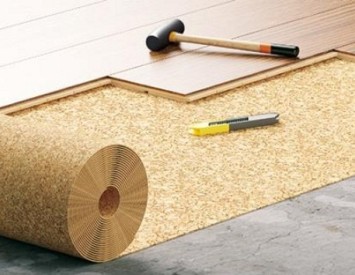
- cork substrate for laminate. The price of the product is held at a high level, but if you explore all the characteristics of this building material, then you don't have to regret the purchase. Briefly describe the technological process of manufacturing cork substrate. The main raw material is a cork oak bark, the material is crushed, and then it falls into the pressing machine, where a homogeneous canvas is connected under pressure from the fiber fiber. In the process of manufacture, additives do not apply, only natural material is used, and the plugging of the traffic jam occurs due to the fact that in the cork tree there is own glue - suberin. Under the influence of high temperature, it softened and glued. The material is absolutely safe, not toxic. You can buy a cork substrate for laminate in any construction supermarket.

Pay attention to the size. A substrate is for sale mainly in rolls of 5 or 10 m. The thickness of the material can also be different, from 2 to 4 mm.
The thickness of the substrate matters?
Most newbies believe that the floors can be easily corrected if you buy a thick substrate. But the thickness of the cork substrate under the laminate will not solve the main problem. If the differences are large, you will have to make a screed. If you decide to avoid so troubletectic classes, then a small curvature of the floor can be tried to fix with a cork substrate under a laminate with a thickness of 4 mm. But here it is necessary to take into account one important factor if you choose the thickness of the material is incorrectly, then as a result of the maximum load on the floor (parts of high passability), in a few months the recesses are formed, and this will result in rapid wear of the castle compound of the floor covering. Therefore, when choosing the thickness of the base for laminate, it is necessary to take into account a small curvature of the floors - the cork substrate under the laminate should be a thickness of 3 mm. If the surface is almost smooth, you can purchase a cork substrate under a 2 mm thick laminate.
Advantages and disadvantages of finishing material
The main advantage of a cork substrate is in universality. This building material can be used to finish the walls and even the ceilings. The cork substrate will last long time and is not excerpt even after 5-7 years of operation. By the way, the manufacturer gives a guarantee for a cork substrate for 200 years! Imagine how much floors can be served, and with them and the substrate! It is clear that the laminate will not withstand such long-term operation and after 10 years it will be necessary to change the old coating on the new one. But the cork base can be left because it will be well saved. This is already a good savings.
Pluses of cork substrate:
- environmental material, does not distinguish harmful substances and toxins;
- can be used in any room, even in the nursery;
- the material is not deformed;
- keeps warm and has soundproof properties.
Of the minuses you can allocate only the only drawback is a high cost.
Based on the above, you can make the following conclusion: if you are not going to change the laminate in 5-7 years, but give preference to a qualitative and durable coating, then you can lay a cork substrate under the laminate.

We will get acquainted with the technical characteristics of the material:
- the density of the product can vary in the range from 220 to 260 kg / 1m 3;
- the humidity of the tube is only 7%;
- high thermal conductivity - on 1m 3043 W;
- high resistance to fire. Despite the fact that the plug of natural origin, this material does not burn, and if it lights up, then toxins are not distinguished when combustion;
- high material strength (2kg / 1m 2).
How to properly lay a cork substrate for laminate
From the correctness of your actions and a clear sequence directly depends on the quality of the work and the end result.
How to drain the cork substrate under the laminate
- First you need to prepare the entire area. That is, if the floor is uneven, then with the help of a self-leveling mixture or liquid putty, it is necessary to align the entire surface.
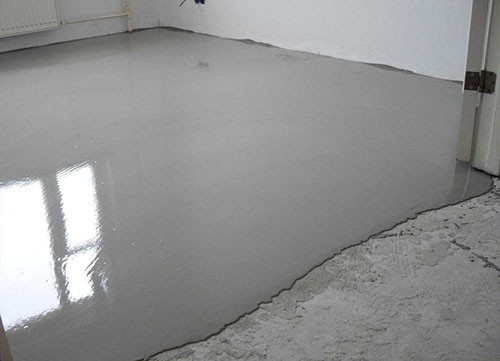
- After the curvature of the sexes will be corrected, it is necessary to walk along the surface of a grouting skirt to clean and smooth all the small irregularities and cracks.
- We process the floor by primer (it is better to buy liquid with protection against mold and fungus).
- After applying the primer, you need to wait 24 hours (or a little less, learn the instruction).
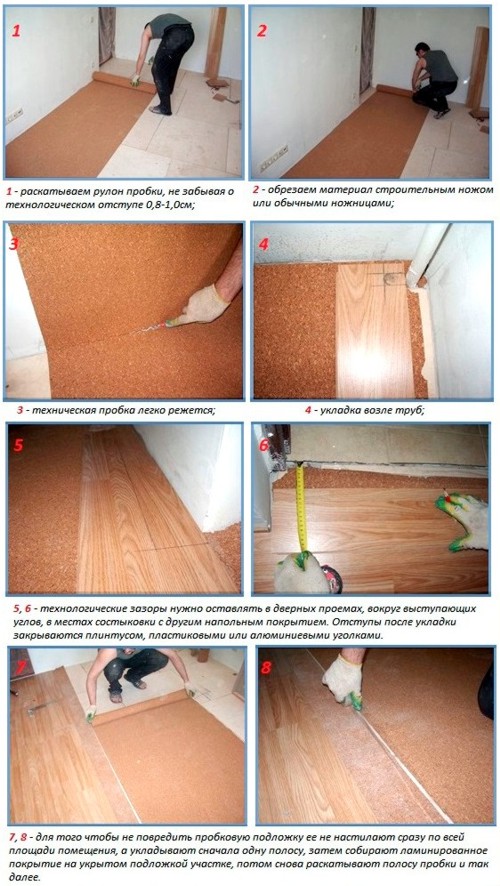
- Remove the packaging from the substrate and put it on the floor. Leave one day so that the material "met" with the climate of the room.
- Getting Started: First you need to lay a layer of waterproofing. It can be a special material or dense polyethylene. We cut it into the strips plus the stock of several centimeters and put on the floor with a small gap, so that the edges of the film "climbed" on the wall (up to 1-1.5 cm quite enough).
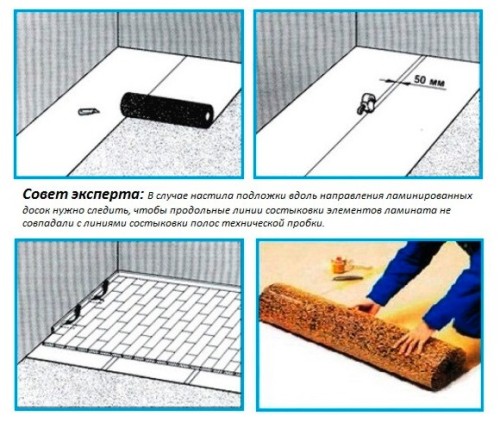
- With the help of the construction tape, we fasten with each other polyethylene. ATTENTION, in no case, do not use metal brackets or nails to fasten the film, as the moisture can be seamless through the holes, and this is the spent time and means for materials.
- We lay out the substrate so that the distance from the wall was approximately 1 cm. We label each sheet tightly to each other, without adhesion, butt into the joint.
- Cork sheets connect with the help of construction scotch.
- If you want to additionally protect the coating from moisture ingress, you can process the cork substrate with a special means that repel water and any liquid.
- All, you can start laying the laminate.


Little secrets that will help you quickly cope with the task and extend the service life of the floor covering:
- any substrate needs to be laid only across the laminate to avoid coverage in the process of operation. You need to decide in advance with the direction of laying outdoor coverage;
- do not be lazy to carefully clean the concrete floor from pollution. If there are cracks, they need to be filled with mortar and deteriorate all irregularities;
- concrete floor need to be treated with antifungal mixture and wait when it is completely absorbed;
- cut the cork substrate so that you can work comfortably and lay sheets on the base, the width of the base may be different;
- remember that laying a cork substrate in several layers is prohibited;
- the cork trees substrate is best used for residential rooms and corridors. For premises with high humidity (kitchen, toilet, bathroom) Buy tiles or if you decide to put the laminate and in these rooms, then it is best to use a cork substrate to work with an additional layer that protects the coating from moisture. Pay attention to the bitumen base for laminate in combination with a cork tree. The basis of such a material is the pressed cardboard, on which on the one hand is a thin layer of bitumen - durable material. The second side is a plug. Such a substrate protects the coating from moisture and even pushes it out. Stacking the combined material must be put in a plug for a concrete base. Joints are fixed with sticky paper;
- it is worth paying attention to when buying the waist for laminate to roll wood rolls in combination with synthetic rubber. The material is cheaper, the quality remains at the height, wear resistance is high.
Cork substrate for laminate. Video: