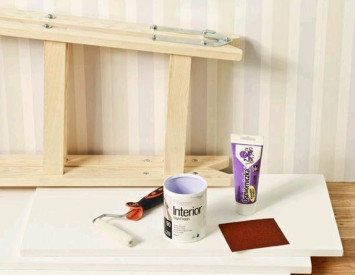
In private farms for numerous needs, staircases are used, including not only stationary, but also mobile (portable) options. Power staircase allows access to various high-altitude objects in the process of construction and repair, it is convenient to rise in the attic or a roof, relieve fruit from high fruit trees. To date, this design is available in many courtyards. If you have not yet acquired a portable staircase, it can be made independently.
Content
Purpose of internal stairs
In the private farm, a convenient and reliable pavement staircase is almost indispensable, as it allows you to get to the places to which you can not reach the height of human growth.

Similar structures allow:
- produce construction and repair, as well as finishing work on the facade of construction;
- performing car wash, check and replace wiring, installation of meters and lamps, cleaning drain pipes outside the building;
- collect harvest with highly branches of fruit trees;
- check and current repair of roof coverage, inspect chimneys, as well as mansard windows.
Thus, without a high-quality portable staircase, in many cases, it's just not to do.
Varieties of Potted Stairs
For repair work, as well as housekeeping, it is convenient to use an appropriate staircase. This design of wooden bars, metal tubes or corners lean towards the wall or a tree at an angle of about 75 °.

The following varieties of appitable stairs are available:
- simple insecurable - are straightforward products of fixed-length, consisting of reference guards with steps recorded on them, which are attached in the grooves either on the ribs;
- folding - these designs from several sections connected by hinges can be stored in the room. Before use, such a staircase is unfolded by purchasing the necessary form;
- sliding - Ergonomic designs of two parts, equipped with guide, providing a slight slip. Sections of these models are fixed firmly and withstand significant loads. The sliding pressing staircase in the folded state takes little space, it is convenient to transport it and store. Comfortable sliding lightweight structures are presented on sale in the form of particle aluminum stairs (such products are slightly weight and equipped with profiled steps that prevent slipping);
- step - universal models that can be used to carry out any work outside the building, as well as in a limited space space. At the site of the panel ladder-ladder, you can install the necessary tools and containers necessary for work.
Constructive requirements
In order for the palter staircase to be quite reliable and strong, when planning its design and in the process of manufacture, a number of rules should be taken into account. Based on the calculations and tests carried out, relevant regulatory documents were developed. In accordance with them, it is necessary to take into account the following recommendations and requirements for the constructive performance of such products:
- the recommended length of the internal staircase is up to 5 m;
- to impart the design of the necessary stability, special nozzles that can be removable should be applied. In the case of the installation of the staircase on the loose soil from the bottom on the support racks, lining with steel pins that are required to buerate into the soil are fixed. In order to avoid sliding side racks on a smooth solid surface, rubber "shoes" are put on the bottom. For reliable fixation of the upper part, removable hooks are used;
- most conveniently moving around the stairs in a step of 30-35 cm;
- steps should not be left outside of the support beams - for reliable fixation, they should be attached to the grooves of the TETIV;
- support racks must be made up from below, as well as along the entire length - with a step of at least two meters, special tightest bolts;
- it is not allowed to use products with transverse cracks in wood, longitudinal should not exceed a depth of 5 mm and a length of up to 15 cm, it should be eliminated to weakening the fixation of the crossbar or racks. Put the cracks with putty are not allowed;
- metal structural elements should be deprived of sowing, sharp ribs and edges;
- sliding structures are equipped with a special lock, excluding spontaneous movement of the stairs. The stairs equipped with wheels are equipped with a locking mechanism for eliminating their movement during work.
It should be checked annually to check the ladder, even if it was not used throughout this period. To do this, it should be installed at an angle of 65-75 ° and to sequentially install the cargo from 120 kg for each stage.
Materials used
For the manufacture of stairs, it is necessary to use a durable and wear-resistant material. Regardless of the size of the inlet stairs, it is required that the design has not too much weight. There are similar products from metal (aluminum or stainless steel), wood. In addition, you can purchase plastic structures reinforced to hardening fiberglass - this light and at the same time durable material is characterized by chemical resistance and is a dielectric. The withdrawal fiberglass staircase can be used in production and in everyday life, as it is an indispensable for a homemade master by a device when connecting to a source of power supply, repair or laying a new wiring line on a plot, in the house, in the attic.

At home, it is easiest to make a wooden dormitory staircase. For these purposes, the wood of coniferous breeds (spruce or pine) is suitable. It is necessary to prepare the durable, well-dried and even bars or logs without bitch, distortion and transverse cracks. In addition, a tree is rejected with signs of rotting and insect affected. The wood used will need to be treated with antiseptic impregnation - this measure will allow to protect the details of the structures from deformation and rotting, and largely extend the service life of this device.
If you are interested in information, how to make a wooden dormital staircase, you must take into account the following. The cross section of bars should be selected depending on the length of the future staircase:
- from 4x5 cm - for lateral supports of stairs up to 3 m long;
- from 4x8 cm - for lateral racks of products longer than 3 m.
For the crossbar (steps), the bars should be used with a cross section of at least 2x4 cm, otherwise the design will be too fragile. As a rule, the cross-section 3x4 or 3.5x4 turns out to be quite enough. It should be noted that too thick bars are dragging the design. For convenient movement on the stairs, its width is enough 50 cm.

Types of fastening steps to side racks
For connecting crossbar with reference racks, the following fastening methods can be applied:
- the easiest way is to install steps - in such cases, the crossbars are fixed on top of the string with nails or screws. To stand on such a staircase falls on the edge of the bar, which is not very convenient. This design is not particularly durable, and is suitable except as a temporary option;
- installation of steps in the grooves on the support racks - for this, the grooves cut out the shape of the ends of the crossbar accordingly. Next, the crossbars are inserted into the grooves and fixed with nails or screws;
- the "groove-spike" compound - in this case, at the ends of the crossbar, spikes are formed, which are inserted into the grooves cut into the staircase support racks. This compound provides the most durable and reliable fixation of the steps.
How to make an appropriate staircase with your own hands
The sale presents a significant number of appropriate stairs - for household needs, use in construction and in factory conditions. Modern technologies make it possible to use various materials for their manufacture, including metal hollow pipes or corners, as well as fiberglass. As a rule, similar products are distinguished by a significant price. For domestic needs, a simpler design is quite suitable, which is easy to make independently. On the Internet, you can familiarize yourself with the schemes of such products and choose the most suitable option. Next, you will need to draw the drawing of the inlet staircase, and then calculate the required amount of materials.

For the manufacture of anxulated staircase, the following tools and devices may be needed:
- chisel, hammer, and screwdriver;
- roulette;
- joiner's pencil;
- plane;
- circular Saw;
- grinding;
- electric drill.
In addition, you will need to prepare two wooden bars of a suitable length for supporting racks, as well as wood for the manufacture of crossbars. For the construction of the stairs, it is preferable to use a well-dryed pine timber - it is necessary to pick up smooth bars without bitch, costelor, cracks and chips. This wood will be necessary to handle the antiseptic.

TECHNOLOGY MAGE
Phased instructions, how to make an appropriate staircase with your own hands:
- In the presence of work skills with carpentry tools, make parts for the assembly of the pavement stairs is easy:
- first, you will need to modify from wooden bars. Two tents with the same length, the lower edge is recommended to be cut off at an angle to prevent slipping;
- next, for the manufacture of the crossbar, it is necessary to cut the bars to a part of 60 cm long. The number of steps are calculated, based on the desired step height (usually about 290-350 mm);
- the corners of the parts should be rounded with a planer or a milling and cutting to a smooth surface.
- On a flat surface, put the support racks of the stairs, while having them in such a way that the distance between the upper ends of the beams is 40 cm, between the lower - 60 cm. Future instruments should be fixed in such a position, having configured to the tablet from both sides.
- In accordance with the selected step of the stairs, apply the markup location locations on the beams.
- The steps must be adjusted in length depending on the distances between the growths, and then numbered according to the location on the support beams.
- At the ends of the crossbar it is necessary to form the spits, in the planned places of fastening of steps on the growths - the grooves corresponding to them with a minimum gap that allows you to install with a dense fitting of parts. The grooves will need to cut down the chisel.
- Spike, as well as grooves are treated with joinery glue. Next, the spike is wrapped with gauze either with a bandage of 1-2 layers, again rinse with adhesive composition, and then insert into the groove. In this way, starting on top, it will be necessary to carry out a consistent assembly of the staircase.
- Under the top step of the staircase, as well as under the bottom it is necessary to drill through the through holes for the installation of tie bolts.
- The bolts are inserted into the holes, fasten with nuts with wide washers under them.
- Next, the staircase should be covered with varnish or paint.
- If necessary, the lining against sliding are put on the support ends - pins either "shoes", on top you can fix special hooks for more reliable fixation of the stairs.
How to make a folding gear stairs
The folding staircase is very convenient to use, it is used as a stepladder. In folded form, a similar design is distinguished by compact dimensions, it can be placed for storage in the basement or in the attic. For its construction, the same materials will be required to be used in the manufacture of a simple gear staircase. In addition, it will also be necessary to prepare a kapron cord, connecting transforming mechanisms in the form of hinges, as well as steel bolts with nuts.

For the manufacture of a folding staircase, the same sequence of actions is used, which in the previous case - the governments and steps are prepared and fixed with each other. It is necessary to make two identical sections (each of them can be the same width over the entire length or expanding book). After that, you will need to install tie bolts, and then cover the surface of the lacquer sections or waterproof. After this section, it is necessary to connect joints between themselves, consolidating the connection locations with bolts with nuts. In order to limit its mobility in the form of a ladder in the form of a ladder in the form of a ladder, it is necessary to attach several layers of the kapron cord or another limiter of the desired length (from a metal wire with a thickness of 8 mm or a wooden bar).

After completion of the installation, it is necessary to test the reliability of the structure - for this, the stairs should be tested in various positions.