Brick is the most sought-after building material in the field of construction of residential and industrial buildings. There are many types of bricks, various in physical parameters, on which the area of \u200b\u200btheir application depends. In this review, we will talk about the chamotte brick. But let's start from the beginning.
Content
- Brick varieties
- Types of Chamota
- Visual challenges of chamotte brick
- What form can be chamotny brick?
- Advantages of chamotte bricks
- Disadvantages of chamotte bricks
- Weight and dimensions of chamotte brick
- Signs of refractory bricks of good quality
- Signs of unworthy bricks
- Where appropriate to apply such a brick?
- Facial facilities

Brick varieties
- Ceramic brick (main component - clay).
- Silicate brick (sand + clay + different additives).
- Brick refractory (sand + clay + additives, improving the ability to resist high temperatures):
- zhelsky;
- refractory;
- borovichsky;
- novomoskovsky;
- subside;
- chamoten.
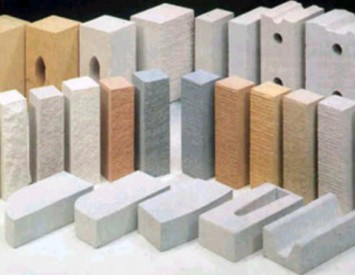
Chamotte (alumina) brick is made of a special chamotte powder and various clays, burning the workpiece in special furnaces at a very high temperature.
Shamot is a refractory clay that has lost the associated chemical water and plasticity in the firing process, apparent to a certain extent. Produce this raw material in mine furnaces by firing at 1300-1500 ° C.
Types of Chamota
- High-dry (moisture absorption 2-10%).
- Substituted (moisture absorption up to 25%).
Visual challenges of chamotte brick
- Yellow (sandy) shade. Saturated and dark color indicates that this brick is suitable for masonry furnace.
- Grainy texture.
- Rough surface.
- Special marking ("sh").
What form can be chamotny brick?
- rectangular;
- wedge;
- trapezoid, etc.


Advantages of chamotte bricks
- Refractory properties. Chammed blocks are capable of withstanding up to 1600 s °.
- The plane, composed of this material, warms up quickly and keeps heat longer than a similar ceramic (i.e., it is necessary to achieve the same effect less fuel).
- Easy styling. Each of the 6 sides of the chamotte brick can act as the front side. For comparison, ceramic brick has only 3 such faces that differ from others visually.
- Does not highlight harmful evaporation when heated, unlike other types of refractory bricks.
- Resistance to aggressive alkaline and acid environments.
Disadvantages of chamotte bricks
- Less quantities of freezing, which can make such a brick compared to a ceramic analogue. To eliminate this disadvantage, you can apply a special varnish or liquid glass.
- Because of the special hardening, it does not cut badly. Trimming this material can be carried out only with a grinder equipped with a diamond disk.
Weight and dimensions of chamotte brick
- Weight \u003d 3 kg.
- Dimensions of the most running types of this type of brick: 25x12x6.5 cm and 23x11,4x 6.5 cm.
Signs of refractory bricks of good quality
- The correct shape and flatness of the surface.
- Lack of chips, white divorces, cracks, irregularities.
- Color saturation (the darker, the better).
- When tapping, the brick produces a ringing sound.
- With a strong impact it does not crumble, and it is divided into large pieces.
Signs of unworthy bricks
- pale not expressed color.
- when tapping, forms a deaf sound.
- fragility (paint when he blows a chisel).
- too porous structure.
With excessive firing, the brick becomes black, charred and melted to the middle. The resulting product is called Zheleznyak. It is very resistant to the influence of various third-party factors. It is advisable to choose to lay the foundations and sewer lines. But, for the construction of the furnaces, this brick is no longer suitable.
Where appropriate to apply such a brick?

- Finishing those surfaces of street furnaces, which account for direct contact with fire - fuel, chimney, etc.
- Laying a fireplace or ovens arranged in a house, entirely of chammed brick.
- Creation of production plants for the processing, metallurgical and chemical, etc. industries, such as blast furnaces, boilers and fuel chambers, etc.
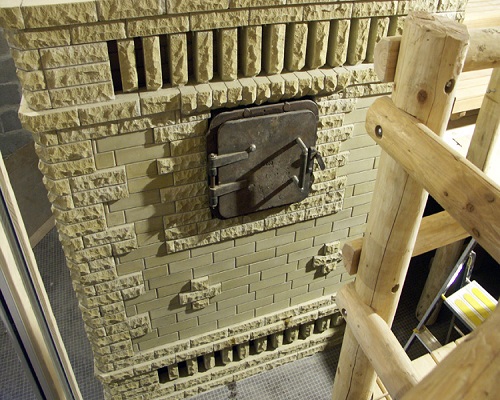

This building material is quite often preferred when erecting a furnace or fireplace, but it must be remembered that the price of chamotte brick is much higher than the classical ceramic.

Facial facilities
- The masonry is made without prior soaking blocks.
- Need a preliminary cleaning of surfaces from clogging using a brush.
- The width of the joints when laying should be not more than 3 mm.
Preparation of a clutch solution for chamotte masonry
Preparing for the beginning of the masonry, you can buy a finished powder (chamoite meter) for the manufacture of a binder solution, and you can perform such a powder personally, mixing the refractory clay and chammed sand. Consider both options.
Preparations of a solution from the measureer (at the rate of 100 pcs. Bricks)

Chamotolar
What do you need?
- 40 kg of finished powder (exit - 3 buckets of the finished substance);
- clean water (without additives, not salted);
- portland cement - 6kg (15% of the weight of dry meter);
- electric drill (concrete mixer).
Cooking technology
- In a dry refractory powder, just add water. This must be done until the time when the solution becomes sour--like lugs.
- In this case, disturb the solution is not less than 5 minutes using a mixer, electric drill or concrete mixer (with large volumes).
- Leave the substance for an hour.
- Stir again.
- Add Portland cement to improve strength quality.
- The solution is ready to use.
The application of the measureer is definitely a more comfortable and simple option. However, the solution made from the main components of the personally carried out does not give such a strong shrinkage and has the best strength characteristics. Therefore, it is better not to be lazy and prepare a solution yourself.
The solution prepared with its hand from chamoite sand and refractory clay

Clay White Kaolinova
What do you need?
- 1 packaging of clay hammer (better than white kaolin);
- sand shammatous (crushed shamded blocks);
- water (clean, without additives, not salted);
- sieve (with 3x3mm cells).
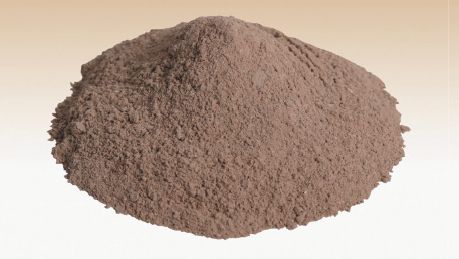
Sand shagotny

Technology of creation
- Soak clay so that the water covered it completely.
- Leave for a while (from 12 hours to 2-3x days).
- Periodically stir the substance.
- Thoroughly wipe the clay through the sieve.
- Add sideways through the sieve (its mass must be twice the weight of clay).
- Stir carefully.
- Start masonry.
Important!
- If the white kaolin clay is not found, replace it with the Cambrian Blue.
- Clean clay almost does not smell. If there is a very strong smell, then organic additives were filled out of the clay.
- The only permissible replacement of chammed sand is mountain sand without inclusions. Do not attempt to replace it with a quartz analogue, marble or granite crumb.
- The final solution should be such a denotation to freely slide from the trin, not sticking and not stacking it. It should be without lumps and clocks.
The solution made in all the rules does not need to be applied to additional additives. However, if there are doubts about the quality of the mixture, you can use certain substances to improve certain qualities.
Additives
- To enhance the strength qualities: Salt Cook - 100-150g / bucket; Cement 150 - 1/2 trunk / bucket. But, it should be understood that by adding cement, you can no longer be able to repair the laying, and the salt often leaves blessed divorces.
- To enhance plasticity - liquid glass (1-3% of the solution volume).
Shamoth brick today has become indispensable, its application guarantees the preservation of masonry in specific operating conditions, increases fire safety and gives a special visual effect of homemade furnaces and campuses.