Stretch ceilings, due to its operational characteristics, are becoming increasingly popular among a huge number of people. However, when choosing this method of finishing, few people take into account all the advantages and disadvantages of stretch ceilings, as well as problems arising for one reason or another.
Content
Differences of stretch ceilings from other types of finishes
In most cases, the perfectly smooth ceiling in the apartment, a private house and other rooms is created using:
- applying putty with subsequent staining;

- making suspended design of plasterboard;

- installation of mounted rush, modular ceiling;

- stretch ceiling.

Of all the ways to make a ceiling of evenness and aesthetics, the most preference is given to the stretch ceilings today, because against the background of the rest of the finishes, they have the following distinguishing features:
- lower cost;
- ease of construction;
- small grinding of the height of the room. When installing the ceiling, the minimum distance from the draft variant to the stretch canvas is 2 cm. However, the distance can be fully increased due to the need to install a certain type of lamps or installation of security alarms, as well as for other reasons depending on the buyer;

- speed installation. Preparatory work before installing stretch ceilings is reduced to the profile attachment and removing the plaster peeling from the ceiling. In this case, the process of preparation and installation occupies from 3-12 hours, based on the complexity of the work performed;
- lack of deformation when shrinking newly built houses;

- security. Stretch ceilings are made of eco-friendly materials. In addition, processed by antistatic additives that impede the accumulation of the canvas;
- practicality, since the ceilings are able to maintain an initial species without any significant changes for 15-20 years, without finishing work throughout the entire operational period.

However, the tension ceilings are also inherent in disadvantages:
- install stretch ceilings without special skills quite problematic;
- the presence of an unpleasant smell in the room for several days from the installation of the ceilings, although it will help to get rid of it to be careful.

Of course, these are only the general and most significant differences, since various types of stretch ceilings are endowed with mercy and disadvantages from each other.
Varieties of stretch ceilings, their characteristics
To date, stretch ceilings are made of 2 materials: films and fabrics.
Film stretch ceiling
The film ceiling is a thin but sturdy polyvinyl chloride film manufactured by pre-produced measurements. At the same time, the standard PVC bandwidth varies in the range of 1.3-5.5 m. If the ceiling width exceeds the width of the polyvinyl chloride strip, then in the process of manufacturing the ceiling, the film is welding with the use of a tch-machine to the required width.

Installation of the film ceiling is carried out using a heat gun warming the suspended web to 70 ° C, as a result of which it becomes elastic and easily fixed in a pre-installed profile. Upon completion of the installation work, gradually cooled canvas acquires strength, color gamut, whose texture depend on the selected type of film.
Currently, tension film ceilings are issued by the following text:
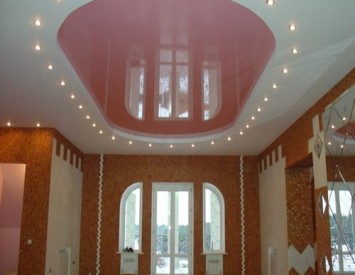
- glossy - characterized by a visual increase in space due to the effect of mirror reflection of interior items;

- matte - visually similar to ceilings, painted with water-level paint, therefore relate to the classical finish option;

- transparent - highlighting high light transpusual ability. As a rule, transparent ceilings are mounted in combination with various types of lamps, thereby easily recreated the illusion of the starry sky, glass roof, etc.;

- satine - visually the surface seems to be velvety, although it is actually smooth, due to which the reflective qualities of satin ceilings increase.

Regardless of the texture, the color gamut of film ceilings is quite varied, so the PVC film is produced in both monophonic and multicolor shades. In addition, a photo printing can be applied during the production of PVC film, or at the end of the installation work, the ceiling can be decorated with artistic painting.

Thus, the advantages of film stretch ceilings are reduced to the following:
- the variety of textures and satellite gamma allows you to choose a ceiling, harmoniously inscribed in the interior of any room;

- excellent water resistance of the web protects from the flooding residing neighbors. If such a situation occurs, it is necessary to call specialists who remove water from the canvas and dismantle the ceiling for drying, and after a few days they will install it in place. At the same time, rust and other traces of incident will remain on the canvas;

- high noise and thermal insulation properties muffled the loud sounds that are coming from the outside and prevent the penetration of drafts from the attic room;

- the elasticity of the heated canvase allows you to create ceiling structures of any degree of complexity;

- easy care. Surrounded over time, the ceiling is enough to wipe with a damp cloth with a small addition of a neutral detergent.
By choosing, despite the lot of advantages, it is worth considering the disadvantages of stretch ceilings:
- in the process of installation, air indoors is heated to 50 ° C, which negatively affects the interior objects sensitive to high temperatures;
- the film after tension becomes easily vulnerable to the damage to acute objects;

- chandeliers that are not equipped with platonists and hanging at a distance less than 40 cm from the canvas, as well as point lights with a capacity above 40 W contribute to the gradual darkening and melting of the ceiling;

- when the air temperature is reduced below 0 ° C, the tensioning canvas becomes fragile and begins to crack, so the film ceilings cannot be installed in the indoor unwapped in winter;

- when mounting the canvas to plasterboard walls, without their preliminary strengthening, the probability of separation of sheets from the walls is large;

- schedules of the canvas are possible when installing a film ceiling on a large area, especially with the presence of a weld;

- "Invisible" welded seams are very noticeable on glossy ceilings, especially with a fairly close location from them point lamps.

Of course, all these shortcomings are sufficiently conditional, which makes it possible to prevent their appearance at the stage of production and installation, not allowing the process of developing a global problem.
Fabric stretch ceiling
For the manufacture of a tissue stretch ceiling, a textile canvas obtained by knitted weaving of a polyester thread, which is thoroughly impregnated with a polyurethane-based mixture, after which it is pressed, sucked and calendered.

Fabric canvases are produced with a width of 5 m. However, unlike the film, the production of the tissue ceiling does not require preliminary measurements, since it is released from the roll with the necessary handle. In this case, during the installation of the excess fabric is cut off. In addition, the installation of the tissue ceiling is made in a special profile without any heating of the canvas.
Based on the foregoing, the following advantages of tissue tension ceilings are followed in front of the film:
- the invariance of the temperature in the room during the installation of the ceilings, since the web is devoid of elasticity and refilled into the baguette without heating;

- higher durability to damage;

- the properties of tissue canvases remain unchanged even at minus temperatures.

It turns out that the shortcomings of the film ceilings are the advantages of the fabric ceiling. At the same time, the disadvantages of tissue stretch ceilings are manifested in:
- limited color solutions pastel colors and matte textures;

- the impossibility of using a damp cloth to remove any stains, because the canvase will remain divorces;
- inability to withstand a large amount of water in the case of flooding by neighbors, and the subsequent restoration of the web is impossible;
- higher cost.
Thus, polyvinyl chloride stretch ceilings, disadvantages, whose problems are quite significant, it would seem, should be tested by fabric. However, tissue ceilings are possessors of material minuses. Therefore, it is worth incredible to the choice of one or another type of ceiling, based on the planned operational conditions.