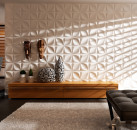
In modern interiors, the wallpaper and tiles in the kitchen moved to the background. They are displaced by smooth surfaces of kitchen walls, acquiring a beautiful gradient due to illumination. The choice of colors and shades under painting at the same time is truly boundless. Such walls successfully emphasize modern furniture, they are easy enough to refresh and repaint. Consider the features of the choice of color solutions, materials for painting walls, as well as process technology.
Content
Dimensions of kitchen paint
Paint - affordable material, which makes it possible to choose any shades and combinations depending on the style of the interior. When it is elected, it should be borne in mind that such parameters such as water resistance, environmental friendliness, ability to "breathe" are important for finishing walls of the kitchen room. It is desirable that the painted wall is washed, not exposed to rapid burnout.

Many of the stated requirements are answered by glossy paints - they are waterproof and well wash, but on their surface all the errors and irregularities are noticeable, the wall under such paint should be perfectly smooth. Matte and half-one varieties will perfectly hide unevenness, but at the same time the surface will absorb dust and kitchen pollution.

Many experts recommend to choose water-based paints for kitchen walls.
There is the following selection of materials for painting the kitchen:
- water-level paint - is distinguished by many advantages (quickly dries, there is no sharp smell, eco-friendly and not allergenna, creates opportunities for creativity - you can independently make shades using the addition to the basis of color pigments). In any paint store, you can easily pick up the desired tint of walls in the catalog, the house will only leave the paint with a pigment in the desired proportion and stir. It will easily disperse from the hands and tools, while not needed the use of the solvent. Specialists are recommended for kitchen walls and ceiling water-mounted paints of several species, depending on the composition (acrylic - including with the addition of latex, silicate and silicone);
- alkid (oil) paint - made on the basis of alkyd resin and oils that give the composition strength and elasticity. It has high moisture resistance and resistance to chemical influences, perfectly clean, does not fade, it is easy to apply and does not give a shrinkage. To dry out the oil paint, you will need at least 12 hours, at this time it is necessary to provide ventilation indoors;
- epoxy and polyurethane paint - due to the presence of appropriate resinous substances formed wear-resistant and durable coatings, differ in resistance to moisture and chemical impacts, as well as a sufficiently high price.
Choice of color of kitchen walls
First of all, the interior design of the kitchen, like any other residential premises, depends on the personal tastes of the owners, their color addictions, the desire to bring a certain mood to their home. Equally important will also be selected the combination of color of walls with an existing room of the room, kitchen furniture and other interior items.

When choosing a design of painting walls of the kitchen, you can use the following designers recommendations:
- kitchen furniture of classic style will look great on the background of walls of calm peach, beige, dairy color;
- contrast finish is well suited to white furniture - for example, an intense turquoise, plum. This rule also works on the contrary - on the background of the white walls, the furniture of saturated shades will look good;
- if you want to combine in the kitchen interior several different colors, then designers advise to combine walls and a kitchen set in one color scheme, and other colors are distributed in other parts of the interior (facing tiles, gender, dishes, etc.);
- to give the kitchen room of a romantic atmosphere, you can choose the color solution of furniture and walls in pastel colors;
- warm tones (light shades of yellow and orange color) will excite appetite, and the cold will fit for those who want to lose weight;
- in case of selection of warm tones, the use of shades adjacent to the color palette are recommended;
- for a visual increase in space, light pastel colors are suitable;
- based on the light of the kitchen - if the room is sunny, then too bright paints will look sharply, or even can change the shade at all. A slightly excluded room is not recommended to make out in dark colors;
- it should be taken into account the location of the kitchen - for the North side, it is recommended to use warm paints in the interior, and for South - cold shades.

The designed color solution of the kitchen interior will contribute to creating an atmosphere of comfort in everyday life.
Preparation of kitchen walls under painting
For painting walls in the kitchen, the following tools and materials may be needed:
- spatulas (wide and narrow);
- roller for painting walls, painting brush;
- primer fluid deep penetration;
- putty (starting and finishing);
- malyary glass chicast (web);
- malar Radio (Scotch);
- grinding sick of medium grain;
- tank for dye (bank, painting bath or pallet);
- rubber gloves - protect when working with aggressive chemicals (safety glasses may also be needed);
- wall paint.
It is necessary to apply paint to the purified and smooth prepared surface. To do this, you need to remove old finishing materials from it - wallpaper, lime blotch, paint residues. In order to easily remove the old wallpaper from the wall, you can use the roller, wet warm water. It is necessary to remove stains of kitchen contaminants, rust, drums. If there are mold and fungus on the walls, then such stains need to be considered a metal brush, after which the data of these areas with anti-grapple preparations.

Next, you need to do the following preparatory work:
- Warf potholes and cracks with a sand-cement solution or sealant.
- Process the surface of the walls of the primer (recommended in two layers).
- To align the surface, it is necessary to apply a starting coarser-grained putty on the walls.
- Before the final putty, we impose the so-called "painting cob" (a grid of fiberglass) for reinforcing and hardening the surface - this will help subsequently avoid cracks on the walls.
- After drying the previous layer, we apply the finish fine-grained putty for the final alignment, after which it is necessary to clean the dried surface with the skin and camp the walls.


Grinding the wall surface allows:
- increase the adhesive surface properties, i.e. Create prerequisites for further good clutch of walls and paints;
- protect against moisture;
- prevent squeezing and cracking, as well as the appearance of divorces and spots.
The use of deep penetration primer is recommended. For a small kitchen, it will take up to two liters of primer, it is allowed to breed it with water in a ratio of 1: 1.
Painting of walls in the kitchen
After preparing the surface under painting, you can proceed directly to applying the painting composition on the walls. It will take several times (at least two, and sometimes three) to paint the walls. The number of layers depends on the consistency and quality of the selected paint. Carefully read the recommendations of the manufacturers of the material used.
To achieve smooth lines when painting and keep the surface of the ceiling clean, it is recommended to be saved by painting tape joints from the wall up.

When painting the walls of the kitchen should take into account the following nuances:
- to exclude the appearance of the flows, use the painted pallet - with the help of its ribbed edge it is convenient to clean the paint surplus from the brush;
- it is recommended to start painting the walls from the window;
- for the first layer of paint, it is allowed to dilute with water by 15-20% (carefully examine the manufacturer's instruction);
- initially, using a painting brush, the angles and hard-to-reach places are scored, and then using the roller, it is processed to staining the surface of the wall;
- the next wall passes after the complete application of the paint layer on the previous one;
- a new layer of paint needs to be applied after the previous completely missile;
- it is recommended to apply the paint in different directions of the layer behind the layer (from left to right, then from the bottom up), after which it is decisive to produce - thus, the paint is uniform without strokes will be distributed over the surface of the walls.
Painting of walls in the kitchen - Photo: