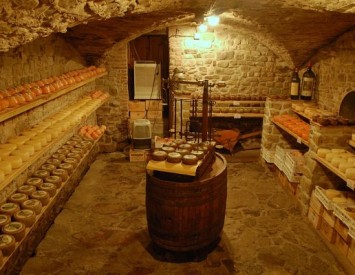
Many owners of private houses of the old sample are interested, is it possible to build a cellar in the house. This, at first glance, unnecessary premises actually solves many tasks. For example, where will you keep the harvest potatoes and other vegetables? And where to fold the stocks of jam, salads, salted cucumbers and tomatoes? Just for these purposes and the cellar is needed in a private house.
Content
In the 60s of the last century, it was customary to build a cellar separately from residential premises. If it was built with compliance with all the rules, there were no problems during operation. After a few decades of use, in such a cellar, the potatoes became worse, just a month after the bookmark began to appear sprouts and rot. Spoiled jars with blockage had to be sent to the trash can almost every week. If a separate cellar does not cope with its tasks, and perhaps in your private house it is generally absent, then there is a need for a cellar device in the house.
How to make a cellar at home? Where to start, at what depth you can position the subfield, and in which part of the house is best to make the room? There are a lot of questions, our task is to build a cellar in a private house for all the rules. The construction of the underground can be trusted by professionals, but this owner will cope with this task on its own. After all, the main thing is a desire, a little patience and skill.
What are the advantages of the underground in a private house
As mentioned earlier, in the past century, separate cellars were popular. Operation of such a basement was very convenient. At any time it was possible to go down to the basement along the steps and fold / take a crop.
Now, to build such a cellar, you need to make a lot of effort. For example, you first need to insulate the repository, pay special attention to the ceiling warming. Even with modern building materials, there is no guarantee that the stable temperature will be maintained in the street cellar. Another thing is the cellar in a private house - the optimal temperature for storing blockage and vegetables is preserved all year round.
Cellar in a private house. Photo:


The basement in a private house is a small room in which the floor level will be less than the height of the walls on 1/2 and below the ground level. If the depth of the underground is less than half the height of the walls, then such a room is called the basement.
Consider the main advantages and disadvantages of basements in residential buildings.
What advantages:
- the basement is an additional useful area in a private house. In the room you can store conservation, food, vegetables, fruits and any other things;
- from the basement you can make a workshop, garage, a separate place for storing vegetables, aging cheese and wine, you can also make a laundry, gym, swimming pool and even sauna;
- if you have a small house, and the area of \u200b\u200bthe local area is not enough to build a separate barn with the basement, it is quite possible to do the basement, built under a private house;
- in the presence of the basement, the floor in your home will always remain warm and dry;
- we will create comfortable conditions for living in the house - during the cold season you do not need to go outside to get into the barn and go down to the basement for conservation or vegetables.
What are the shortcomings of the basement in the house:
- the only drawback of the construction of the basement in a private house is the high cost of materials. To build a cellar at home will be able to afford not anyone who wants, because if you calculate the costs, the cost of construction work will be approximately 25% of the total construction of a residential building. After all, you first need to fulfill the most difficult part of the work - remove the earth, then equip waterproofing and make the inner trim of the basement.
How to make a cellar in a private house
Before building a cellar I will define a place at home. It is very important not only the convenience of the technical room itself, but also factors that may affect its functionality. When building a cellar in a private house, it is important to take into account the depth of groundwater.
How to make a dry cellar in the house:
- It is necessary to take into account the type of soil. If your house is located on the rocky basis, then the cellar will be problematic, because under the room it is impossible to "drive" a heavy technique.
- The height of the groundwater is if it changes several times a year (the maximum level is achieved in winter), then laying a reliable base (waterproofing layer) is necessary, which does not always justify hopes. Over time, if the groundwater is raised high, the basement can be caught. Avoid this is possible if you raise the bottom of the cellar 50 cm above the top mark.
Groundwater
How can I determine the level of groundwater? It is impossible to predict this natural process, the only thing we can do is ask for neighbors if they have a well or well, then what is the depth of groundwater. You can go to another way and perform trial drilling or do this: when dry weather was installed on the street, cover the small portion of the soil, which adjoins your home, film. The next day you can get an answer to your question - if the polyethylene film remained dry, then you can start the construction of the basement, and if the condensate appeared - groundwater is located in the immediate vicinity.
When the optimal place is chosen for the cellar arrangement, you can proceed to work. Take care in advance where you will move excess soil. The problem is solved if you simultaneously build a residential building and lay the cellar. At this stage it is easier to make ventilation. Another question is, how to be if a basement and walls already have in a residential building. Then it is necessary to manually pull the pit, and the entire soil is delivered to the surface in small batches. This time-consuming process, so you will need skill and patience.
Tools, to perform this part of the work:
- shovel;
- pick;
- capacity for the Earth (bucket and car).
When you are engaged in the device of a pit, learn that it is undesirable to dig a hole near the walls of a residential building, because then you can weaken the soil under the structure and the building can be deformed.
If your home is built on the pile soil, then the dangers can not be, since the entire load falls on the lower ground layer, to which it cannot be crammed manually with the help of a shovel.
The depth of the pit for arranging the cellar should be 2.5 m, given the floor level in the residential room. In addition, we take into account the thickness of the sprinkling layer, plus the screed - the height of the room will eventually be equal to 2 m. This is quite enough for a comfortable operation of the cellar.

If the groundwater is low, then the drainage well can be pulled into which water and condensate will come during precipitation (rains, snow). The depth of the well is 1 m, the diameter is 50 cm. If the water level remains stable and high, the need arises in the adjustment of the pit - this is a small tank with hermetic walls for collecting water, which from time to time it is necessary to pump off with the help of a drainage pump.
Choosing a place
It is important when building a cellar to decide on the location of its location. It is impossible that the underground can be adjacent to the foundation, since then the temperature differences will arise, and therefore it will not be possible to ensure the safety of reserves.
It is advisable to place the cellar not under the heated room. If you choose a place for cellars under the hallway or veranda, you can provide a natural microclimate in the repository.
Many owners of private houses believe that if you deepen the cellar, then you can count on a stable room temperature. This is true, just why spend strength and extra funds to make a deep cellar, because you can use high-quality insulating materials.
What is needed ventilation in the cellar
The preservation of not only the basement, but also all communications in the house is proper ventilation. If there is a good air circulation, then the appearance of fungus and mold can be avoided, and most importantly - get rid of extra moisture, which over the years gradually destroys the design of the house. Regardless of the selected material (even the most expensive and modern), oxygen and moisture act on the structure of destructive.
In the basement there is always some oxygen, plus an increased humidity. It turns out that the cellar contains an increased percentage of methane, which means that the probability of fire and even the explosion is large. It is clear that it will be dangerous in such a room. How to make a cellar at home to avoid this problem?
Since the optimal temperature of the correctly equipped cellar is + 5-7 oC, and humidity ranges from 60-70%, it will be quite enough to ensure the safety of vegetables and conservation. To get closer to these indicators of the perfect cellar, you need to equip the ventilation system. It will not allow the temperature to fall in the cold season.
It is best to equip the natural ventilation of the cellar. Her principle of work is extremely simple - warm air should rise, and cold down down. Make it without big investments are quite real - it is necessary to equip the natural supply and exhaust ventilation system. To implement this task to reality, take 2 steel or galvanized pipes, you can use polyvihloride pipes or asbetic. Install the supply pipe in the corner of the cellar - at a height of 50 cm from the floor, exhaust - on the opposite side of the room at the top of the cellar, right under the ceiling. It should be above half a meter than a horse, as a result we get the pressure difference, and in the cellar - the natural circulation of air. From the cross section of the pipe, as well as the difference in temperature and circulation of the air, the final result will depend on.
Usually, such ventilation is installed during the construction of the house and special problems with the installation of pipes are not observed. If you make a cellar in a residential building, then you first need to prepare a plot, drill a hole in the foundation to set the exhaust pipe. It can be used along the wall and attach to the house with brackets or clamps. From the opposite side of the cellar also dodge the foundation site and install the supply pipe. The gaps between the pipes should be sealed, and on the top of the supply pipe to put a finelystic mesh so that rodents and garbage do not fall inside the room.

Floor and wall arrangement in the cellar
After the place has been prepared for the improvement of the cellar and the ventilation is thought out, it is time to insulate a residential building. For this purpose, the bottom of the cellab needs to be dissolved and fall asleep with small rubble (layer thickness of 15 cm). If you have done a well, it must be dispersed with a wooden bar, so that the concrete solution does not come inside.
We pour a pre-prepared melted bitumen on crushed stone, so we can provide a barrier of water - even with low groundwater running during prolonged floods and rains, water may appear in the cellar.
A good option is to fall asleep the floor with a layer of rubble and sand, and on top to lay dense polyethylene, which also serves as a waterproofing material.

Next, we mount the metal grid on the film. It should not lie on the screed, so we build a stand (height 3 cm). After performing this part of the work, you can pour the floor in the cellar concrete. As a solution for the preparation of concrete, the cement of the M200 brand is better used, and you can prepare a solution yourself from a mixture of sand with cement. Proportions: 1 part of cement M400 and 3 parts of sand (can be replaced with small rubble).
We carry out the trim of the cellar walls in a wooden house. The walls in the cellar can be derived from monolithic reinforced concrete or brick. By the way, instead of bricks you can use foam blocks.
How to complete the walls of the walls by monolithic reinforced concrete:
- We build an inner formwork from any girlfriend. Supreme OSP, plywood or boards.
- The wall is lined with waterproofing material (rubberoid or dense polyethylene).
- We collect the frame of reinforced wire.
- The method described above will prepare a solution and proceed to the pouring of the frame layer. Every 25 cm make a bug.
- You can remove the formwork in 5 days, but the final strength of the concrete will drop a month later.
- If you work in hot time, it is important to prevent the tone of concrete, for this wall, from time to time you need to moisten with water from the spray.

Construction of brick walls
For masonry, you can use foam blocks or red bricks (only not hollow). Such material retains warmly and does not miss moisture.
If your home is built on dry soil, the walls of the walls in the cellar can be made in the Pollipich, if the groundwater is running around, then in 1 brick.

Finish cellar
The walls in the basement must be treated with a primer mixture and stuck. Instead of primer, you can soak their lime to protect the cellar from the spread of the fungus.
It is undesirable to sow the walls of cellar with wood materials (lining, etc.) to prevent the condensate accumulation generated between the panels and the wall.
It is possible to equip the cellar in different ways. If you plan to store vegetables and preservation, then you need to set a sufficient number of shelves for storing glass cans. The shelves are better to immediately build metal, as the tree will start roting over time.

For storage of vegetables (cabbage, potatoes, onions, carrots), make wooden boxes. They can be set closer to the entrance.
How to build a staircase in the cellar
Since we built a cellar in a private house, you can get into it directly through the hatch or make a full-fledged staircase.
If you want to visit the repository with comfort, the staircase can be installed ready wooden (which actually facilitates the process) or build a staircase. Steps (width 35 cm, depth - 15 cm) It is best to cast out of concrete, use a tree for these purposes is undesirable.
Ladder march with a bias 60 oWith horizontally, it should be restricted on the outer wall, and on the other hand - on the rustle.

To cope with the construction of a cellar in the house, we suggest familiarizing with the video material: