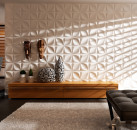
The decorative illumination of the walls today is the original technique that is performed primarily to create an aesthetic effect and interior addition. But the lighting elements that are used for this purpose can be independent light sources. Lighting of decorative nature allows you to diversify the room space, it is beneficial to supplement the home design and give it a complete view. Consider the features of the use and installation of the backlight.
Content
Selection of lighting devices
Lamps, with which wall lights are highlighted, are classified for several types:
- Suspended lamps. In its appearance, they resembled desktop devices. Many models of such products allow you to adjust the light, directing it in the right direction.
- Lamps with ceiling. These elements may have a different form: a square, round, rectangular or other. Preferably, they are made of beige or white frosted glass. The main area of \u200b\u200btheir use is bathrooms and hallways.
- Wall bras. Their main advantage is high aesthetic indicators. These items are recorded using special brackets. They differ in variety of models, which allows you to choose a lamp for any interior.
- LED products. In terms of its operational characteristics, they exceed the lighting elements of other species. LED devices consume fewer energy, give more vivid lighting, are environmentally friendly, they have greater strength and serve a longer period.
- Embedded lamps - designed to install in the wall. These products give multiple light, so they are desirable to install several units. They are divided into several types:
- lED-A03B lighting elements are designed for mounting into a wall of concrete or plasterboard material without the use of the mounting box;
- the LED-J04 devices allow you to create the effect of light coming from the inside of the wall due to the direction of the light flux. Installation is carried out using specially intended spacers;
- the LED-L02B model gives a soft backlight and mounted using plastic fasteners;
- lED-HH02 lamps are characterized by efficiency and apply for night lights.

LED wall lighting
To create this type of lighting, flexible tapes with LEDs are used. These lighting elements have an adhesive base with which they are fastened. Such tapes are recommended to be installed on a metal profile, which will perform the role of heat sink. This will prolong the period of operation of LED lighting.
Important! Installation of tape is possible and without the use of heat-conducting material, but in this case the LEDs overheat and fail.
On the sale of the tape comes by fragments of 5 m in the form of coils. When choosing a tape, such criteria should be taken into account as:
- brightness of LED elements;
- their number on one meter;
- type of tape;
- the degree of protection against mechanical impact.
When making large premises, the tape can be combined with a soldering or using special connectors. The first method was most widely distributed, since in this case the material is not oxidized. The functioning of the tape is carried out by means of power supplies that are connected to the lighting element itself and a source of 220 W. Blocks are different power - 12 and 24 watts. When they choose, it is necessary to consider the power of the tape and its length.
LED control is carried out by means of a console and controller. With their help, you can change the color of the lighting, its brightness, turn on and off the device. However, it is necessary to take into account that nuance that when combining several tapes, the controller cannot cope with a large load, then the amplifiers need to be added.
LED backlighting walls. Photo:


Features of the installation of LED backlight:
- When working with LED ribbon, the level of humidity level should be taken into account.
- Open tapes are used to illuminate the wall on the inside. They are well combined with decorative plaster, brick and plasterboard surfaces.
- The illumination of the outer walls is carried out using hermetic products.
- If it is supposed to perform work in a room where the humidity indicator is increased, closed tapes should be used. These are elements whose LEDs are covered with silicone composition. Due to the presence of such a protective layer, the lamp will function even with direct contact with moisture.
Important! It is not recommended to use these tapes in rooms where humidity is within the normal range, as they have a certain disadvantage. The light that passes through the protective silicone coating is more dull. In addition, silicone over time becomes more muddy, which further worsens the lighting. For this reason, the use of these luminaires should be justified.
Placing the ribbon depends on the desired effect:
- When placing the lighting element in the opening of the wall or ceiling eaves, the glow is directed from top to bottom.
- Illumination can be located at the bottom. In this case, it is placed in a niche or outdoor plinth.
- The backlight in the niches of the walls allows you to highlight the items in it, such as photos, pictures or various decorative elements. This part of the room can only be used as a decorative element, and may have a practical purpose. In this place, quite often place functional items, such as TV. Niche with backlit will look more original and attractive.
Before making a backlight in a niche in the wall, you need to decide on the location of the lighting elements:
- To obtain an idea of \u200b\u200bthe final result, it is recommended to draw a schematic pattern.
- Then you should calculate the amount of tape that will be required for the design of the niche. The variety of colors makes it possible to choose a tape under the interior decorated in any direction. If there is a need, it should be cut into several parts.
- Next, the tape is performed in pre-designated places. With the origin of the lighting element, the protective film is removed, and it is attached in the appropriate place.
- Then all the items are connected to the power supply, and in turn it is connected to the network.
- After the installation is completed, the LED backlight in the wall of the wall is checked for performance.

How to make a wall light using laminate
This type of backlight design is very original and at the same time Malotatraten. And simple rules for performing the work will allow the illumination with their own hands.
To implement this project, you will need the following:
- wooden planks;
- laminate boards;
- light tubes;
- screwdriver or screwdriver;
- level;
- saw or jigsaw;
- screws;
- mounting glue;
- self-tapping screw;
- scotch.
The installation process is made in such a sequence:
- First you need to draw on the wall a scheme of the location of light pipes. These items must be placed so that only light is noticeable after the completion of the work, not communications. For this line on the wall it is better to apply at eye level.
- After that, you need to hold the cable according to the drawn scheme and secure it with special holders or screws.
- When installing the cable it is important to correctly determine the length, as it will need to be connected to the power source. In this regard, it is advisable to conduct it from the place where the socket is placed or its installation is planned.
- Next, you need to install lamps, boards and secure the lighting mechanism.
- Wooden strips are cut into fragments (while their size can be different) and attached evenly to the surface of the wall.
- Then the boards should be glued to the plars. Work should be started at the bottom and move in the upper direction. From the upper boards to the lower elements, a certain pressure will flow, so the installation must be carried out as the glue dry. To save their position, you can use scotch tape or nails.
- After that you need to connect the power, and on this work is over.

Built-in wall lighting
Among the diversity of lighting elements, built-in fixtures are highly popular. They lightly illuminate the room, and at the same time there is a need for additional wall or suspension devices. Built-in elements can be turned on all simultaneously or only one lamp. Such illumination is embedded in most cases in drywall walls and implies the implementation of such actions:
- Before starting work, it is necessary to determine the areas in the room that need lighting and its intensity. If necessary, highlight a certain place, the power of the lamps should be calculated so that the light is not turned out too bright.
- At the preparatory stage should also pay attention to the style of the room. Lighting must match the interior.
- It is not recommended to install lighting elements only in the central part of the wall. More attractive will look symmetrically located lamps at an equal distance from each other. Due to this location, the lighting will evenly spread throughout the room.
- Next, you need to designate the placement of lamps in the wall. Since plasterboard sheets are mounted on the frame, in the designated zones, the material should be pierced to make sure that there is no crossbar. If the profiles will be detected in this way, the mounting zones must be shifted.
- Then it is necessary to measure the lamp in diameter and using the circus, make the corresponding marks on the wall surface.
- In the designated place with a knife, the hole is cut.
- Next, you need to remove the power of the power supply and clean the ends. Connecting clips are used to connect the wire to the luminaire.
- Electric boxes are inserted into the hole, after which it is fixed by screws.
- Then the lamp is placed in it, which is fixed using a spring. This significantly facilitates the installation process.
- On this wall with backlit from plasterboard is ready.

Recommendations for the process
For the most uniform distribution of the light stream, the lamps are recommended to be placed at 2 m from the floor. If you set the lighting elements under the ceiling, this will make it possible to achieve bright lighting. If necessary, to get muffled lights should be placed closer to the floor.
There are also certain recommendations regarding illumination in different premises:
- Bedrooms are best suited for the bedroom. They are installed on both sides of the bed or from the head of the head.
- The same lamps are used in the design of corridors. Placed at the human height level they are a kind of decor for the walls.
- Also with their help you can make mirrors.
- In the living room, the most suitable zones for the backlight will be the place above the sofa or armchairs.
- In the room of the bathroom you need to illuminate the zone near the mirror. Screen or built-in lighting elements are used for this purpose.
- In the kitchen, the backlight should be placed above the dining table.
With the help of lamps, you can visually adjust the space. If they are installed only on one wall, the room will seem longer. The lighting elements placed in the upper part will direct the light stream down, due to which the room is visually increasing. Warm color will create the impression of close-based items, and the cold will visually remove them.

Conclusion
The wall lights with their own hands allows you to transform the interior, to check the room with a note of originality. At the same time, correctly selected and installed lighting elements can produce intensive light at which the need for mainly illumination will disappear. The backlight should not drastically differ from the design of the room, but to act as his addition. The technology of installation of modern lamps is quite simple and carried out in a short time. At the same time, special skills and knowledge are not required, the unprofessional will successfully cope with the work.
How to make LED backlight shown on video: