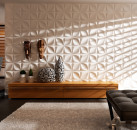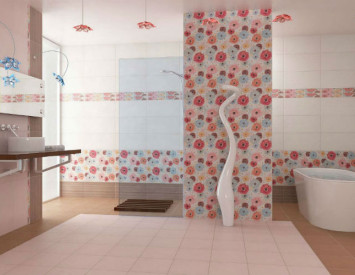
For facing the bathroom tile, perhaps is used most often. This material has a mass of performance. From the merits it should be noted the strength and stability of tile to abrasion. Due to this, it is used not only for wall decoration, but also gender. In addition, this material is resistant to moisture and pair, which makes it suitable for use in rooms with high humidity, for example, in pools and bathroom. It should also be noted its durability and hygiene. The surface lined with tiles is easily comfortable and does not delay pollution. In addition, today there is a variety of colors and forms of this material, thanks to which you can post any bathroom design with tiles. Given all the above advantages, this material is very popular. Next, we will tell about how to put the tile in the bathroom.
Content
Characteristics and features of the choice of material

We note the main "strengths" of this material:
- Tile, first of all, is valued for high strength. The service life of the surface, lined with it, is quite large.
- In addition, this material is distinguished by fire resistance and does not secrete toxic substances and smoke.
- It is also necessary to note the moisture resistance of this material, which makes the tile ideal for facing the premises with high humidity.
- Of the benefits you also need to note the resistance to wear. Therefore, in the bathroom, the ceramic tiles is lined up onto the walls and on the floor. In addition, the wear-resistance of this material also says that many places of large accumulation of people, for example, such as underground transitions and trading zones are mainly covered with ceramic tiles. So that the tile is not slippery today in the glaze in the manufacture of the abrasive sand add.
- It should also be noted the resistance of ceramic tiles to low temperatures, which makes it one of the most suitable materials for the external cladding of buildings.
- Surface, lined with tiles, easy to wash. For this, it is enough to just wipe it with a damp cloth. In this case, virtually any detergents can be used. After all, the tile is resistant to chemicals, and even to what contains alkali and acid.
- It does not fade from the exposure to sunlight.
As for the shortcomings, the main maintenance of this facing material is main. But these costs pay off due to the excellent operational qualities that were listed above. Before stabbing tiles, you need to remove measurements from the walls, and on the basis of the values \u200b\u200bobtained, count the area. This will help navigate with the necessary amount of material. And the tiles are better to take a little more, because The likelihood is high that part of the material in the process will be married.
Today, you can find a large assortment of tiles. Among all this variety is difficult to make the right choice. First of all, you need to take into account the purpose of using the material. For example, for premises with high humidity, the tile should have a low porosity. The appearance of the tile also reflects its quality. The edges of high-quality tiles are smooth, surface without cracks and smooth. Many important information can be found by packaging. In particular, the purpose of the tile is indicated as a special pattern.
- So, if the feet drawing is depicted - this is a floor tile.
- There is an image of a hand - this tile is designed for walls.
- Figure Foot on a shaded background - a sign of wear-resistant tiles.
- Snowflake can also be depicted on the package - this means that the tile is frost-resistant.
Methods of laying tiles in the bathroom

There are several ways to put tiles. The simplest is the direct laying. This option is suitable for beginners and for those who cannot decide on the way of laying. If the walls of the room are the same in height and width, then you can use a diagonal or chess version of the laying. The first allows you to hide small surfaces of the surface. The second way is safe can be called classic. For it, tiles of two different colors are used, which, when mounting, alternately, articulate the chessboard. For rectangular premises, laying with displacement. When this option is used, each subsequent row is laid at a certain distance relative to the neighboring. The disadvantage of this method is a lot of risen tiles.
A rather complicated laying option is to lay a tile with a mosaic. For it, pieces of different sizes and color are used. This is the main difficulty. Despite this, with a great desire, even a person without experience can master this skill.
We listed the main methods for laying tiles for the bathroom. In accordance with the selected surface plans, the future position of the tiles is placed on the surface plans with a pencil and ruler. In addition, there are places where decorative elements will be located. The plan should be made in such a way that at the corners and places of the adjunction there were no bottlenecks so as not to cut the tile. After completing the plan, on its basis, you can already decide on the required amount of material.
Laying tiles in the bathroom

Procedure for work:
- The initial stage is the preparation of the working surface. This should be paid to special attention. First of all, you need to remove the coating from the walls, which is on the surface before repair. It is even worth cleaning that the coating that keeps reliably. If this is not done, then the tile after some time can start falling off.
- After that, the walls must be carefully cleaned from dust, and check with the help of the level as it is vertical. It is likely that as a result of such a test, the walls will not be completely even. Overliness is usually aligned with plastering.
- To lay the tile can be proceeding only after the main preparatory work will be completed. It is likely that in the process of laying you will have to cut the tile. The fact is that very rarely the height of the walls is painted by the dimensions of the tile. To find out in advance whether it will need to cut the tile, it is enough to divide the height of the room walls on the size of the tile. If the result is not a whole number, then without cutting can not do. In addition, in the process of laying the tile, it is not close to each other, but with a certain gap of about 3.5 mm. This moment is sure to take into account when calculating.
- Stop the tile is recommended so that the cropped pieces are lower. So they will have the least noticeable. But starting the laying should be not from top, and below using the horizontal starting rail to leave the place below the trimmed tile. From the floor you need to measure the necessary height. It is at this mark that this rail is fixed. And you need to check that it is strictly horizontal.
- To lay the tile you need to prepare a solution. To do this, we need a container with water and a dry mixture. It falls asleep not immediately, but gradually, in small portions. After each portion, the tool must be mixed. It is convenient to do with a building mixer. As a result, a solution should be obtained, the consistency of which resembles the cream - it should not flush from the tile, but at the same time it must be easily unwinding on the surface.
- When the solution is ready, you can start laying the tile. To do this, you will need a toothed spatula. It is this tool that it is convenient to apply a solution on the tile. After that, the tile should be pressed against the wall. Starting should be started at the bottom, without forgetting to fix at the bottom of the rail, which will rely on the first row.
- With the next tile, the process is repeated. It is important that all the gaps are the same. For this, special plastic crosses are usually used. The gap between the tiles is needed in order not to give the material to crack due to thermal expansion. These cross will help make seams with more identical and aesthetic.
- After laying the lower row on both sides, it is necessary to put vertical planks from it and make sure they are flattered through the level. In order to save time when laying a second row, you can pull the thread as a guide at the altitude of one tile. Then you will not need to check the level of this series.
- If, as a result of the measurements, it turned out that the tile would have to cut due to the fact that the wall width is not painted with the dimensions of the tile, then try to put pieces so that such places are at the corners or, as already mentioned, at the bottom of the wall. So the violation of symmetry will be less noticeable. By the way, for cutting tiles often use tiles, but not for each case it is suitable. So, for example, to make a groove in the tile under the pipe, then for this is suitable for the Bulgarian.
- Do not forget to periodically check the level of installation. After all, the quality of installation work depends on it. If this is neglected, even a small skew can spoil the appearance of any tile.
- When the tile is laid, it is necessary to carefully clean the surface from the residues of the mixture, after which it is to give a solution to dry and grow. While she dries, it is better not to enter the room at all.
- When the solution is finally grabbed, embarking on the seams. Do not underestimate the importance of grouting. It can significantly improve the appearance of the treated surface. It is not necessary to save on the grout, it is recommended to acquire an expensive fine mixture.
- When the grout is applied, it is recommended to remove all excess means as quickly as possible. Especially if the stove has texture patterns. After soaring the grouts, it is very difficult to extort it.

Some secrets laying tiles in the bathroom
Tile cutting is often inevitable. Therefore, it is worth knowing some tips on how it is better to do. So, before cutting, it is recommended to soak tiles in water for about an hour. After that, tick the line on which the glass cutter. After that, align the cut line with the edge of the table and press the tile from above to break the tile. You can put a thin wand under the end line and put pressure on both sides. As a result, the material must break exactly on the incision. The incision should be done only once, and so that it passes from the edge to the edge. For cutting tiles, as already mentioned earlier, still use a special tool - plates, but not everyone has the opportunity to get it. This tool is similar in appearance on the glass cutter, only the rotating wheel has more and there is a special mechanism for flushing. Platekorez is especially useful with a large amount of work.
Tile on the walls are usually placed from the bottom up horizontal rows. Before proceeding with work, you should make sure that the surface is smooth and the horizontal markup was made. The solution for each tile should be applied with a smooth layer with a thickness of not more than 1.5 cm. After which the tile with the solution is strong, but neatly, pressed to the working surface. So that the tile sat down to the desired level on the front surface is gently hit by the hammer handle. Between the tiles are definitely installed plastic crosses. Without them, it is problematic to obtain even the smooth seams. They are usually not taken out to the drying of the solution. If it is necessary to cut the tile for mounting, then inspect the remaining material. Perhaps among it there is a tile with a defect that can be trimmed.
Tile in the bathroom: photo