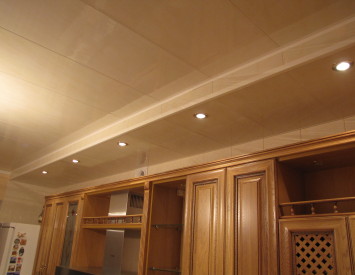
Nowadays, finishing materials are constantly improving, and not only externally, but also in terms of characteristics. For a certain amount, you can find finishing products that will not have a single drawback. Previously, the owners who wish to transform their home a little, come to choose between beautiful material and high-quality (or safe).
Now there is nothing like that, everything is limited in the price issue. However, recently, it is often possible to meet the products that the price and quality corresponds to the best way.
In this material it will be about plastic products that are used to finish the ceilings. Despite the fact that many people still continue to stick the ceilings with classical wallpaper, such decisions gradually go into the past. Now in construction stores you can find hundreds of options for plastic panels for the ceiling. Of course, they differ in properties, appearance and price.
Content
Main features of plastic panels for ceilings
Most often, plastic panels are available as PVC. Given that the basis of this product is plastic, manufacturers have the opportunity to create a wide variety of designer compositions. The only important requirement for PVC panels is the creation of a picture that would be perfect for the dwelling.
Plastic ceiling panels can have a glossy, matte surface, or the original basis that will resemble wood or stone.

Many may say that plastic panels for the ceiling are practically the same as the walls for the walls. In fact, it is similar products, but the ceiling panels have a small weight, in contrast to the material for the walls. Accordingly, it allows without any problems and substantial restrictions to fix material to the ceiling.
Surely the main advantage of plastic panels is the fact that they will create the surface of the ceiling perfectly smooth, even if the ceiling itself has serious flaws. Obviously, ordinary wallpapers do not have such an advantage. As for other positive parties to PVC, which are similar to the rest of plastic materials, then they include durability, plasticity, sound insulation, as well as moisture resistance.
Of course, the properties of certain plastic panels depend on a particular manufacturer. Some of them saves the important components that, in turn, makes the material somewhat limited to use. However, in most cases, plastic panels are really high-quality material, and every year products of this direction becomes more and more perfect.
If we talk about the lack of PVC panels, then you need to focus on their fragility. Accordingly, any manipulation with the material should be carried out carefully. If the panel cracked the panel, or any other flaw appeared, it is better to get rid of the product and replace it with a new product fragment.

Purchase of material
As for the dimensions of the material, from which should be repel during the purchase, then you need to know that the thickness of plastic panels is often from 5 mm to 10 mm. Width - from 20 mm to 50 mm. Panel length is often limited to three meters. Often, you can also find other product options, the length of which can be 2.5 m.
For the installation of plastic panels, we will also need a metal profile that will be placed all over the ceiling area. We also need rigid profiles, they will need to be located along the perimeter of the surface.
Do not forget about the fasteners that will be used in the process very often. Of course, at the end of the repair work, you will need to install a ceiling plinth, which will successfully hide all the flaps that appeared when installing panels.
We also need the following tools:
- drill;
- screwdriver;
- knife;
- scissors;
- liquid Nails.

Creation of plastic ceiling
The main process of creating a ceiling of plastic panels begins with fixing rigid profiles. Metal design should be horizontal and durable. In order not to get into the unpleasant situation, you need to use a building level that will not allow the profile not under the angle. The fastening of all the frame element is made on the basis of transverse profiles using self-samples.
Next to the perimeter of the ceiling is mounted another profile, which will correspond to the overall thickness of the metal structure.
With the help of the hacksaw, it is necessary to cut the panels so that they match the ceiling area. Obviously, in some cases, products may be too long or wide. This should not prevent us with creating high-quality plastic ceiling. Fastening panels to metal profiles will occur by using liquid nails. And here you need to ensure that the surface of the plastic ceiling is perfectly horizontal. To apply too much glue to the surface of the material is not worth it, as usually liquid nails hold the building material even if it has a lot of weight.

Special attention should be paid to the last panel, which will be installed in the very edge of the ceiling. Obviously, for accommodation, it will be necessary to cut it a little in width. Accordingly, this panel also needs to be tightly placed.
Ceiling plinths that are used in this process are the most common building elements that are glued to the wall and the ceiling after the adhesive of the wallpaper. In this case, the attachment plinth will be easier, since the metal frame allows you to create a smooth surface. Again, the ceiling plinths are mounted with liquid nails. With the help of a cloth, it is worth getting rid of the remaining glue that can spoil the appearance of plastic panels.
Throughout the process, you need to use the construction level to check the surface horizontal. If the metal design is fixed not very high quality, over time it can simply collapse.